Should You Pay for Google Ads on Your Own Business Name? What the Research Found
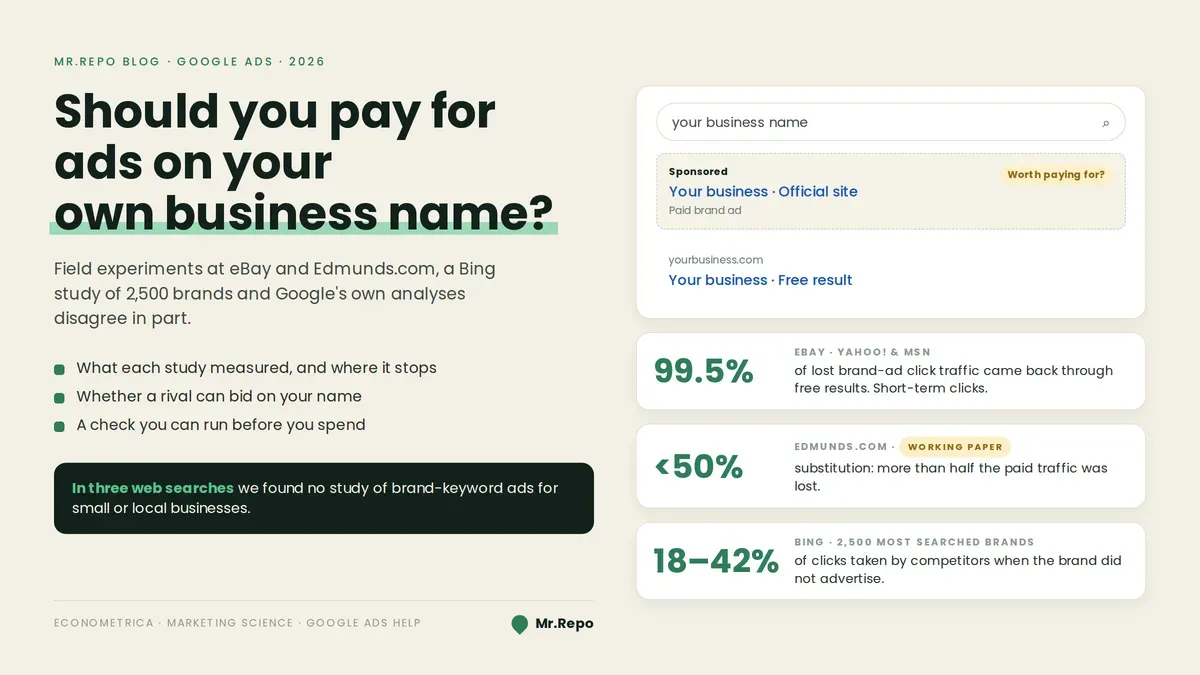
Someone types your business name into Google. Your website is already the first free result. Should you also pay for an ad that sits above it?
There is real research on this question: field experiments at eBay and Edmunds.com, a study of 2,500 brands on Bing, and Google's own analyses. They disagree in part. This post sets out what each one measured, where they part ways, and that in three web searches we found none on small or local businesses.
We sell a tool for running Google Ads campaigns, so read us with that in mind. We make no claim that brand ads pay off for your business.
What "brand keyword ads" means
A brand keyword ad is an ad that shows when someone searches for your business by name. The question is whether the ad brings you anyone the free result would not have brought anyway.
Researchers call the extra visits "incremental". An ad click is incremental only if that visit would not have happened without the ad.
The eBay experiment: almost all the clicks came back for free
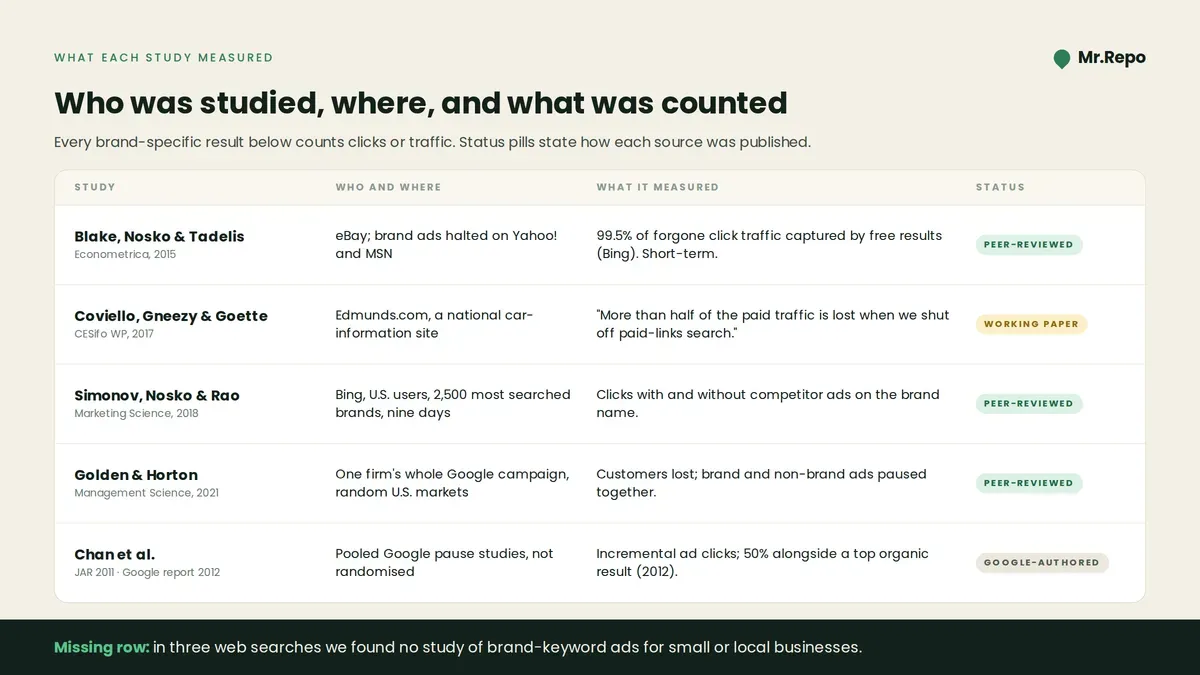
Start with Blake, Nosko and Tadelis (2015), published in Econometrica. They report "a series of large-scale field experiments done at eBay that were designed to measure the causal effectiveness of paid search ads."
Their abstract says: "As an extreme case, we show that brand keyword ads have no measurable short-term benefits." For non-brand keywords, the authors found new and infrequent users "positively influenced by ads" but "average returns that are negative."
The authors' working version describes how. "eBay halted advertising for its brand related terms on Yahoo! and MSN." The result: "almost all (99.5 percent) of the forgone click traffic from turning off brand keyword paid search was immediately captured by natural search traffic from the platform, in this case Bing." A follow-up on Google in July 2012 "yielded similar results", with no figure given.
Three limits travel with this result. It is eBay, "a very strong brand" in Simonov and colleagues' words. The main test ran on Yahoo! and MSN, with the free traffic arriving via Bing. And the 99.5% is click traffic in the short term, not sales.
Experiments with different results
Edmunds.com. Coviello, Gneezy and Goette ran a similar test with the car-information site Edmunds.com, "arguably a more representative company", and "found starkly different results." Their abstract: "More than half of the paid traffic is lost when we shut off paid-links search." In a column comparing it with eBay's brand-ad figure, they write: "We found that substitution was less than 50% for Edmunds.com." This is a working paper, not peer-reviewed; in two checks we found no journal version.
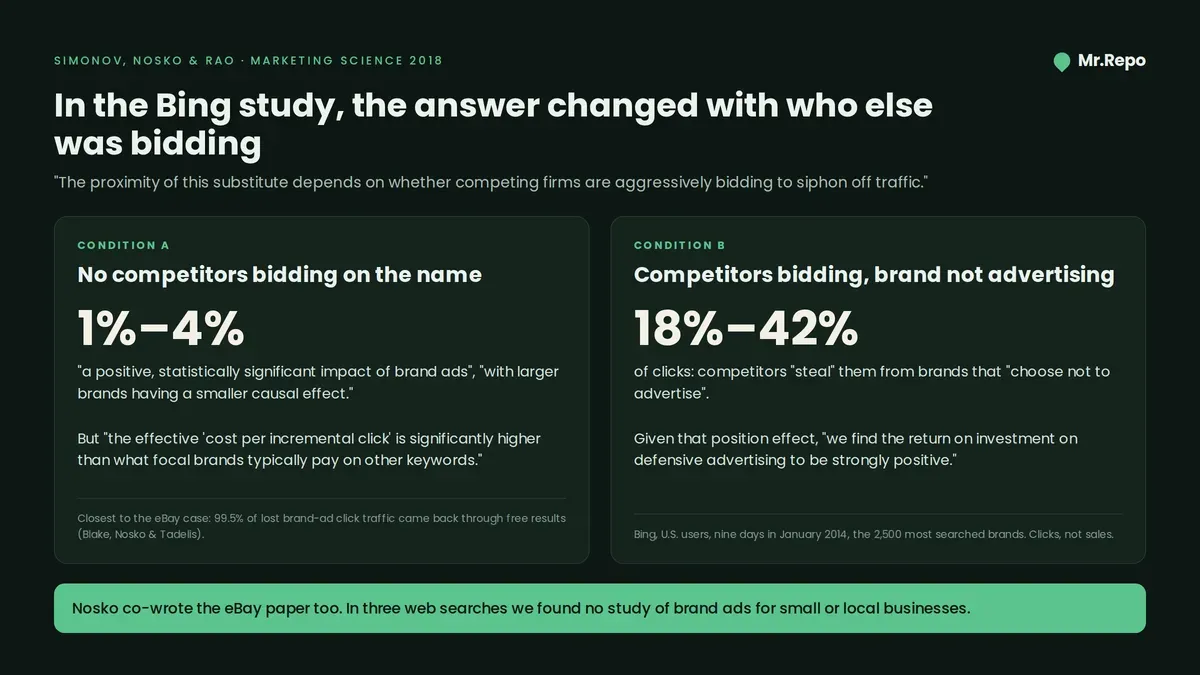
2,500 brands on Bing. Simonov, Nosko and Rao (2018), in Marketing Science, studied "the 2,500 most searched brands" using experiments on Bing with U.S. users over nine days in January 2014. Chris Nosko co-wrote both papers, so this is not a fully independent check. The paper's framing: the organic link is a substitute for the paid click, and "The proximity of this substitute depends on whether competing firms are aggressively bidding to siphon off traffic."
No competitors bidding on the name: "a positive, statistically significant impact of brand ads of 1%-4%, with larger brands having a smaller causal effect." But "the effective 'cost per incremental click' is significantly higher than what focal brands typically pay on other keywords."
Competitors bidding, brand not advertising: "competitors 'steal' 18%-42% of clicks". Given that position effect, "we find the return on investment on defensive advertising to be strongly positive."
The authors say their results are consistent with the eBay paper "for a company like eBay", but add that "eBay's case as a very strong brand facing no competitors is not the norm." Even their lesser-known brands were among the 2,500 most searched.
Simonov and colleagues split results by competitor bidding, and in their data it changed the answer.
Can a competitor bid on your business name?
Google's Trademarks policy lists what it "will not restrict", including "Using trademarks as keywords".
What it may restrict is a trademark's use in the ad text. Its restrict list includes "Using trademarks in an ad from a direct competitor". This runs on complaints: "If a trademark owner submits a complaint to Google about the use of their trademark in Google Ads and Display & Video 360 ads, we'll review it and may restrict use of the trademark." And "The trademark must be used in the ad, not only on the ad's landing page."
Two cautions. Google accepts complaints only against specific advertisers, and only "within the countries and industries in which trademark owners have demonstrated trademark rights." And a business name is not automatically a trademark. The page does not use the word "registered"; whether your name qualifies is a question for a trademark lawyer in your country.
What Google's own research says
Chan and colleagues (2011, Journal of Advertising Research), Google authors, pooled "several hundred" studies of ad campaigns being turned off and reported "more than 89 percent of the ads clicks were incremental". These were not randomised, and the figure pools all keywords, brand or not.
A 2012 Google technical report by largely the same authors, not peer-reviewed, looked at the case closest to a brand search: your site already ranks first. "On average, 50% of the ad clicks that occur with a top rank organic result are incremental, compared to 100% of the ad clicks being incremental in the absence of an associated organic result." It drew on 390 studies (April to October 2011) of "advertisers who had dropped their search ad-spend by 95% or more".
The report cites the "high organic rank" of branded terms and variation across advertisers, and recommends that advertisers "use value-per-click calculations."
Google earns money from ad clicks; weigh its research as you would ours.
Why none of this settles it for a local business
eBay is a very strong brand, Edmunds a national site, and the Bing study covered the 2,500 most searched brands. In three web searches we found no study, peer-reviewed or working paper, of brand-keyword ads for small or local businesses.
A search for a local business name can show a Business Profile with calls and directions, and the brand studies above measured clicks or traffic, not bookings or sales. Do not assume they carry over to Business Profile clicks or to India.
Golden and Horton (2021, Management Science) paused one firm's whole Google campaign in random U.S. markets and found it "lost customers, but only 63% as many as a nonexperimental estimate would have suggested." That test switched off brand and non-brand ads together, so it cannot tell you what the brand ads alone did.
A check you can run on your own name
These are our working practices, not study findings, though items 2 and 3 draw on the studies above.
Search your own name the way a customer would. Use a phone, not a browser signed into your ad account. Note whether any other business's ad appears. Check on several days; results vary.
If a competitor's ad appears and you are not advertising, you resemble the case where one peer-reviewed study found the return on defensive ads "strongly positive". That was a Bing study of heavily searched brands, measured in clicks, so treat it as a reason to test, not a guarantee.
If no other ad appears, you share eBay's no-competitor condition, though not its brand strength. Simonov and colleagues found gains of 1%-4% there, larger for lesser-known brands, at a higher cost per extra click than other keywords.
Look at the paid and organic report. It needs setup: "you'll need to have a Search Console account for your website, and you'll need to link that Search Console account to your Google Ads account." It "counts performance of text ads only."
If you already run brand ads, a pause gives a rough read at best. Pause brand ads for a length decided in advance, keep other changes out of that period, and compare total visits and enquiries, not just paid clicks. Without randomised markets, a before-and-after comparison is noisy; a slow week can look like an ad effect.
On setup: Google says "Broad match is the default match type that all your keywords are assigned because it is the most comprehensive." Even exact match can show ads on searches with "the same meaning or same intent as the keyword." Negative keywords "let you exclude search terms from your campaigns", which can help keep brand and non-brand spend apart.
About Mr.Repo
Mr.Repo's Google Ads feature lets you "Connect your Google Ads account to create Search, Performance Max, Demand Gen and Shopping campaigns." It is "Available on Premium and Pay As You Go." It is a self-serve tool; our team does not run your campaigns. Our features page does not describe pause tests or competitor-bid detection, and the decision is yours. See the features page and pricing.
Key takeaways
The studies disagree in part; in the Bing study, competitor bidding changed the answer. At eBay, turning off brand ads on Yahoo! and MSN lost almost none of the click traffic: 99.5% came back through free results. One very well-known brand; short-term clicks only.
At Edmunds.com, in a working paper, more than half the paid traffic was lost when paid-links search was shut off.
In a Bing study of 2,500 heavily searched brands, with no competitors bidding, brand ads raised clicks 1%-4%, at a higher cost per extra click than other keywords; brands that did not advertise while competitors did lost 18%-42% of clicks to them.
Google's policy will not restrict your trademark as a competitor's keyword. Google may restrict ad text after a complaint from an owner with demonstrated trademark rights.
In three web searches we found no study of brand ads for small or local businesses.
FAQ
Will my free listing catch the clicks if I stop brand ads? At eBay, almost all of them did. At Edmunds.com, the authors put substitution under half. In the Bing study, the answer depended on whether competitors bid on the name. Our three searches found no small-business study.
Can I stop a competitor from bidding on my business name? Google's Trademarks policy says it will not restrict "Using trademarks as keywords". It may restrict a trademark's use in ad text after a complaint from an owner with demonstrated trademark rights. Ask a trademark lawyer whether your name qualifies.
Are brand clicks cheaper than other clicks? On Bing, Simonov and colleagues found that without competitors, the cost per incremental click "is significantly higher than what focal brands typically pay on other keywords". That is per extra click, not per click.
Does Google recommend bidding on your own name? In two searches of Google's help centre we found no page that recommends or discourages it. A 2012 Google research report, not help-centre guidance, recommends that advertisers "use value-per-click calculations."