The Google Sentence Quoted for "Keep Your Listings Consistent" Is Not on Google's Page Today
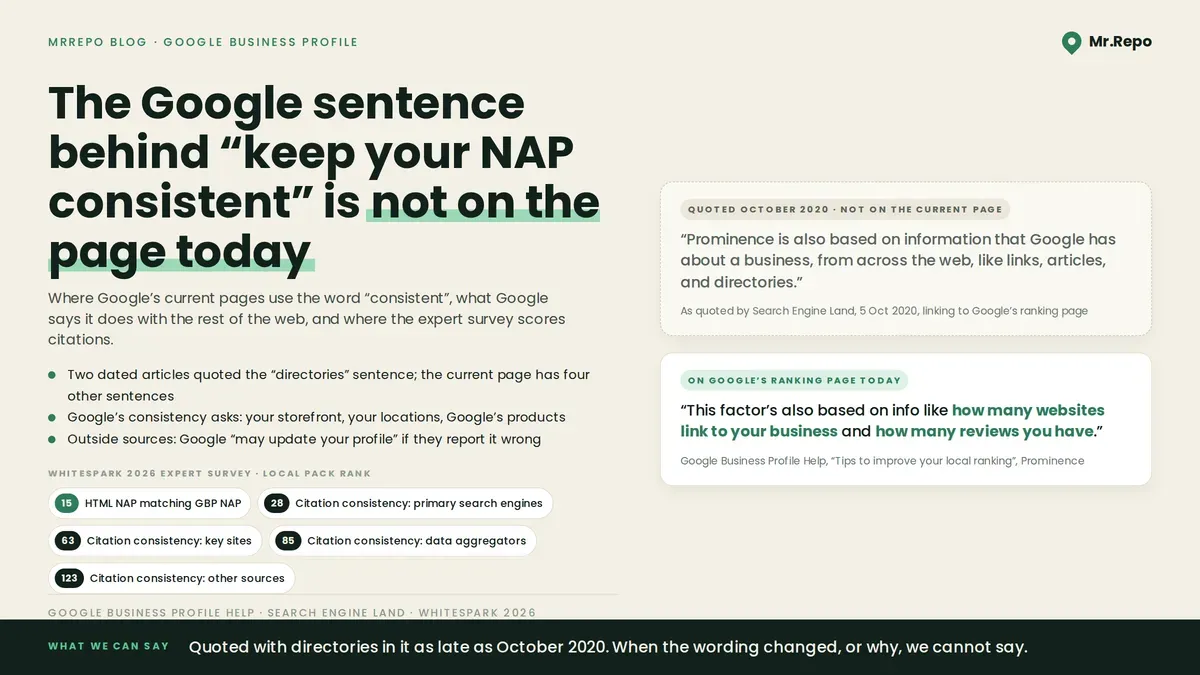
If you have paid for local SEO, you have likely been told to keep your NAP consistent — name, address and phone number, identical on every directory that lists you. One quotation attributed to Google's help page on prominence gets used for it: that Google draws on "information that Google has about a business, from across the web, like links, articles, and directories."
That sentence is not on Google's current page.
This post covers where Google's current pages use the word "consistent," what Google says it does with information from the rest of the web, and where Whitespark's expert survey scores the citation factors. The short version: Google's consistency instructions point at your own branding, your own locations and Google's own products, and the use its pages describe for outside sources is keeping your profile accurate; we found no "ranking" on them.
Who quoted the sentence, and when
The quotation has a real history. In April 2016, Search Engine Watch reported that Google had updated its help page and gave the wording on prominence as: "Prominence is also based on information that Google has about a business from across the web (like links, articles, and directories)." In October 2020, Search Engine Land quoted Google's ranking page, linking to it: "Prominence is also based on information that Google has about a business, from across the web, like links, articles, and directories." Search Engine Land also carried a second sentence: "Your position in web results is also a factor, so search engine optimization (SEO) best practices apply."
Google's page today, "Tips to improve your local ranking," has a Prominence section of four sentences:
"Prominence means how well-known a business is." "Prominent places are more likely to show up in search results." "This factor's also based on info like how many websites link to your business and how many reviews you have." "More reviews and positive ratings can help your business's local ranking."
We did not find the words "directories," "articles" or "position in web results" anywhere on the page. We cannot tell you when the wording changed or why. As late as October 2020 the page was being quoted with directories in it; today it gives two examples under prominence, links and reviews. It does not say Google ignores directory listings.
Where Google does use the word "consistent"
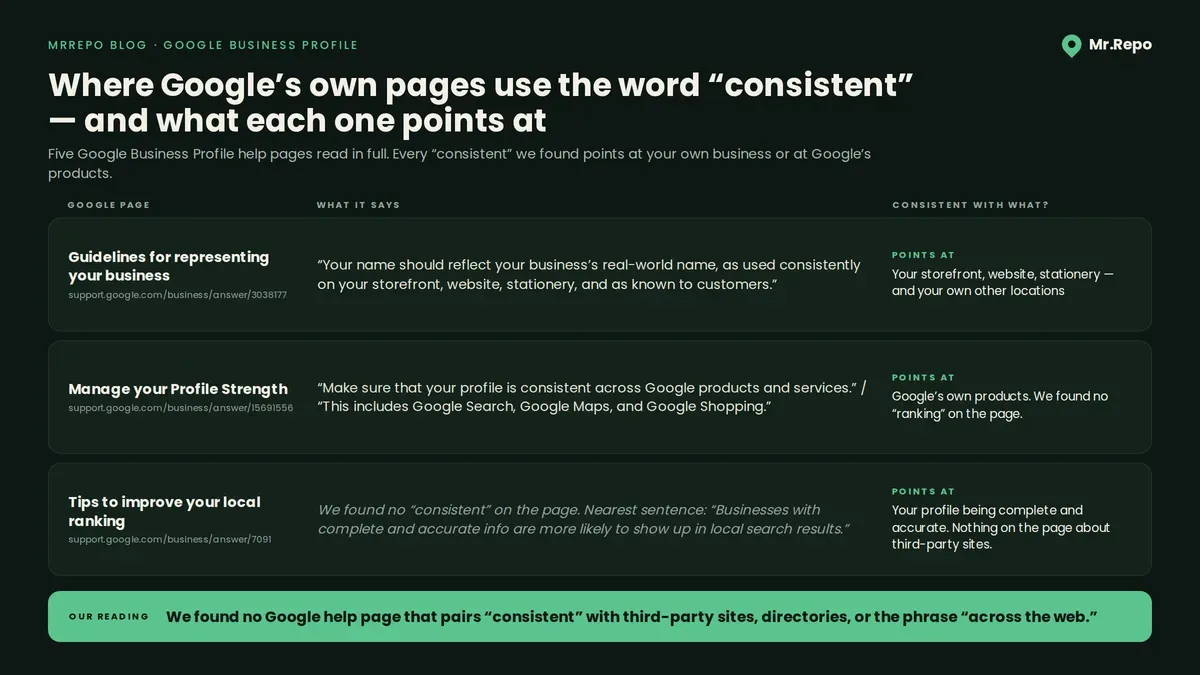
Across Google's Business Profile guidelines, its ranking page, its sources page, its Google-updates page and its Profile Strength page, every "consistent" we found is about something specific.
The guidelines page asks you to represent your business "as it's consistently represented and recognized in the real world across signage, stationery, and other branding," and says your name "should reflect your business's real-world name, as used consistently on your storefront, website, stationery, and as known to customers." A third consistency sentence is for multi-location businesses: "Maintain consistent names and categories across all of your business locations to help customers quickly identify your business on Google Maps and search results." We found no "directories" on the page.
The Profile Strength page says: "Make sure that your profile is consistent across Google products and services." The next sentence defines the scope: "This includes Google Search, Google Maps, and Google Shopping." That is consistency inside Google, and we found no "ranking" on the page.
We found no "consistent" on the ranking page itself. Its nearest sentence is "Businesses with complete and accurate info are more likely to show up in local search results."
We found no Google help page that pairs "consistent" with third-party sites, directories or the phrase "across the web."
What Google says it does with the rest of the web
Google does describe where profile information comes from, on a page titled "Understand how Google sources & uses info in Business Profiles & local search results." It says: "Information in profiles is compiled from a variety of sources:" and lists four. "Publicly-available information, such as crawled web content (e.g., information from a business' official website)." "Licensed data from third parties." "Users who contribute factual information (such as addresses and phone numbers), and content (such as photos and reviews), including business owners who claim profiles through Google Business Profile." And "Information based on Google's interactions with a local place or business." We found no "ranking" on that page.
A second page, "Understand Google updates on your Business Profile," says what Google may do when sources report your information is wrong: "To help keep your Business Profile accurate, Google gathers info from different sources, like user reports and licensed content." Then: "If sources report that your profile info is incorrect or outdated, Google may update your profile." And: "You can't manage all Google updates through your Business Profile," although "You can review and manage these updates on your Business Profile."
The "may update" sentence is what gives listing accuracy its weight, and it is not about rank. The consequence of a source disagreeing with you, on Google's description, is that Google may change what customers see; we found "ranking" on neither page. The guidelines page adds one more use of outside information, for one field: "Google can also detect category information from your website and from mentions about your business throughout the web."
What Whitespark's expert survey scores consistency at
The survey to read is Whitespark's Local Search Ranking Factors, published 6 November 2025 for 2026. It is a survey: "47 of the best and the brightest local search experts are invited to complete a comprehensive 2-hour survey," and "The combined results from all their scores are summed and ranked by total score to determine which factors the experts believe have the greatest impact." It measures expert opinion, not rankings. Here is where five NAP and citation-consistency rows land in its Local Pack list; for scale, the top three are Primary GBP Category (227), Proximity of Address to the Point of Search (Searcher-Business Distance) (225) and Keywords in GBP Business Title (223).
15 — HTML NAP Matching GBP NAP — 153
28 — Consistency of Citations on Primary Search Engines (Google Maps, Bing Maps, Apple Maps) — 124
63 — Consistency of Citations on Key Sites (Yellowpages, Yelp, D&B, CityGrid) — 101
85 — Consistency of Citations on Data Aggregators (Infogroup, Localeze, Foursquare/Factual) — 91
123 — Consistency of Citations on Other Citation Sources — 70
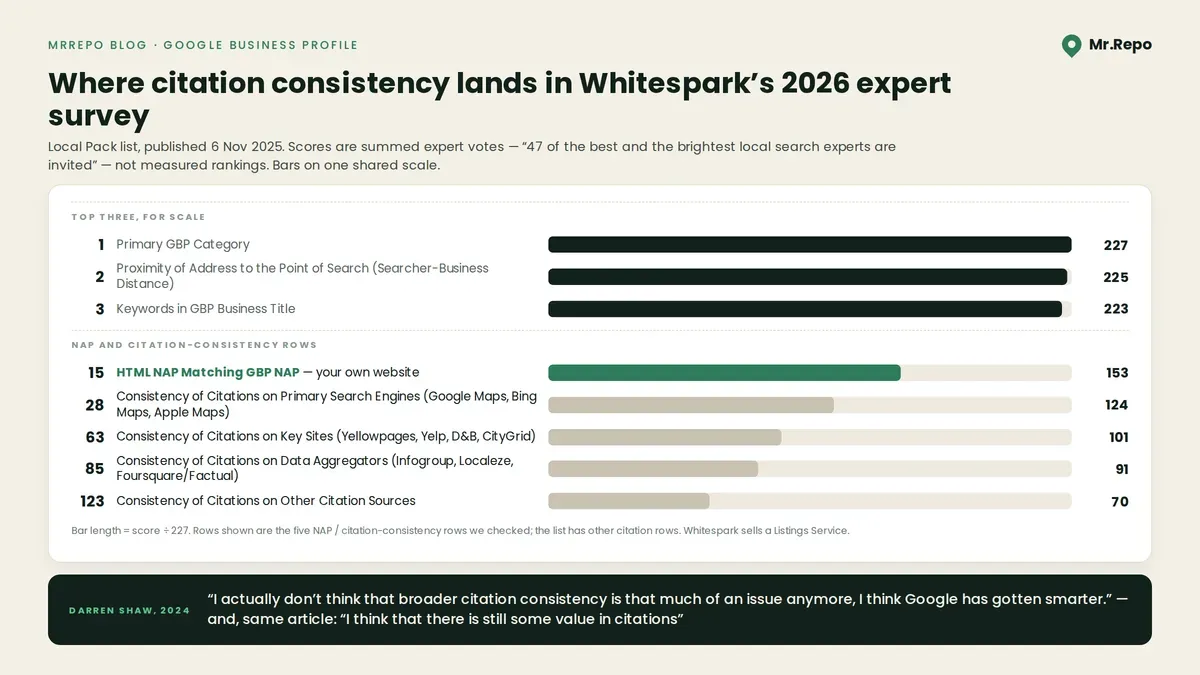
The highest-scored of these is not a directory factor. It is whether your own website's name, address and phone match your profile — and Google's own list of sources names your website.
Darren Shaw, who runs the survey, writes: "Citations as a local search strategy have been decreasing in importance for the past decade, but AI SEO is breathing new life into them." He adds, of this edition, "I was surprised to see that citations lost about half a percentage point, continuing the downward trend from previous editions." In a 2024 article he put it more plainly: "I actually don't think that broader citation consistency is that much of an issue anymore, I think Google has gotten smarter."
Two things travel with those quotes. Shaw is not saying citations are worthless: in the same article, "I think that there is still some value in citations and I've got a number of reasons why I think that," and he cites an Uberall comparison in which "The direct searches were 89% greater for the locations that were listed on all the directories" — two groups of 3,000 locations, a vendor's metric rather than rank, no controls described. And his 2026 report separates local ranking from AI search: "3 of the top 5 AI Search visibility factors are citation factors," and "In AI SEO, mentions (citations) are the new link." Whitespark sells a Listings Service, which is worth knowing when reading any of this.
We found no peer-reviewed or controlled study of citation consistency and local rank.
What to do with your listings, then
These are our own working practices, not findings from a study, though the first three lean on the pages quoted above.
Make your website match your profile first. Google's own list of sources names it, and it is the highest-scored consistency factor in the Whitespark rows above.
Check the Google updates on your profile. Google says it "may update your profile" from other sources, and that "You can review and manage these updates."
Fix listings you know are wrong because Google may use them. That is reason enough; it does not need a ranking story attached.
Treat "consistency" sold as a ranking fix as a claim to be shown, not assumed. Ask which Google page the claim rests on.
Where MrRepo fits
MrRepo does not sell citation or listing building. Our local SEO service is reporting built on Google's Performance data for your profile, delivered alongside the review product, which shows every customer the public-review and private-feedback options at the same moment. Reviews are one example Google's current prominence section gives; directories are not on that page. If you want to see what the report contains, the interactive demo is the place to look.
Frequently asked questions
Does Google say NAP consistency affects local ranking? None of the five Google pages we read says so. Google's ranking page gives links and reviews as examples under prominence and "complete and accurate info" elsewhere.
Does that mean directory listings do nothing? No. Google's sources page lists "Licensed data from third parties" as one of the places profile information comes from, and its updates page says Google "may update your profile" if sources report your information is wrong. Google describes this in terms of accuracy; we found "ranking" on neither page.
What does Whitespark's survey say? Its 2026 expert survey scores "HTML NAP Matching GBP NAP" at rank 15 and the citation-consistency factors at 28, 63, 85 and 123 in the Local Pack list. Its author writes that citations have been "decreasing in importance for the past decade" while calling them "the new link" in AI SEO. It is an opinion survey, and Whitespark sells a listings product.
Should I stop paying for listings management? This post cannot answer that for you. It can tell you what Google's pages give: Google says it may update your profile from outside sources, and Google's list of sources names your own website.
Where did the "links, articles, and directories" sentence go? We do not know. It was quoted as Google's wording by Search Engine Watch in April 2016 and by Search Engine Land in October 2020, the latter linking to the page. We did not find it on the current page.
Key takeaways
The Google sentence quoted for "keep your citations consistent" — prominence based on "links, articles, and directories" — was quoted as late as October 2020 and is not on the current page.
Google's current prominence section gives two examples: "how many websites link to your business and how many reviews you have."
Google asks for consistency with your real-world branding, across your own locations, and across Google's products. We found no Google page asking for consistency with directories.
Google's updates page describes one use for outside information, accuracy: it "may update your profile" if sources report it is wrong. We found "ranking" on neither of Google's two sourcing pages.
In Whitespark's 2026 expert-opinion survey, the consistency factor scored highest is your website matching your profile (rank 15); citation consistency sits at 28, 63, 85 and 123.