Review Gating: What It Is, Why Google Bans It, and How to Collect Reviews Without Breaking the Rules
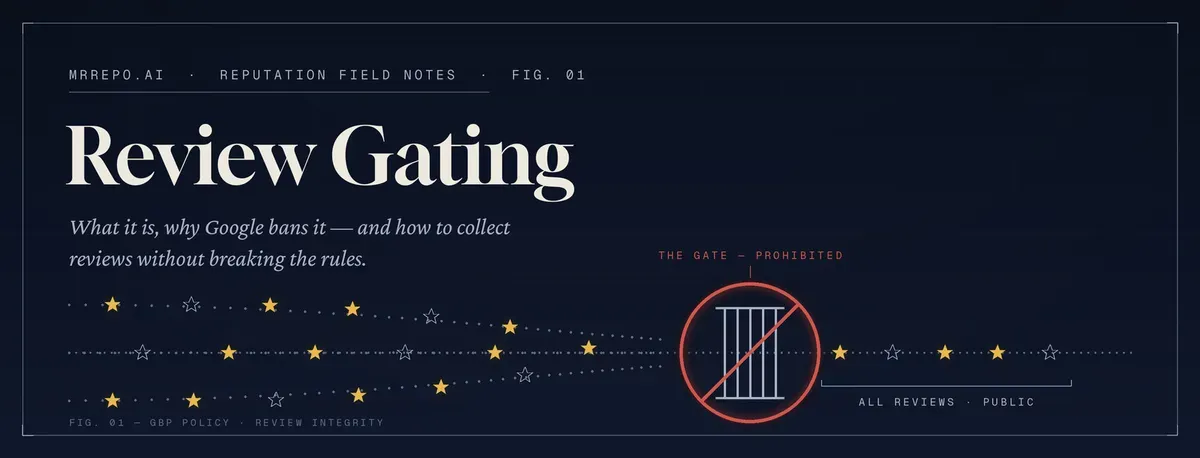
You've probably seen the pitch. A software vendor promises to "protect your Google rating" by asking customers how their visit went before inviting them to review you. Happy customers get sent to Google. Unhappy ones get quietly routed to a private feedback form you handle internally.
It sounds smart. It feels harmless. And in 2026, it's one of the fastest ways to lose your reviews, your rankings, and potentially your entire Google Business Profile.
This practice is called review gating, and it's explicitly banned by Google — and, since late 2024, restricted by U.S. federal law with penalties that reach $51,744 per violation. Here's what actually counts as gating, what the rules say, and how to collect reviews the compliant way without giving up private feedback altogether.
What Is Review Gating?
Review gating is the practice of filtering customers by sentiment before asking them for a public review. The typical flow looks like this:
A customer gets a text, email, or QR code after their visit: "How was your experience?"
If they tap 4 or 5 stars (or a thumbs-up), they're forwarded to your Google review page.
If they tap 1–3 stars (or a thumbs-down), they're sent to a private complaint form instead — and never see the review link.
The result is a Google rating built almost entirely from your happiest customers. That's exactly why it's prohibited: the rating no longer reflects real customer experience, which defeats the purpose of reviews for the people reading them.
Review gating goes by several names — "review funneling," "sentiment pre-screening," "smart review routing" — but if the software decides who gets asked based on how happy they seem, it's gating, whatever the label says.
What Google's Policy Actually Says
Google's prohibited content policy for user-generated content classifies gating under deceptive content and fake engagement. The policy bans "discouraging or prohibiting negative reviews, or selectively soliciting positive reviews from customers" — an 11-word sentence that describes the entire gating playbook.
In practice, that means a business may not:
Ask only customers it believes are happy to leave a review
Pre-screen sentiment (stars, thumbs, "how did we do?") and route only positive responses to Google
Discourage, delay, or add friction for customers likely to leave a negative review
Offer discounts, freebies, or entries into a draw in exchange for reviews
And enforcement is no longer theoretical. According to Google's 2025 Trust and Safety report, roughly 292 million policy-violating reviews were blocked or removed in 2025 alone. Google now uses AI moderation (powered by Gemini) to evaluate review patterns before publication — including whether a business's incoming reviews look statistically "too clean" compared to its industry.
The April 2026 update raised the stakes again
In April 2026, Google added two explicit bans to its rating-manipulation policy that many business owners missed:
Staff review quotas are banned. You can no longer direct employees to collect a specific number of reviews ("everyone gets five reviews this month").
Scripted review content is banned. You can't ask staff to request reviews that mention specific keywords, services, or a staff member's name.
If your team currently runs review contests between locations or coaches customers on what to write, both practices now sit on the wrong side of the policy.
What happens if you're caught
Google applies escalating penalties for rating manipulation:
Review removal — suspicious reviews disappear, often in batches. (If your count recently dropped, gating detection is one possible cause — see our guide on why Google reviews disappear.)
Review pauses — new reviews on your profile are temporarily blocked.
Public warning banners — a notice on your profile telling customers that suspicious activity was detected. This is arguably worse than a low rating.
Profile suspension — in severe cases, your Business Profile is removed from Search and Maps entirely.
Review Gating Isn't Just Against Google's Rules — It's a Federal Issue
In August 2024, the Federal Trade Commission finalized its Rule on the Use of Consumer Reviews and Testimonials, which took effect on October 21, 2024. The rule bans buying or selling fake reviews, undisclosed insider reviews, and — most relevant here — review suppression: preventing or removing negative reviews so that the reviews a business displays misrepresent overall customer opinion.
Two things every small business owner should know:
The penalty is up to $51,744 per violation, and the FTC treats each suppressed or fake review as a potential separate violation. The agency's own Q&A guidance makes clear the rule applies to businesses of every size, not just large brands.
There's precedent. Back in 2022, the FTC reached a $4.2 million settlement with Fashion Nova over allegations it blocked hundreds of thousands of negative reviews from appearing on its website. That case predates the current rule — which now gives the FTC a far more direct enforcement tool.
The FTC's position and Google's policy point the same direction: your public reviews must represent your real customers, not a curated subset.
The Part Most Articles Get Wrong: Private Feedback Is Still Legal
Here's the nuance that gets lost in most coverage of this topic. Collecting private feedback is not review gating. Offering customers a private channel to tell you about a problem is not just allowed — it's good business. Unhappy customers rarely complain before leaving; most simply don't come back (we covered this in The Silent Customer Problem).
The line between compliant and non-compliant is simple:
| Review gating (banned) | Compliant feedback flow | |
|---|---|---|
| Who gets asked | Only customers who seem happy | Every customer, identically |
| What they see | Options change based on sentiment | Same options for everyone |
| Pre-screening | Stars/thumbs before the review link | No sentiment check before the choice |
| Negative feedback | Diverted away from Google | Customer freely chooses public or private |
A compliant flow gives every customer the same two doors at the same time: leave a public Google review, or send private feedback to the business. The customer decides which door to walk through. No quiz first, no routing, no filtering. Some unhappy customers will still choose Google — and that's the point. That's what keeps the system honest, and it's why a handful of critical reviews doesn't actually hurt you the way owners fear.
When we analyzed the review-collection flows behind 500 small business QR codes, the pattern was consistent: businesses using sentiment pre-screens showed the rating volatility and review-removal patterns Google's filters are built to catch, while businesses collecting feedback openly grew slower — but kept what they earned.
A Compliance Checklist for Your Review Requests
Run your current process against this list. If you answer "yes" to any of the first five, it's time to change tools or settings:
❌ Does your software ask for a star rating or thumbs up/down before showing the Google review link?
❌ Do happy and unhappy customers see different screens or options?
❌ Do you only send review requests to customers you expect to be positive?
❌ Do you offer discounts, freebies, or prize draws for reviews?
❌ Do you set review quotas for staff, or ask customers to mention specific names or keywords? (Explicitly banned since April 2026.)
✅ Does every customer see the same choice: public review or private feedback?
✅ Can a customer with a complaint still easily reach your Google review page?
✅ Are review requests sent to all customers, regardless of their experience?
One more step worth taking today: if you used a gating tool in the past, stop using it before deleting anything, and start collecting reviews compliantly. A sudden pattern change looks better to Google's systems than a frozen profile — and a steady stream of authentic reviews is the strongest recovery signal there is. Our complete guide to Google reviews in 2026 covers rebuilding velocity the right way.
How MrRepo Handles This
Compliance is the reason MrRepo's flow works the way it does. When a customer scans a MrRepo QR code, they see the same two options every time — leave a public Google review, or send private feedback straight to the owner — with no sentiment screen in between. Nobody is filtered, nobody is routed, and the private channel means you still hear about problems while they're fixable. You get the early-warning benefit gating tools promise, without the policy risk they hide. You can see the full flow in how QR code feedback works.
FAQ: Review Gating in 2026
Is review gating illegal in the US? Review gating violates Google's content policy, and closely related practices — suppressing negative reviews so displayed reviews misrepresent customer opinion — violate the FTC's Consumer Reviews and Testimonials Rule (effective October 21, 2024), which carries civil penalties of up to $51,744 per violation. At minimum, gating risks review removal and profile suspension; at worst, federal enforcement.
Can I ask customers how their experience was before requesting a review? Not as a routing mechanism. Asking for internal feedback is fine, but the moment the answer determines whether someone sees your Google review link, it's gating. Keep satisfaction surveys and review invitations separate, or offer both options to everyone simultaneously.
Is it review gating to have a private feedback form? No — as long as every customer sees the same options and can freely choose the public review instead. Gating is defined by filtering and routing, not by the existence of a private channel.
Can I still ask happy customers for reviews in person? You can ask any customer for a review. What you can't do is ask only the happy ones as a systematic practice, pressure customers on-site, set staff quotas, or tell customers what to write — the last two were explicitly banned in Google's April 2026 policy update.
Will Google know if my review software uses gating? Increasingly, yes. Google's AI moderation evaluates review patterns — velocity, rating distribution, and how your profile compares to similar businesses. Google reported removing or blocking roughly 292 million policy-violating reviews in 2025. Profiles with unnaturally positive distributions are exactly what those systems flag.
What should I do if I've been using a gating tool? Stop the sentiment pre-screen immediately, switch to a flow that shows all customers the same options, and keep collecting reviews consistently. Don't attempt to delete old reviews or make sudden bulk changes — steady, authentic review activity is the best path back to a trustworthy profile.