When a Competitor's Reviews Look Bought — What US Law and the Research Actually Say
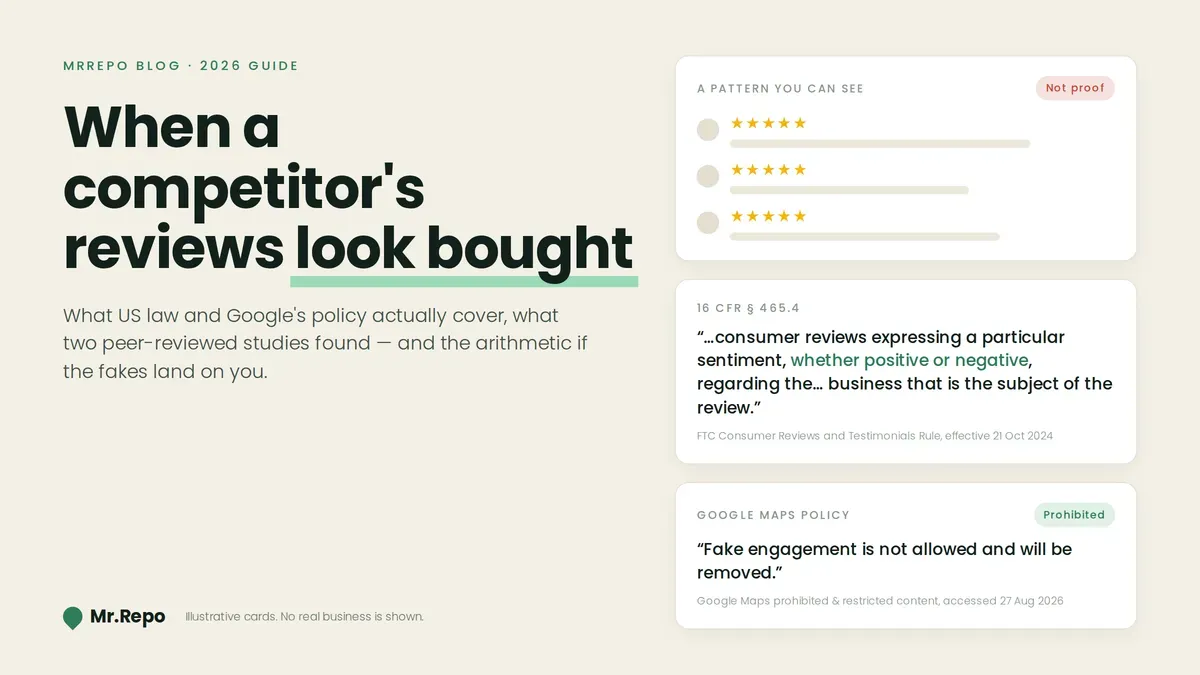
Picture a scenario — and it is only that, not a case we have data on. The shop two streets over has added review after review for months: bursts of five-star ratings, most one line long, several from accounts with no other reviews.
You are fairly sure what you are looking at, and you cannot prove it. That gap is the hard part — and it is a different problem from fake reviews on your own profile.
The visible signals are not proof
The usual tells — heuristics, not validated indicators: bursts of reviews, five stars with no text, single-contribution accounts, out-of-area profiles, near-identical phrasing. Worth noticing. But we could not find a published, validated method that lets someone outside a platform identify bought reviews from visible signals alone, nor any published account from Google of the signals it uses.
Luca and Zervas, in one of the two studies below, used Yelp's own filtering algorithm to flag suspicious restaurant reviews and still called those flags only "a proxy for review fraud (an assumption we provide evidence for)."
The Yelp and Amazon studies
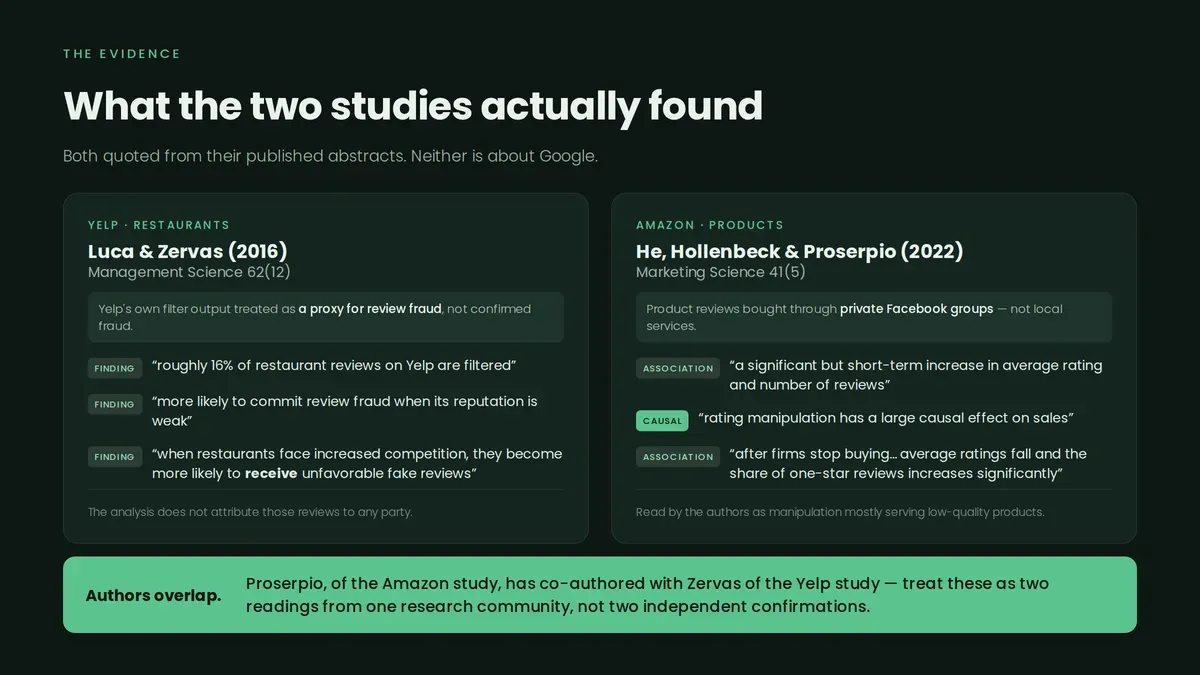
Neither of these peer-reviewed studies is about Google, and their authors overlap — Proserpio, of the Amazon study, has co-authored with Zervas of the Yelp study.
Luca and Zervas (2016), Management Science, studied Yelp restaurant reviews, treating reviews caught by Yelp's filter as a proxy for fraud rather than confirmed fraud. On that proxy, their abstract reports that "roughly 16% of restaurant reviews on Yelp are filtered," and that "a restaurant is more likely to commit review fraud when its reputation is weak, i.e., when it has few reviews, or it has recently received bad reviews."
The finding that matters here is the fourth: "when restaurants face increased competition, they become more likely to receive unfavorable fake reviews." Competitive pressure is associated with receiving suspicious negative reviews; that analysis does not attribute them to any particular party.
He, Hollenbeck and Proserpio (2022), Marketing Science, studied Amazon product reviews bought through private Facebook groups. "Buying fake reviews on Facebook is associated with a significant but short-term increase in average rating and number of reviews." The paper's one causal claim runs the other way: exploiting "a sharp but temporary policy shift by Amazon," the authors report that "rating manipulation has a large causal effect on sales."
But: "after firms stop buying fake reviews, their average ratings fall and the share of one-star reviews increases significantly... indicating rating manipulation is mostly used by low-quality products." The same paper found buyers include "products with many reviews and high average ratings." Amazon products are not local services.
What US law says, and what it does not do for you
General information, not legal advice — talk to a lawyer about your own situation.
The FTC's Consumer Reviews and Testimonials Rule, 16 CFR Part 465, took effect on 21 October 2024.
§ 465.2(a) makes it "an unfair or deceptive act or practice" for a business "to write, create, or sell a consumer review [or] testimonial" that "materially misrepresents, expressly or by implication" that the reviewer exists or "used or otherwise had experience with the product, service, or business that is the subject of the review." That reaches whoever writes or sells the review — the farm, not its customer. Paragraph (b), covering a business that purchases a review it "knew or should have known" was false, is limited to reviews "about the business or one of the products or services it sells."
§ 465.4 is where the payer sits. It prohibits a business from providing "compensation or other incentives in exchange for, or conditioned expressly or by implication on, the writing or creation of consumer reviews expressing a particular sentiment, whether positive or negative, regarding the product, service, or business that is the subject of the review."
"Whether positive or negative," and "the business that is the subject of the review." On our reading, a competitor paying for one-star reviews of your business is the kind of conduct that sentence describes. Whether the FTC would treat any particular case that way is a separate question. (§ 465.2(d) exempts generalized solicitations to purchasers and mere review hosting; § 465.4 still bars conditioning an incentive on sentiment.)
We found no enforcement action brought under the rule. On 22 December 2025 the FTC announced warning letters to ten companies over possible violations; the press release named none of them, and warned that knowing violations can bring civil penalties of up to $53,088 each.
One caveat matters here: the FTC acts against businesses, not listings. We found nothing to suggest a complaint removes anything from Google.
What Google's own rules say
Checked 27 August 2026; the Maps content policy carries no last-updated date, so we cannot vouch for its currency.
Under "Fake engagement," Google's Maps content policy says contributions "should reflect a genuine experience at a place or business. Fake engagement is not allowed and will be removed," and its prohibited list includes "Reviews or ratings that have been paid for, directly or in kind." The same policy tells merchants not to "Post content on a competitor's place or business to undermine that business' or product's reputation."
For reviews on your own profile, Google documents a Report option next to each review in Read reviews, and says "Review evaluation typically takes several days." Status shows in the Reviews Management Tool, and if a review "doesn't qualify for removal," you get one appeal.
For a review on someone else's listing there is a separate documented route: search the business in Maps, open Reviews, then Menu → Report Review and complete the form. Reported content ends up at one of five statuses — "Processing report, Content removed, Content not removed, Content restored, or Report Canceled."
One honest gap: we found no published removal rate and no service-level commitment from Google. "Several days" was the only duration we found.
If the attack lands on you: the arithmetic
The numbers here are arithmetic, not research findings, and they assume the fake reviews stay up.
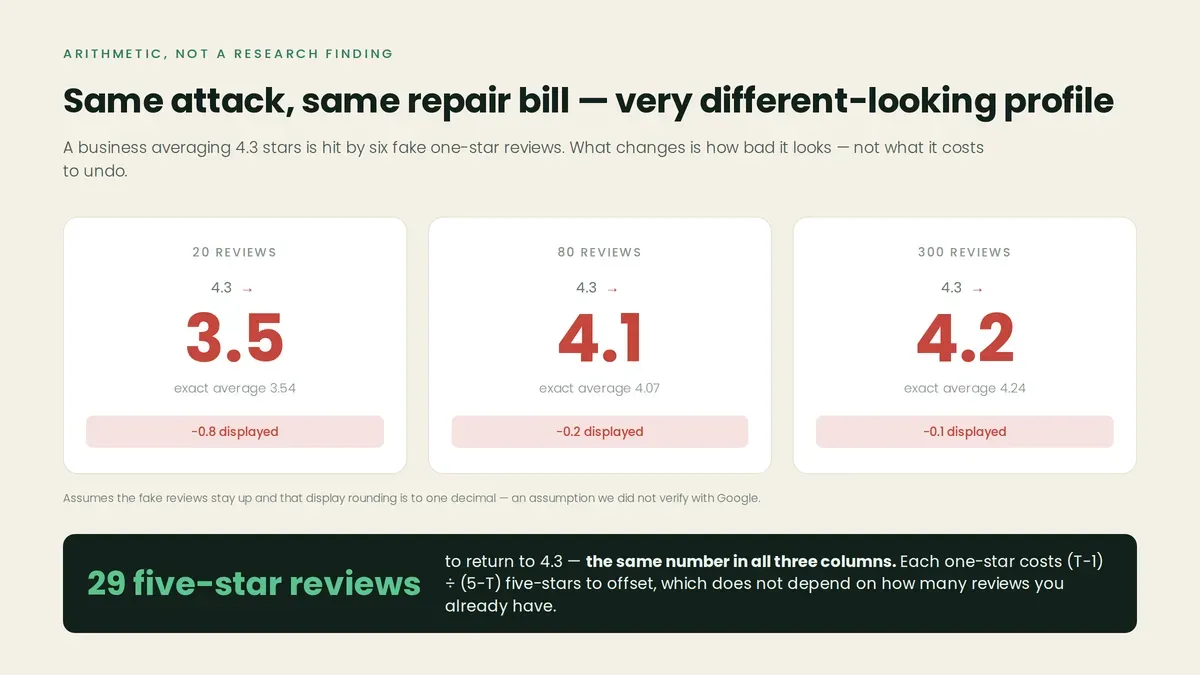
To hold an average of T, each one-star must be offset by (T−1) ÷ (5−T) five-star reviews. At a 4.3 average that is 4.71; at 4.5 it is exactly seven — the seven-to-one rule we worked through previously.
So six fake one-stars aimed at a 4.3-rated business cost about 29 genuine five-star reviews to undo — and that 29 does not change with how many reviews you already have.
What your review count changes is the visible damage. Six fake one-stars take a 4.3 average to 3.54 with 20 reviews, 4.07 with 80, and 4.24 with 300 — displayed, if rounding is to one decimal, as 3.5, 4.1 and 4.2.
What is actually worth doing
Our working rules, not research findings — we found no established playbook for this.
Document before you complain. Screenshot the profile with dates and counts — a pattern you can show beats one you describe.
Report specific reviews, not vibes. Google's policies address individual content; "their whole profile is fake" is not actionable.
Keep the accusation out of your marketing. We are not lawyers, but public accusations you cannot substantiate can create their own risk.
File with the FTC only with substantive evidence, and do not expect it to fix your listing. It is a regulator, not a moderator.
Spend most of the effort on your own volume. It sets how bad an attack looks, not what repair costs.
FAQ
Can I get a competitor's fake reviews removed? You can report them: search the business in Maps, open Reviews, then Menu → Report Review. But we found no published removal rate and no stated outcome — treat any single report as an unknown, not a plan.
Is buying reviews actually illegal in the US — including bad ones about me? 16 CFR § 465.4 makes it an unfair or deceptive act for a business to give compensation conditioned on review sentiment, "whether positive or negative, regarding the product, service, or business that is the subject of the review" — which on our reading includes your business. § 465.2(a) separately covers writing or selling a review that materially misrepresents the reviewer's existence or experience. It is a trade regulation rule enforced by the FTC, not a criminal statute; knowing violations can carry penalties of up to $53,088 each.
How can I tell for certain that reviews were bought? From outside the platform, you generally cannot. Our working rule: treat visible patterns as a reason to report, not a conclusion to publish.
Do bought reviews work? In He, Hollenbeck and Proserpio's study of Amazon product reviews bought through Facebook groups, buying was associated with a short-term rise in rating and review count, and the authors report a large causal effect of manipulation on sales — but ratings fell afterwards, which they read as manipulation mostly serving low-quality products. We found no study testing this on Google Business Profiles.
Should I reply to fake one-stars while I wait? A measured public reply is written for the people reading afterwards, not for the reviewer. Our guide to responding to negative reviews covers the wording.
Key Takeaways
Visible patterns are grounds for suspicion, not proof. Even Luca and Zervas, working with Yelp's filter output on restaurant reviews, called those flags only a proxy for review fraud.
On Yelp's filter as proxy, restaurants with weak reputations are flagged more, and restaurants facing more competition more often receive unfavourable fake reviews — unattributed.
In Amazon product reviews bought through Facebook groups, He, Hollenbeck and Proserpio found buying associated with a short-term lift and a large causal effect on sales, with ratings falling afterwards — which they read as manipulation mostly serving low-quality products.
16 CFR § 465.4 covers compensation conditioned on reviews "whether positive or negative," which on our reading reaches a competitor buying negative reviews about you. We found no enforcement action under the rule.
By arithmetic, not research — and assuming the fakes stay up — each fake one-star takes about 4.71 genuine five-stars to offset at a 4.3 average. Your review count changes how bad the profile looks, not what repair costs.
Nothing MrRepo does will remove a competitor's fake reviews, and we would be sceptical of any tool claiming it can. What it does is help you ask every customer, not a selected subset — a QR code giving each the same two options, a public Google review or private feedback, with the choice left to them. Per the arithmetic above, that does not lower the cost of repairing an attack; it changes how much a few bad reviews distort the number people see. Try the interactive demo.