How Many 5-Star Reviews Does It Take to Raise a 4.2 to a 4.5? (The Exact Math)
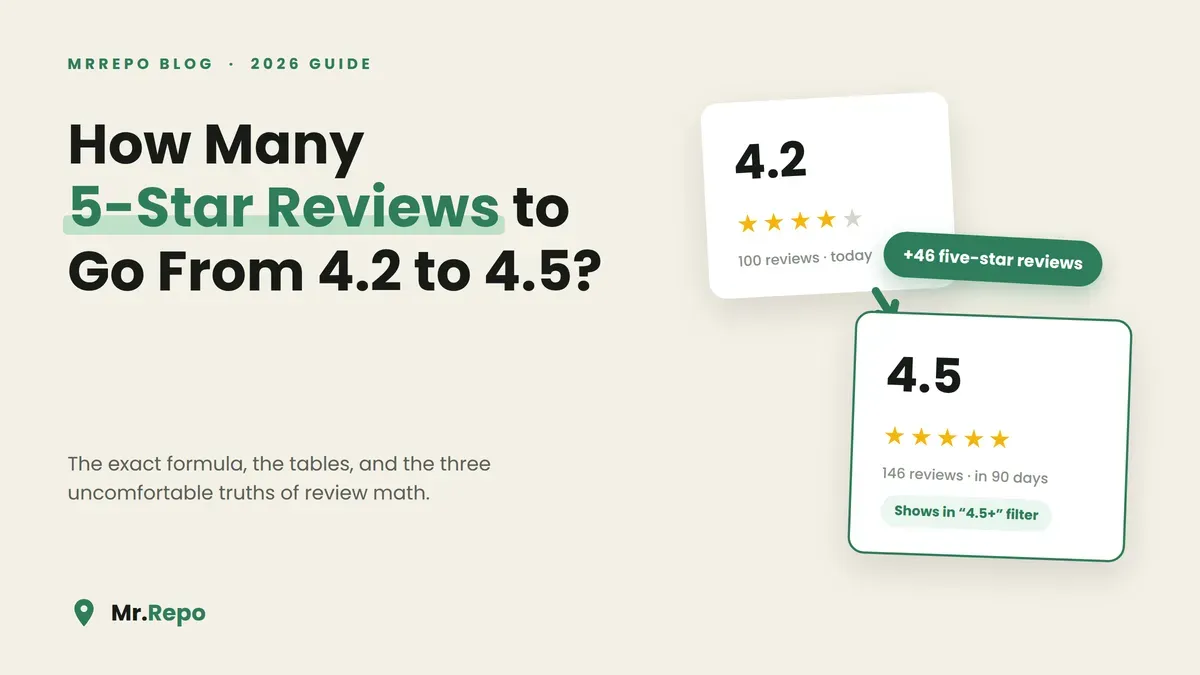
Your Google rating is 4.2. Your competitor across the street is at 4.5. How far apart are you, really?
Most owners guess "a handful of good reviews." The real answer is worse: if you have 100 reviews, you need 60 consecutive 5-star reviews — with zero bad ones in between — to reach a true 4.5 average.
That number surprises almost everyone, and it's exactly why this article exists. According to BrightLocal's 2026 Local Consumer Review Survey, 31% of consumers will now only use a business rated 4.5 stars or higher — nearly double the 17% who said the same a year earlier. Another 68% won't consider anything under 4 stars. The threshold for "good enough" is climbing, and the math of getting there is unforgiving.
Below is the exact formula, pre-computed tables for the most common rating jumps, and the three uncomfortable truths the math reveals about how review averages actually work. No fluff — you can check every number with a calculator.
Why 4.5 Is the New 4.0
A decade ago, anything above 4.0 looked respectable. In 2026, the data says otherwise.
BrightLocal's survey found that 92% of consumers care about star ratings when choosing a business, and the minimum acceptable rating is rising fast: 68% now require at least 4 stars (up from 55% in 2025), and the share requiring 4.5+ jumped from 17% to 31% in a single year.
There's a mechanical reason for this, too. When people search on Google Maps, the rating filter offers "4.0+" and "4.5+" cutoffs. A business at 4.4 doesn't show up slightly less often to someone filtering at 4.5 — it disappears entirely. Ratings don't work on a smooth curve; they work on cliffs.
The revenue stakes are well documented. Harvard Business School economist Michael Luca's landmark study of Yelp data found that a one-star increase in rating leads to a 5–9% increase in revenue for independent restaurants. More recent compilations report that businesses rated above 4.5 earn significantly higher click-through rates than those below 4.0, and that in competitive industries the average rating needed to compete now sits between 4.5 and 4.7.
So the question isn't whether the climb from 4.2 to 4.5 matters. It's how long the climb actually is.
The Formula (and a Worked Example)
Google displays your rating as the average of your published reviews, rounded to one decimal place. That gives us everything we need.
If your current rating is R, you have N reviews, and you want to reach target T, the number of 5-star reviews required (x) is:
x = N × (T − R) ÷ (5 − T)
Let's walk through the headline example: 100 reviews, 4.2 average, target 4.5.
x = 100 × (4.5 − 4.2) ÷ (5 − 4.5)
x = 100 × 0.3 ÷ 0.5
x = 60 five-star reviews
Check it: (4.2 × 100 + 5 × 60) ÷ 160 = 720 ÷ 160 = 4.5 exactly.
One piece of good news: because Google rounds to one decimal, you don't need a true 4.50 to display 4.5 — you need roughly 4.45. That lowers the bar meaningfully. For the same business, 46 five-star reviews gets the displayed rating to 4.5 (true average 4.452). Still a campaign, not a weekend.
One caveat for honesty's sake: Google doesn't publish every detail of how it calculates and refreshes ratings, and displayed averages can lag while reviews are processed or filtered. The arithmetic here models the average of your published reviews — which is the number the system is built around.
The Tables: How Many 5-Star Reviews You Need
All figures below are the number of consecutive 5-star reviews needed, assuming nothing negative lands in between. First, reaching a true 4.5 average:
| Starting rating | 25 reviews | 50 reviews | 100 reviews | 200 reviews | 500 reviews |
|---|---|---|---|---|---|
| 4.0 | 25 | 50 | 100 | 200 | 500 |
| 4.2 | 15 | 30 | 60 | 120 | 300 |
| 4.3 | 10 | 20 | 40 | 80 | 200 |
| 4.4 | 5 | 10 | 20 | 40 | 100 |
And reaching a displayed 4.5 (true average ≥ 4.45, which rounds up):
| Starting rating | 25 reviews | 50 reviews | 100 reviews | 200 reviews | 500 reviews |
|---|---|---|---|---|---|
| 4.0 | 21 | 41 | 82 | 164 | 410 |
| 4.2 | 12 | 23 | 46 | 91 | 228 |
| 4.4 | 3 | 5 | 10 | 19 | 46 |
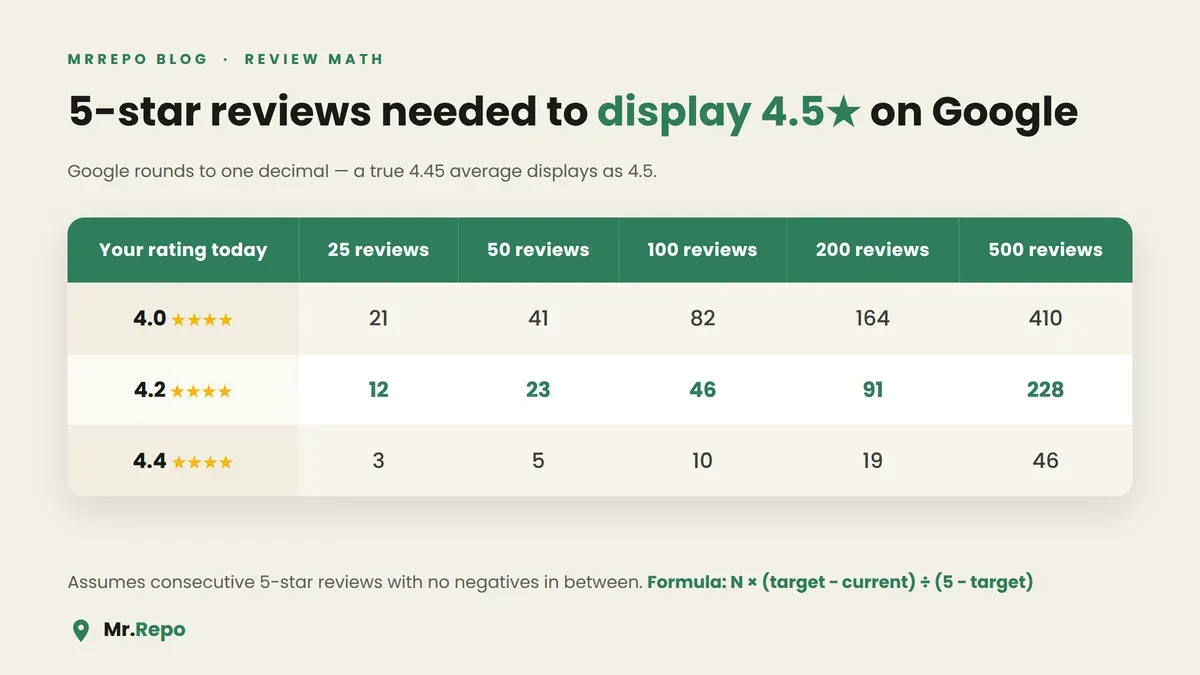
Two smaller but common jumps, for reference: a business at 3.8 with 100 reviews needs 20 five-star reviews to reach a true 4.0 (15 to display it). And a business at 4.5 with 100 reviews needs a punishing 150 five-star reviews to reach 4.8 — more on that below.
Three Uncomfortable Truths the Math Reveals
1. The more reviews you have, the heavier your rating gets
Notice that every column in the table scales linearly. Double your review count, and you double the number of 5-star reviews needed for the same jump. A 4.2 with 50 reviews is 30 good reviews away from 4.5; a 4.2 with 500 reviews is 300 away.
This is why established businesses with years of accumulated mediocre reviews feel stuck — their history acts as ballast. It's also half the answer to a question we've covered before: why your rating can drop even when service improves — a heavy denominator means today's excellence barely registers. It's also why the best time to take reviews seriously was when you opened, and the second-best time is today, while your N is as small as it will ever be.
2. One 1-star review costs you seven 5-star reviews
Here's the most striking result in the whole exercise. If your average is 4.5, a single 1-star review requires seven 5-star reviews to pull you back to 4.5 — and that ratio holds whether you have 25 reviews or 250. The arithmetic: each 1-star lands 3.5 points below your average, and each 5-star adds only 0.5 above it. 3.5 ÷ 0.5 = 7.
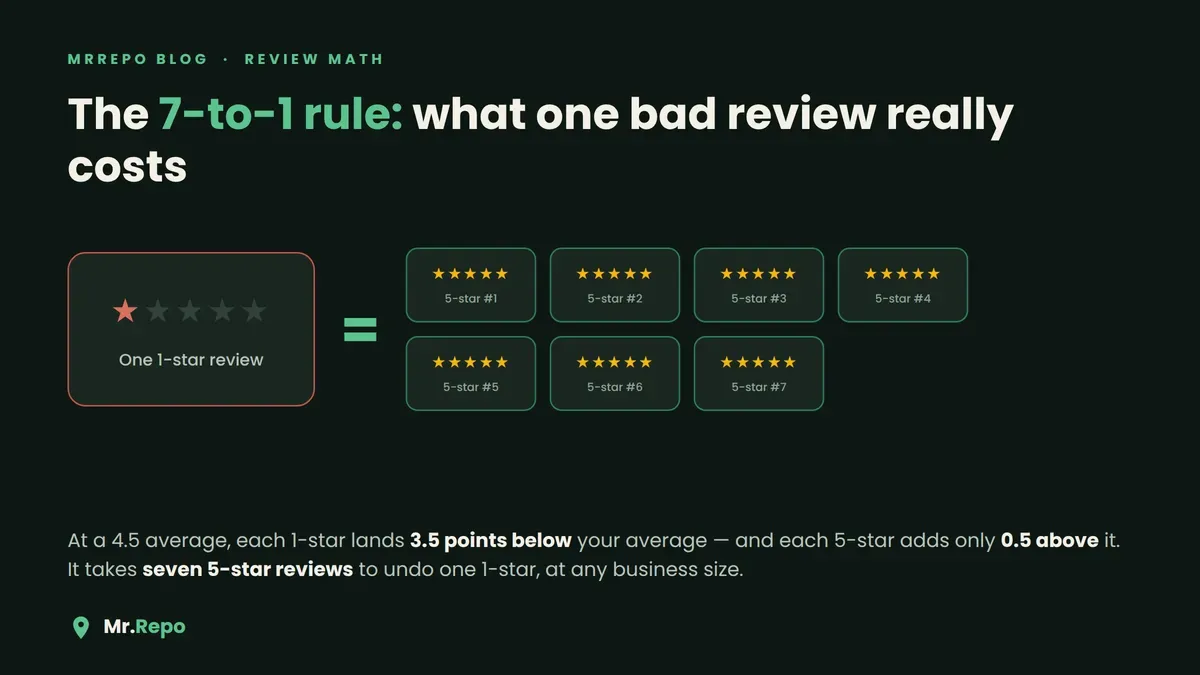
The damage to your displayed rating shrinks as you grow (one 1-star drops a 4.5 average to 4.37 at 25 reviews, but only to 4.49 at 250), yet the recovery ratio never changes. Prevention is seven times cheaper than cure — which is exactly the case for catching unhappy customers privately before they reach Google. That's the problem private feedback channels exist to solve.
3. Going from 4.5 to 4.8 is harder than going from 4.0 to 4.5
Climbing from 4.0 to 4.5 with 100 reviews takes 100 five-star reviews. Climbing from 4.5 to 4.8 takes 150. The denominator in the formula — (5 − T) — collapses as your target approaches 5, so every extra tenth costs more than the last.
The practical takeaway: chasing 4.8 or 4.9 is usually a poor use of energy. The consumer thresholds that matter are 4.0 and 4.5, because that's where the filters and the trust cliffs sit. Past roughly 4.6, incremental gains buy you very little — and a suspiciously perfect 5.0 can even read as fake to seasoned review-readers.
What the Math Means for Your Strategy
Volume of asks beats quality of asks. If you need 46 five-star reviews and a well-run request flow converts even a modest share of happy customers, the variable you control is how many people get asked. Businesses that ask every customer, every day, systematically — rather than in bursts when someone remembers — are the ones that put up 20–30 new reviews a month. At that pace, a 4.2 with 100 reviews displays 4.5 in about two months.
You cannot cherry-pick your way there. Asking only customers you know are delighted — or routing happy people to Google and unhappy people away from it — is review gating, and Google explicitly prohibits it. Beyond policy risk, gated averages get hollowed out the first time a genuinely angry customer bypasses your funnel. The compliant approach is to ask everyone and give every customer an equal choice between public review and private feedback.
Recency compounds the math. BrightLocal found 44% of consumers specifically look for reviews posted within the last month. Sixty reviews earned over three months don't just move your average — they dominate your "most recent" tab, which is what many readers actually judge. A steady drip beats a one-time push on both fronts.
Protect the average while you build it. Every negative review during your climb adds seven reviews to the bill. Respond to the negatives you do get — a calm, specific owner response is read by 37% of consumers as a trust signal — and give dissatisfied customers a private route to you before they open Google.
How to Actually Collect Those Reviews
The formula tells you the size of the job; execution is where most businesses stall. The pattern that works in 2026 is simple: ask at the moment of the experience, make it effortless, and never filter who gets asked.
That's the model MrRepo is built on. A QR code placed where customers actually scan — the counter, the receipt, the mirror, the table tent — opens a page where every customer gets the same two options: leave a public Google review or send private feedback. Happy customers land on Google in two taps. Unhappy ones reach your inbox instead of your rating, and real-time alerts let you respond while the problem is still fixable. No gating, no bias, no policy risk — and the analytics dashboard shows your scan volume and satisfaction trend so you can watch the math from this article play out week by week.
If you want to see what that flow feels like from the customer's side, the interactive demo takes about a minute.
A Realistic 90-Day Plan: 4.2 to a Displayed 4.5
Put the formula to work with a concrete scenario — a business with 100 reviews at 4.2, which needs 46 net five-star reviews.
Days 1–7: Fix the leak first. Before scaling asks, make sure unhappy customers have a private route to you. Every 1-star you prevent during the campaign saves seven 5-stars of climbing. Put your feedback QR code live and test the flow yourself.
Days 8–30: Build the asking habit. Serve 30 customers a day and ask all of them, and even a 2% conversion produces roughly 18 reviews a month. A restaurant does this with table tents and receipts; a salon at the mirror and checkout; a clinic at the front desk on the way out. The channel matters less than the consistency — the businesses that fail here are the ones that ask enthusiastically for a week and then stop.
Days 31–90: Hold the pace and respond to everything. At 15–20 new reviews a month, you cross the displayed-4.5 line around the end of month three — and, just as importantly, your "newest" tab now shows a wall of recent, replied-to reviews, which is what the 44% of recency-checking readers actually see. Reply to the positives too; it signals an owner who's paying attention.
The plan fails in only two predictable ways: a burst of negatives you didn't intercept, or asking that quietly stops in week five. Both are process problems, not math problems.
FAQ
How many 5-star reviews do I need to go from 4.2 to 4.5 on Google? It depends on your review count. The formula is N × 0.3 ÷ 0.5, so with 50 reviews you need 30; with 100 reviews, 60; with 200 reviews, 120. Because Google rounds to one decimal, displaying 4.5 (a true 4.45) needs about 23% less: 23, 46, and 91 respectively.
Does Google round star ratings up? Google displays your rating to one decimal place, so a true average of 4.45 displays as 4.5. That rounding works in your favor near a threshold — but Google doesn't publish every detail of its calculation, and displayed ratings can lag as new reviews are processed or filtered.
How much does one bad review hurt my rating? It depends on how many reviews you have. One 1-star review drops a 4.5 average to about 4.37 at 25 reviews, 4.43 at 50, and 4.47 at 100. Recovering to 4.5 costs about seven 5-star reviews regardless of your size.
Is a 4.2 rating bad? It's below where the market is moving. In BrightLocal's 2026 survey, 68% of consumers require at least 4 stars — which 4.2 clears — but 31% now require 4.5+, and Maps rating filters make that a hard cutoff. In competitive industries, typical winning averages sit between 4.5 and 4.7.
Should I aim for a 5.0 rating? No. The math gets brutally expensive above 4.6 (going 4.5 → 4.8 costs more reviews than 4.0 → 4.5), consumer behavior doesn't reward it proportionally, and a flawless 5.0 with many reviews can trigger skepticism. Aim for 4.5+, sustained with recent reviews.
Can I just remove my bad reviews instead? Only reviews that violate Google's policies (fake, spam, off-topic, conflicts of interest) can be reported and removed — here's the process. A genuine negative review from a real customer won't be removed; the productive responses are a good owner reply and a higher volume of genuine positives.
Key Takeaways
The formula: 5-star reviews needed = N × (target − current) ÷ (5 − target). A 4.2 with 100 reviews needs 60 five-stars for a true 4.5, or 46 to display 4.5 after rounding.
Thresholds beat increments: 31% of consumers now filter at 4.5+ and 68% at 4.0+, so crossing those lines matters far more than moving 4.6 to 4.7.
Review count is ballast — every jump scales linearly with N, so start building volume now, while your denominator is small.
One 1-star review takes seven 5-star reviews to undo at a 4.5 average, at any business size. Catching unhappy customers privately is seven times cheaper than repairing publicly.
You can't gate your way up: ask every customer, give equal options, and let volume plus recency do the work — that's the compliant path, and the one that survives scrutiny.