How to Respond to Positive Reviews: Templates & Examples
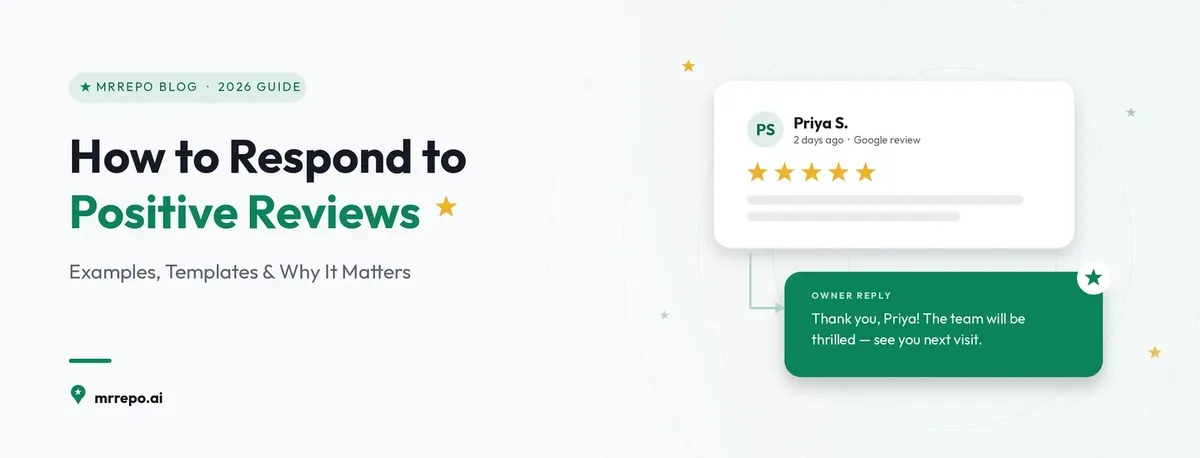
A customer just left you a glowing 5-star review. Most business owners smile, feel good for a minute, and move on. That's a mistake — and a surprisingly expensive one.
According to BrightLocal's 2026 Local Consumer Review Survey, 89% of consumers expect businesses to respond to reviews, and 80% say they're more likely to use a business that responds to all of its reviews — not just the angry ones. Every unanswered 5-star review is a public "thank you" you never said, watched by hundreds of future customers deciding whether to walk through your door.
We've already covered how to respond to negative reviews. This guide covers the other 80% of your inbox: how to respond to positive reviews in a way that builds loyalty, wins new customers, and quietly strengthens your local SEO — without sounding like a bot.
Why Responding to Positive Reviews Matters
Your reply isn't for the reviewer — it's for the next 100 readers
When you respond to a positive review, you're really writing to everyone who reads it afterward. Prospective customers scan review responses to answer one question: what kind of business is this? A warm, specific reply signals that you notice your customers. Silence signals that you only show up when there's a fire to put out.
The numbers back this up. BrightLocal's 2026 survey found that 42% of consumers won't use a business that ignores reviews entirely, and roughly half are unlikely to choose a business whose responses are clearly generic templates. In other words: not responding hurts you, and responding badly hurts you almost as much.
Responding supports your visibility on Google
Google's own guidance on improving local ranking states: "When you reply to customer reviews, it shows that you value their feedback. Positive reviews and helpful replies can help your business stand out."
To be precise about what this means (and doesn't): responding to reviews is not a confirmed direct ranking factor. Google's local algorithm weighs relevance, distance, and prominence. But review engagement feeds prominence, active profiles convert better, and replies give you a natural place to reinforce what you do and where you do it. Treat responses as a conversion tool with an SEO bonus — not the other way around.
It turns one-time customers into repeat customers
A positive review is a customer raising their hand and saying "I liked this experience enough to tell strangers about it." Acknowledging that publicly is the cheapest retention tool you have. It costs sixty seconds, and it makes a customer who already likes you feel seen — which is exactly the feeling that brings people back.
The 4-Part Formula for Responding to Positive Reviews
Every great positive review response does four things. We call it the Thank–Echo–Add–Invite formula:
1. Thank them by name
"Thanks, Priya!" beats "Dear valued customer" every single time. Using the reviewer's name is the fastest way to prove a human wrote the reply. If the reviewer's username is something like FoodLover_92, skip the name rather than using the handle — "Thanks so much for this!" reads better than "Thanks, FoodLover_92!"
2. Echo one specific detail from their review
This is the step that separates real responses from templates. If they praised your masala dosa, mention the masala dosa. If they named a staff member, say you'll pass the compliment along — and actually do it. Echoing a detail proves you read the review, and it's the single most effective defense against sounding automated.
3. Add something useful
One sentence of new information rewards future readers for reading your reply. Mention a related service, a seasonal menu, extended weekend hours, or a detail about how you do what they praised. This is also where relevant keywords fit naturally — "so glad the bridal makeup trial worked out" — never stuffed.
4. Invite them back
End with a forward-looking line: "See you next time," "Can't wait to have you back for the winter menu," "We're here whenever the car needs its next service." It closes the loop and plants the seed for the next visit.
Full example, all four parts:
Thanks so much, Rahul! We're thrilled the team got your AC repair done same-day — that's exactly what we aim for. If you ever need it, we also do annual maintenance plans that catch these issues before summer hits. See you next time!
Four sentences. Sixty seconds. Done.
10 Positive Review Response Templates You Can Copy
Use these as starting points, not scripts — swap in the reviewer's name and one specific detail every time. Half of consumers say they'd avoid a business whose replies look copy-pasted, so the details are not optional.
For restaurants and cafés
Template 1 — Detailed food review:
Thank you, [Name]! We're so happy the [dish they mentioned] hit the spot — our chef will love hearing that. If you enjoyed it, the [related dish] is worth a try on your next visit. Hope to see you again soon!
Template 2 — Short "great food!" review:
Thanks a lot, [Name]! Reviews like this keep our kitchen fired up. Come hungry next time — we'd love to have you back.
For salons and spas
Template 3 — Stylist mentioned by name:
Thank you so much, [Name]! [Stylist] will be delighted — we'll make sure they see this. You can always book with them directly through our booking page. See you at your next appointment!
Template 4 — First-time client:
[Name], welcome to the [Business] family, and thank you for the kind words! We're so glad your first visit went well. We can't wait to see you again.
For clinics and healthcare practices
Template 5 — Patient experience review:
Thank you for this kind feedback. Making patients feel comfortable and informed is what we work hardest at, so this means a lot to our whole team. We're here whenever you need us.
(Note: keep healthcare responses generic — never confirm a diagnosis, treatment, or even that the reviewer is a patient. Privacy rules apply even when the review is glowing.)
For service businesses (repair, cleaning, trades)
Template 6 — Job-specific praise:
Thanks, [Name]! Glad we could get the [job type] sorted quickly. We also handle [related service] if you ever need it — and don't hesitate to call if anything comes up with the work we did.
Template 7 — Technician praised by name:
Thank you, [Name]! [Technician] is one of our best, and we'll pass this straight to them. We appreciate you trusting us with the job.
For retail and e-commerce
Template 8 — Product praise:
Thanks so much, [Name]! So glad the [product] is working out. If you ever have questions about it, our team is one message away. Happy to have you as a customer!
Universal templates
Template 9 — Short review with no details:
Thank you, [Name]! We really appreciate you taking the time to leave this. Hope to see you again soon!
Template 10 — Long, detailed rave review:
Wow — thank you, [Name]! This might be one of the nicest reviews we've ever received. [Echo one specific detail.] Our whole team read this and it made our week. You're welcome back anytime.
5 Mistakes That Ruin Positive Review Responses
1. Copy-pasting the same reply everywhere
A profile where ten reviews in a row get "Thank you for your feedback! We appreciate your business!" looks worse than no responses at all — it broadcasts that your gratitude is automated. Vary your openings, echo details, and never let two adjacent reviews carry identical replies.
2. Keyword stuffing
"Thanks for reviewing the best salon in Koramangala for bridal makeup, hair spa, and keratin treatment!" reads like it was written for a robot, because it was. One naturally placed keyword per reply is plenty. Zero is fine.
3. Pitching too hard
A discount code or upsell in every reply turns a thank-you into an ad. Add value in one sentence, at most — the reply's job is gratitude, not conversion copy.
4. Responding weeks later
BrightLocal's 2026 data shows expectations have tightened sharply: 32% of consumers now expect a response by the next day, and 81% expect one within a week. A "thank you" that arrives a month late tells readers your attention is inconsistent. Batch your responses twice a week if daily isn't realistic.
5. Ignoring the 4-star reviews
A 4-star review with a minor gripe ("great food, slow service") is your highest-value response opportunity: thank them for the praise and acknowledge the gripe in one calm sentence. Future readers weigh these responses more heavily than your replies to pure raves, because they show how you handle imperfection.
How Often — and How Fast — Should You Respond?
Respond to every review if you can; prioritize ruthlessly if you can't. The order that matters:
Negative reviews — same day whenever possible (full guide here)
Detailed positive reviews — within 1–2 days, while the specifics still feel fresh
4-star "mixed" reviews — within 1–2 days
Short star-only or one-line reviews — within the week, in batches
For a small business getting 10–30 reviews a month, this is a 20-minute, twice-a-week habit. The consistency matters more than the speed: a profile where every review has a thoughtful reply — including ones from two years ago — is a trust asset that compounds.
Make Positive Reviews a System, Not an Accident
Responding well is the second half of the job. The first half is making sure happy customers actually leave reviews — most never do unless you make it effortless at the moment of the experience.
That's the problem MrRepo is built for: customers scan a QR code at your counter or on a receipt, feedback lands in your inbox in real time, and you get an alert the moment a new review needs a reply — so a 5-star review never sits unanswered for weeks. You can see how it works in the interactive demo.
Frequently Asked Questions
Should I respond to every positive review?
Ideally, yes — 80% of consumers say they're more likely to use a business that responds to all reviews. If volume makes that impossible, respond to every detailed review and batch-reply to short ones, making sure no visible stretch of your profile looks ignored.
Does responding to positive reviews help SEO?
Indirectly. Google confirms that helpful replies "help your business stand out," and review engagement contributes to the prominence signal in local ranking. But treat replies primarily as a conversion tool — their measurable effect is on the people reading them, not the algorithm.
How long should a positive review response be?
Two to four sentences. Long enough to include the reviewer's name and one specific detail, short enough that future readers actually read it. Only exceptionally detailed reviews deserve longer replies.
Can I use AI to write review responses?
As a drafting tool, yes — as an autopilot, no. Roughly half of consumers say generic, templated responses make them less likely to choose a business, and readers are increasingly good at spotting machine-written replies. If you use AI, always add the reviewer's name and a specific detail from their review before posting.
Should I offer a discount or reward when thanking a reviewer?
Be careful here. Publicly offering rewards in exchange for reviews can violate Google's policies on review incentives. A warm thank-you costs nothing and carries no policy risk. If you run a loyalty program, mention it generally — don't frame it as payment for the review.
What should I say to a 4-star review that includes a small complaint?
Thank them for the specifics, acknowledge the gripe briefly and without defensiveness, and note anything you're doing about it: "Thanks, Anita — glad the food landed well, and you're right that Saturday service has been slow. We've added weekend staff this month. Hope the next visit is quicker!"
Key Takeaways
89% of consumers expect responses to reviews — positive ones included. Silence on 5-star reviews is a visible gap in your reputation.
Use the Thank–Echo–Add–Invite formula: name, one specific detail, one useful sentence, one invitation back.
Never copy-paste identical replies — generic responses actively push customers away.
Respond within 1–2 days for detailed reviews, within the week for everything else.
4-star mixed reviews are your highest-leverage responses — future customers study them closest.
Replies help local SEO indirectly, but their real job is converting the readers of tomorrow.