How Google Reviews Impact Local SEO: What Actually Moves Your Map Pack Ranking in 2026
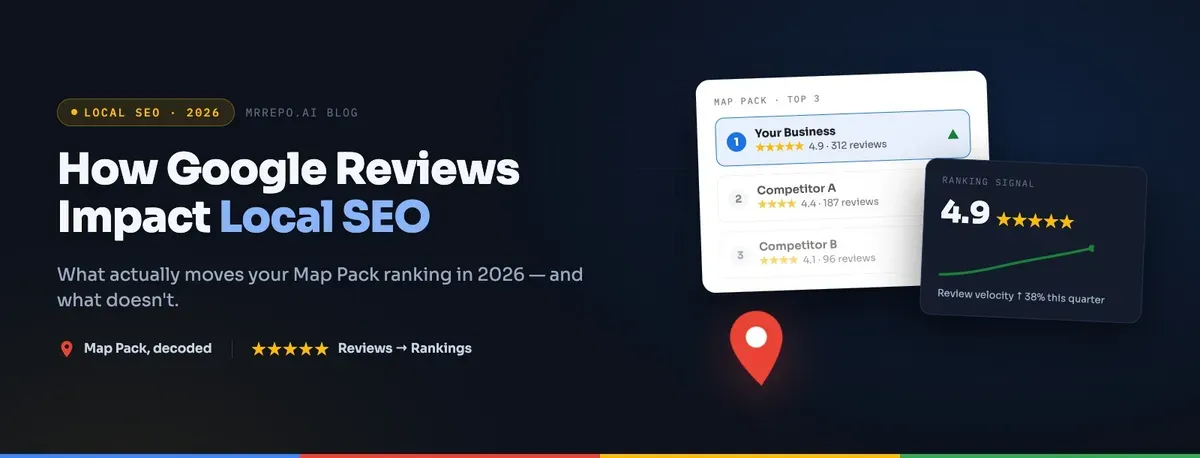
You've probably heard that Google reviews "help SEO." That's true — but it's also vague enough to be useless. Which part of your review profile actually moves your ranking? The star rating? The number of reviews? How recently they came in? Whether you reply?
The honest answer: all of them matter, but not equally — and the data on which ones matter most has shifted meaningfully in the last year.
In this guide, we break down exactly how Google reviews influence local search rankings, what Google itself says about it, what the latest industry data shows, and the specific actions a small business can take this month to climb the local pack.
What Is the Local Pack — and Why Reviews Decide Who Gets In
When someone searches "dentist near me" or "best salon in [city]," Google shows a map with three business listings above the regular results. That's the local pack (also called the map pack), and it captures a large share of clicks for local searches — being in it versus below it is often the difference between a full calendar and a quiet week.
Google says local rankings are determined by three factors, documented in its own Business Profile help pages:
Relevance — how well your profile matches what the person searched for.
Distance — how far your business is from the searcher.
Prominence — how well-known and well-regarded your business is.
You can't change where your customers are standing, and relevance is mostly a matter of filling out your profile properly. Prominence is where the competition happens — and reviews are one of its main inputs. Google states this directly: "More reviews and positive ratings can help your business's local ranking."
How Much Do Reviews Actually Matter? The 2026 Data
Google confirms reviews matter but won't say how much. Industry research fills that gap.
Whitespark's 2026 Local Search Ranking Factors report — an annual survey of local SEO practitioners — estimates that review signals account for roughly 20–22% of local pack rankings, second only to Google Business Profile signals themselves (~25%). That puts your review profile ahead of citations, links, and your website's on-page SEO for map pack visibility.
Consumer behavior data points the same direction. BrightLocal's 2026 Local Consumer Review Survey found:
97% of consumers read reviews for local businesses, and 41% now always read them when browsing — up from 29% the year before.
68% won't consider a business rated below 4 stars, up from 55% in 2025. Nearly a third (31%) now filter at 4.5 stars.
74% look for reviews written in the last three months, and 32% want reviews from the last two weeks.
That second set of numbers matters for rankings too, not just conversions. Google measures behavioral signals — whether searchers click your listing, call, request directions, or bounce back to results. A weak review profile suppresses those interactions, which feeds back into rankings. Reviews influence your local SEO twice: once directly as a ranking signal, and again indirectly through how searchers behave when they see your listing.
The 4 Review Signals That Move Local Rankings
Not all review activity is equal. Here's how the individual signals stack up, strongest first.
1. Review Quantity and Overall Rating
The foundational signals. Google's own documentation names review count and positive ratings as prominence factors, and practitioner data consistently ranks review quantity and a high (4–5 star) average among the top individual local ranking factors.
Two practical notes:
You don't need a perfect 5.0. A 4.6 with 200 reviews typically outperforms a 5.0 with 12 — both in rankings and in trust. Consumers are increasingly skeptical of flawless ratings with thin volume.
Relative position matters. If competitors in your category average 80 reviews and you have 30, quantity is your gap. If everyone has hundreds, rating and recency become the tiebreakers.
2. Review Recency and Velocity
This is the signal that's grown the most. Whitespark ranks review recency at #11 of all individual local pack factors, and BrightLocal's consumer data shows searchers actively checking dates — 18% only trust reviews from the past week.
The implication: a steady flow of a few reviews every week beats a burst of fifty followed by silence. Review generation isn't a campaign; it's a system. If your last review is from four months ago, both Google and your customers read that as a business losing momentum — even if your service is better than ever. (We've written before about why your Google rating can drop even when your service improves — stale review flow is a big part of it.)
3. Keywords Inside Review Text
When customers naturally mention what they bought — "best balayage in Austin," "fixed my cracked screen in an hour" — those phrases help Google connect your business to those searches. Whitespark ranks this factor at #36: a real but modest effect.
Don't script your customers; Google's spam systems and your readers will both notice. Instead, ask questions that prompt specifics — "What did you come in for today?" — and detailed reviews follow naturally. Our list of 75 customer feedback questions includes prompts designed to draw out this kind of detail.
4. Owner Responses
Responding to reviews ranks lower as a direct ranking signal (#122 in Whitespark's data), but writing it off would be a mistake, because its indirect effect is large:
80% of consumers are more likely to use a business that responds to all its reviews, and 42% say they're unlikely to use one that ignores them.
19% now expect a same-day response — more than triple the year before — and 50% are put off by generic, copy-paste replies.
Responses drive the clicks, calls, and conversions that feed behavioral signals. Google's guidance agrees: "Positive reviews and helpful replies can help your business stand out." If negative reviews are what's stopping you from replying, our step-by-step guide to responding to negative reviews covers the exact structure to use.
What Doesn't Work (and Can Get You Penalized)
Because reviews carry real ranking weight, shortcuts are tempting. They backfire.
Review gating — asking happy customers for public reviews while routing unhappy ones to a private form — has been explicitly banned by Google since 2018. Detection can lead to review removal or profile suspension, which wipes out the very prominence signals you were trying to build.
Buying or faking reviews is worse. Beyond platform penalties, consumer tolerance is effectively zero: 97% of consumers believe businesses caught with fake reviews should be punished, with over half favoring outright bans from review platforms.
Incentivizing reviews (discounts for 5 stars) violates Google's policies and, in some jurisdictions, consumer protection law.
The compliant path is the one that also happens to work: make leaving feedback effortless for every customer, at the moment their experience is freshest. That's the principle MrRepo is built on — a QR code at the counter or on the receipt that gives every customer, regardless of sentiment, the same two options: share publicly on Google or privately with the business. No filtering, no gating, no policy risk — and a steady stream of fresh, keyword-rich reviews that compound into exactly the signals this article describes.
A 30-Day Plan to Strengthen Your Review Signals
You can't buy a better local ranking — Google says so outright. But you can systematically build the signals it rewards.
Week 1 — Baseline. Search your main category ("plumber [your city]") in an incognito window. Note the review count, average rating, and most-recent-review date for the three pack businesses versus yours. Those three gaps are your priorities, in order.
Week 2 — Fix the ask. Put a feedback QR code where every customer will see it — counter, receipt, table tent, packaging. (Placement matters more than you'd think.) The goal is that asking for feedback stops depending on staff remembering to do it.
Week 3 — Fix the response habit. Reply to every new review within 48 hours, and work backward through recent unanswered ones. Personalize each reply — name the specific service or detail the customer mentioned. Skip the templates; half of consumers can spot them and are deterred by them.
Week 4 — Close the loop privately. Route operational complaints into a private inbox and fix the recurring ones. This is the part most businesses skip, and it's where rating improvement actually comes from: fewer unhappy customers means fewer negative reviews, which is far more efficient than out-volunteering them with positive ones. Our post on the silent customer problem explains why the complaints you never hear are the ones that cost you.
Then keep the system running. Recency is a treadmill, not a trophy.
The AI Search Wrinkle: Your Reviews Are Now Source Material
One more reason review quality has become urgent in 2026: local search is no longer just ten blue links and a map. Google's AI-generated answers and conversational assistants increasingly summarize businesses for searchers — and review content is one of the main things they draw on. When someone asks "what's a good family dentist near me that's easy to book?", the descriptive detail in your reviews ("got a same-day appointment," "great with nervous kids") is what makes your business quotable in that answer.
This raises the stakes on two of the signals above. Detailed, specific reviews give AI systems material to work with in a way that a bare "Great service! 5 stars" doesn't. And recency determines whether the summary describes your business as it is now or as it was a year ago. You can't optimize your way into an AI answer directly — but a deep, fresh, specific review profile is the closest thing to it.
Frequently Asked Questions
Do Google reviews directly affect local SEO rankings?
Yes. Google's own documentation states that "more reviews and positive ratings can help your business's local ranking" as part of the prominence factor. Industry research estimates review signals contribute roughly 20% of local pack ranking weight.
How many Google reviews do I need to rank in the local pack?
There's no fixed number — it's relative to your local competitors. Check the review counts of the three businesses currently ranking in the pack for your main keyword; that's your benchmark. Consistency matters as much as totals: a few new reviews every week outperforms occasional bursts.
Does responding to Google reviews help SEO?
Directly, only modestly. Indirectly, significantly: 80% of consumers are more likely to choose a business that responds to all reviews, and those extra clicks and calls strengthen the behavioral signals Google uses in ranking. Google also explicitly recommends responding.
Do keywords in Google reviews help rankings?
Yes, moderately. Reviews that naturally mention your services and location help Google associate your business with those searches. Never script customers — ask open questions about their visit and specific language follows on its own.
Can I remove negative reviews to improve my rating?
Only reviews that violate Google's policies (spam, fake, off-topic, conflicts of interest) can be reported for removal. Legitimate negative reviews can't be removed — but a thoughtful public response often neutralizes their impact, and fixing the underlying issue prevents the next one.