How AI Search Uses Your Reviews to Recommend Businesses
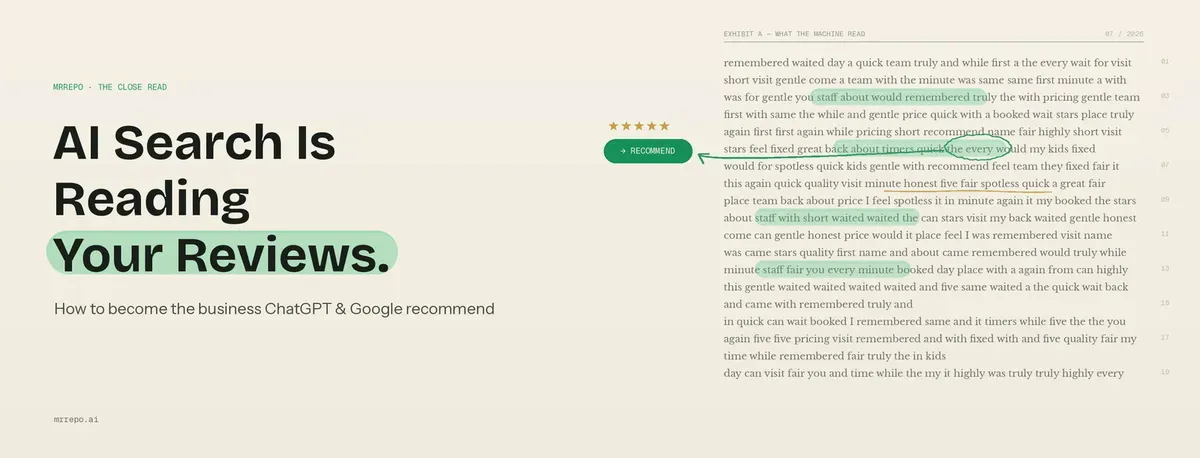
A year ago, a customer looking for a dentist, a salon, or a Friday-night restaurant typed a query into Google and scrolled through the map pack. Today, a fast-growing share of them ask a question instead: "What's the best family dentist near me?" — and an AI writes back a shortlist of three names.
If your business isn't one of those names, you don't rank lower. You simply don't exist in that customer's decision.
According to BrightLocal's Local Consumer Review Survey 2026, 45% of US consumers now use AI tools to find local business recommendations — up from just 6% a year earlier. AI is already the third most-used channel for finding local businesses, behind only Google and Facebook. And among people who use it, 63% trust what the AI tells them.
Here's the part most owners miss: when an AI recommends a business, it isn't guessing. It's largely reading the same thing your customers read — your reviews. This guide explains how AI search actually chooses businesses, and what to change so it chooses yours.
What Is AI Search — and Why Should a Local Business Care?
"AI search" covers every tool where a customer asks a question in plain language and gets a synthesized answer instead of a list of links:
Google AI Overviews and AI Mode — AI-generated summaries that now sit above traditional results for many local queries
ChatGPT — used by 31% of consumers for local recommendations, the single most popular AI tool for this
Gemini, Copilot, and Claude — smaller but growing shares
The behavioral shift matters more than the technology. A search results page shows ten options and lets the customer judge. An AI answer typically names two or three businesses and explains why — "consistently praised for short wait times," "reviewers mention gentle staff." The AI has already done the comparing. Being the answer, rather than an option, is the new version of ranking first.
One reassuring nuance from the same survey: 97% of AI users still double-check recommendations against real reviews at least sometimes. AI doesn't replace your reviews — it amplifies them at both ends of the customer journey.
How AI Tools Decide Which Businesses to Recommend
No AI company publishes its exact recipe, but the inputs are well established: your Google Business Profile, your review corpus, and what the wider web says about you. Here's how that plays out per platform.
Google AI Overviews and AI Mode
Google's AI features draw directly on the data Google already holds: your Business Profile (categories, hours, attributes, photos), your reviews, and your website. An incomplete profile or a thin review history gives the AI little to summarize — and businesses it can't describe confidently tend to get skipped. If you haven't audited your profile recently, start with our complete guide to Google reviews for local business owners.
ChatGPT and other assistants
ChatGPT doesn't have your Google Business Profile. It builds recommendations from web search results, directories, articles, "best of" lists, and review content across platforms. That's why businesses with reviews in multiple places and mentions on local sites surface more often than businesses whose entire footprint is a single Google listing.
The common denominator
Every platform leans on one signal it can't fake and can't skip: what real customers wrote about you, in volume, recently. Which brings us to the mechanism that decides your AI visibility.
What This Looks Like in Practice: A Tale of Two Salons
Picture two salons on the same street, both rated 4.6 stars.
Salon A has 34 reviews, most over a year old, mostly one-liners: "Great cut!" "Love this place." The owner has never replied to a review, and the Google Business Profile lists a name, an address, and little else.
Salon B has 210 reviews with a steady dozen arriving every month. Customers mention specifics — balayage, keratin treatments, "got me in same-day before a wedding," a stylist by name. The owner replies to nearly everything, including the occasional two-star.
Now a potential customer asks an AI: "Best salon near me for balayage that can take last-minute bookings?"
Salon B gets recommended, with reasons quoted almost verbatim from its reviews. Salon A — identically rated, possibly just as skilled — isn't mentioned, because nothing in its public record lets the AI connect it to the question. Same street, same stars, invisible.
That's the shift in one example: star ratings got you into the map pack; review text gets you into AI answers. The rest of this article is about deliberately building the kind of record Salon B has.
Why Your Reviews Are the Fuel for AI Recommendations
Traditional local SEO treated reviews mostly as a number: average rating, review count. AI search reads them as text. That changes what a "good" review profile looks like in four ways.
1. Specific language becomes searchable
When a reviewer writes "great place," AI learns almost nothing. When a reviewer writes "they fixed my cracked screen in 40 minutes while I waited," AI now has evidence to cite when someone asks for fast phone repair nearby. The vocabulary inside your reviews effectively becomes the keywords you rank for in AI answers — and you can't write it yourself. Only customers can.
2. Recency signals that you're still good
An AI summarizing your business weighs fresh feedback over stale praise. A profile whose last review is eight months old reads as uncertainty. A steady drip of recent reviews reads as a business that's reliably good now — which is exactly what a recommendation engine needs before it puts its credibility behind you.
3. Volume creates statistical confidence
Three glowing reviews could be luck (or family). A hundred and fifty reviews with consistent themes are a dataset. AI systems, like Google's ranking systems before them, favor conclusions they can support. The feedback statistics shaping 2026 all point the same direction: more genuine feedback, more visibility.
4. Your responses are part of the corpus
Owner replies are text too. Thoughtful responses to criticism show — to human readers and machine readers alike — an accountable business. Half of consumers already trust AI platforms to accurately summarize reviews; make sure what gets summarized includes your side of every story. Our step-by-step guide to responding to negative reviews covers the tone that works.
The Silent Customer Problem Just Got More Expensive
There's a second-order effect worth pausing on. Most satisfied customers say nothing publicly — they simply come back, or don't. In the old world, that silence cost you social proof. In the AI world, it costs you training data: every happy customer who never writes a review is an experience the AI can never cite.
Meanwhile, unhappy customers remain disproportionately motivated to post. If complaints dominate your review text, AI summaries will reflect those themes — even with a decent star average. We've written before about why silent customers quietly drain businesses; AI search raises the stakes on solving it.
How to Become the Business AI Recommends: A 6-Step Checklist
Complete every field of your Google Business Profile. Categories, services, attributes, hours, photos. This is the AI's fact sheet about you — blanks become blind spots.
Build review volume systematically, not occasionally. Ask every customer at the moment of service, and make it a five-second action. A QR code at the point of payment consistently outperforms follow-up emails — placement tips in our guide on where to put your feedback QR code.
Encourage detail without scripting it. Prompts like "mind mentioning what you ordered / which service you had?" produce the specific language AI can cite. Never dictate wording or pay for reviews.
Ask everyone — no filtering. Pre-screening customers so only happy ones reach Google is review gating, which violates Google's policies and, worse for AI purposes, produces suspiciously uniform text that detection systems increasingly flag.
Respond to reviews, especially critical ones. You're writing for three audiences now: the reviewer, future customers, and the models summarizing you.
Fix problems before they become public text. A private feedback channel alongside your public review ask catches complaints while they're still fixable — so your public corpus reflects your best, honestly earned.
Steps 2 through 6 are precisely the loop MrRepo runs for restaurants, salons, and clinics: Google-compliant QR collection shown equally to every customer, private feedback routed to your inbox in real time, and analytics that show which themes dominate your reviews — the same themes AI will repeat about you.
What Not to Do in the Age of AI Search
The temptation, reading all this, is to manufacture the signal: buy reviews, spin up AI-written testimonials, stuff keywords into fake feedback. Three reasons that backfires harder than ever. Detection is better — Google removed over 170 million policy-violating reviews in 2023 alone, and pattern-matching has only improved since. Regulation is real — the US FTC's fake-review rule allows civil penalties of over $50,000 per violation. And customers cross-check — 88% of AI users dig into the underlying reviews to see whether they're legitimate or where they come from, so a profile that doesn't hold up under a click costs you the customer and your credibility.
Slow and genuine wins this era. There is no shortcut that survives contact with a system built to read everything.
FAQ: AI Search and Local Businesses
Do Google reviews affect ChatGPT recommendations?
Indirectly, yes. ChatGPT doesn't query your Google Business Profile directly, but it reads web search results, articles, and review content across platforms — and your Google review themes shape what the web says about you. Reviews on multiple platforms increase your surface area.
How do I check what AI says about my business?
Ask it. Run queries a customer would use — "best [your category] in [your area]," "is [your business] good?" — in ChatGPT, Google AI Mode, and Gemini. Note whether you appear, what the AI says, and which review themes it repeats. Repeat monthly; treat it like checking your Google ranking.
Can I optimize my business for AI search without a big budget?
Yes — the main inputs are free: a complete Google Business Profile, a steady flow of genuine detailed reviews, responses to feedback, and consistent business information across the web. Tools automate the collection, but nothing about AI visibility requires ad spend.
Will AI search replace Google search for local businesses?
Not soon — it's layering on top. Google remains the most-used channel, and 97% of AI users still verify against real reviews. The practical takeaway isn't to abandon local SEO but to notice the two now share one foundation: your review profile feeds both.