What Actually Changes When You Start Replying to Reviews
Almost every reputation guide tells you to reply to your reviews. Very few tell you what replying has actually been measured to do — and fewer still admit the research is messier, and more contradictory, than the advice built on top of it.
This post is about the effect of a reply policy, not the wording of a reply. For wording, see our guides on responding to negative reviews and responding to positive reviews. This one asks: if you turn on replies tomorrow, what should you honestly expect to change?
Short version: something real happens, it's smaller and stranger than the marketing suggests, and three of the most confidently repeated claims about it don't survive a look at the sources.
The number everyone quotes — and what it's actually measuring
The figure behind most "respond to your reviews" advice comes from one 2017 study: Davide Proserpio and Georgios Zervas, Online Reputation Management: Estimating the Impact of Management Responses on Consumer Reviews, in Marketing Science.
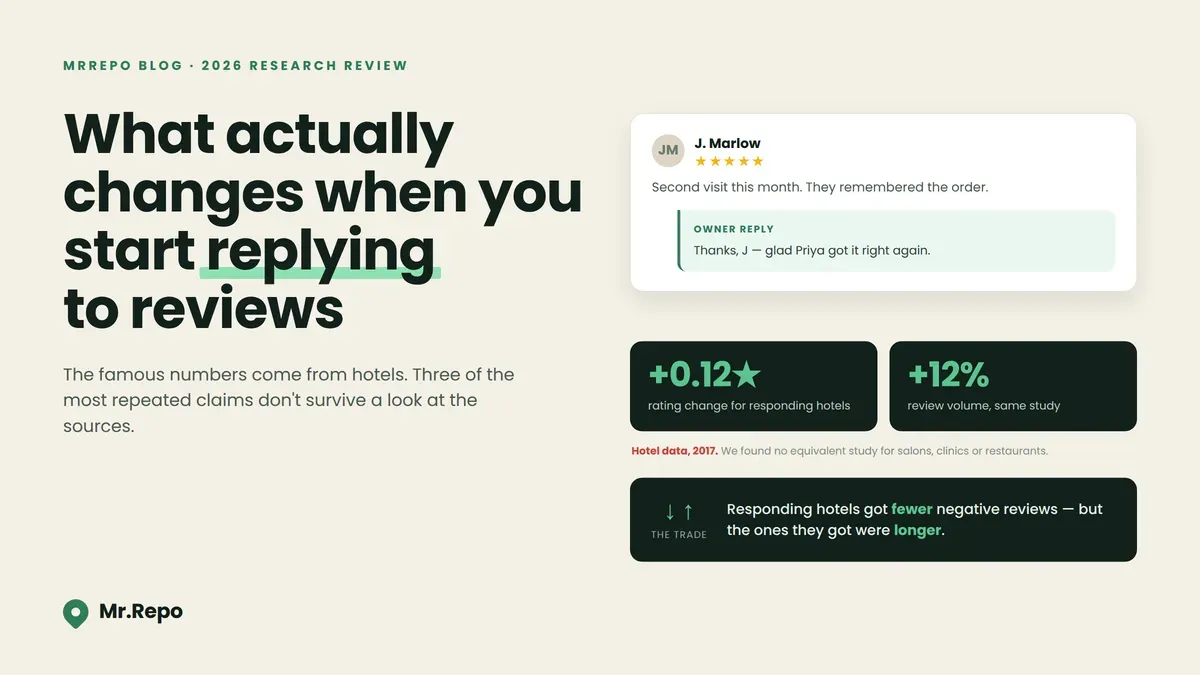
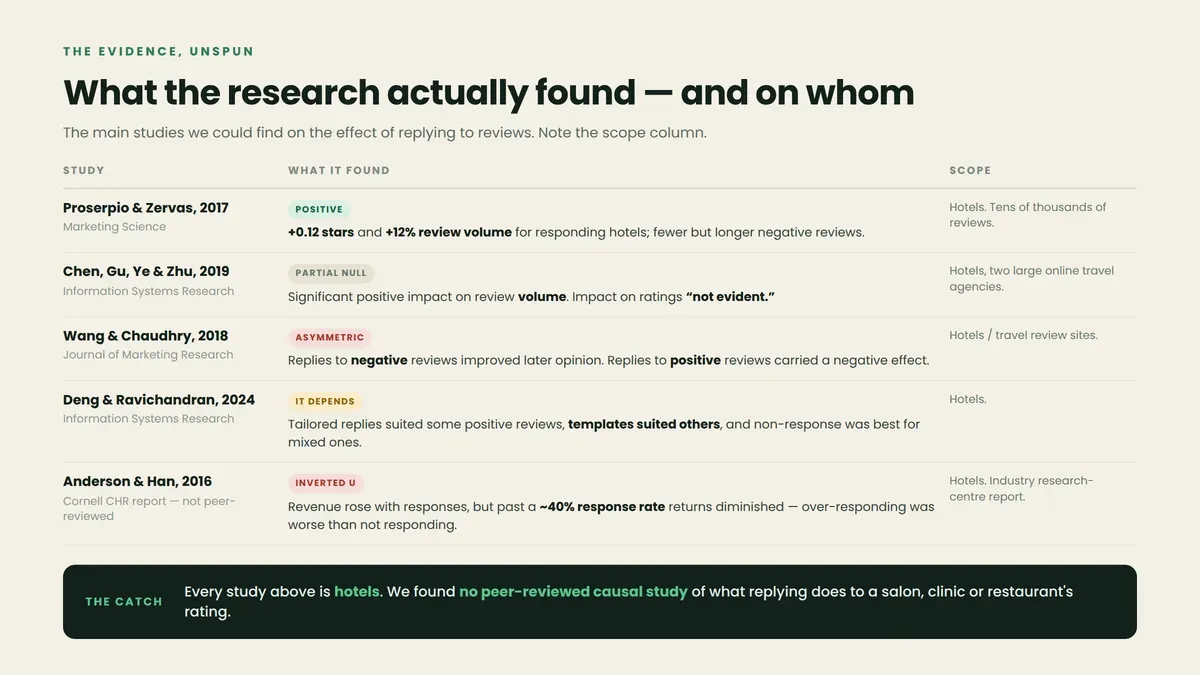
They found a 0.12-star increase in ratings and a 12% increase in review volume for responding hotels.
Note the last word. This is hotel data. The researchers analysed tens of thousands of hotel reviews, and their identification leaned on differences in how often hotels respond across review platforms, combined with differences in how likely guests were to see those responses at all.
A hotel is not a dental practice, a barbershop, or a taqueria, and the purchase plausibly differs in ways that matter — booking lead time, how many reviews get read before choosing, how substitutable the options are. We found no peer-reviewed causal study measuring what replying does to the rating of a plumber, a salon, or a nail bar. If you see "responding raises your rating by 0.12 stars" on a page aimed at local businesses, you're reading travel-industry data with the label filed off — a starting hypothesis, not a promise.
The strangest finding: fewer negative reviews, but longer ones
Buried in the same paper is the result that should actually change how you think about this.
When hotels started responding, they received fewer but longer negative reviews. The authors' explanation is that unsatisfied consumers become less likely to leave short, indefensible reviews when they expect management to scrutinise them. As the INFORMS write-up of the study put it: "It is almost like someone is looking behind your shoulder when you are writing a negative review."
That's easy to misread in a flattering direction. The study does not show responding hotels had fewer bad experiences. On the authors' reading, the drive-by one-liner became less common while the people who did complain wrote more substantively. They frame it as a trade-off: fewer negative ratings, at the cost of longer and more detailed negative feedback.
One related finding comes from outside hotels. A 2025 study in Electronic Markets (Choi and colleagues) compared 43,747 reviews from 56 restaurants against 27,952 reviews from 37 control restaurants on Yelp and TripAdvisor. Response intensity and diversity were positively associated with the length and cognitive language content of subsequent reviews; where responses more closely mirrored the review they answered, the affective tone of later reviews improved.
Be careful what you take from that. It measured review content, not ratings or volume, and it reports associations rather than a tested mechanism — so it is neither a restaurant version of the self-censorship story nor of the 0.12 stars. It's a weaker, separate signal that replying changes how people write about you.
Where the research disagrees with itself
If the story stopped at the 2017 paper, "reply to everything" would be easy to defend. It doesn't.
The rating effect isn't settled. Chen, Gu, Ye and Zhu, in Information Systems Research (2019), used a different design across two large online travel agencies and reported that responses had a significant positive impact on the volume of subsequent reviews — but that the impact on review valence "is not evident." More reviews, yes. Better ones, unproven. Hotels again.
Replying to positive reviews may not be free. Wang and Chaudhry, in the Journal of Marketing Research (2018), found the effect is asymmetric: responses to negative reviews significantly improved subsequent opinion when future reviewers could see them, while responses to positive reviews carried a negative externality. Tailored responses amplified both directions — including the unhelpful one.
Other work points the other way. Han, Anderson and Chung (Humanities and Social Sciences Communications, 2023) analysed satisfaction-survey data from 5,058 customers of a US mid-scale hotel chain — managerial responses inside a private survey system, not public review-platform replies — and found thank-yous on positive feedback increased subsequent online word-of-mouth by 12.7 percentage points. Deng and Ravichandran (Information Systems Research, 2024) found the right move depends on the review: tailored responses suited some positive reviews, template responses suited others, and non-response was optimal only for mixed positive ones.
There's no clean consensus, and you should be suspicious of anyone who presents one. The defensible summary is narrow: the evidence for replying to negative reviews is the most consistent across studies. What to do with five-star reviews is genuinely unsettled — which is not the same as "don't bother."
Three claims that don't survive a fact-check
1. "Replying to reviews improves your Google ranking"
Google doesn't say this, and the distinction matters.
On Google's Tips to improve your local ranking page, the ranking claim attaches to reviews themselves, under Prominence: "More reviews and positive ratings can help your business's local ranking." That's count and rating.
The same page's advice on responding says something different: "When you reply to customer reviews, it shows that you value their feedback. Positive reviews and helpful replies can help your business stand out." "Stand out" is a differentiation claim, not a ranking claim — and Google's dedicated review-management page makes no ranking claim about replies at all.
So: more reviews plausibly help your local ranking — the subject of our guide on how Google reviews impact local SEO. Replying is a customer-facing act, not a documented ranking lever on the pages where Google explains local ranking.
2. "Reply to 100% of your reviews"
The only evidence we found bearing directly on this points against it — with caveats. A Cornell Center for Hospitality Research report by Anderson and Han (2016) found hotel revenue rose as the number of management responses rose, but only to a point. After roughly a 40% response rate, the report found diminishing returns, and concluded that making too many responses was worse than offering no response at all, for both ratings and revenue. It also found ratings improved more from constructive responses to negative reviews than from simple acknowledgement of positive ones.
Hold it loosely: hotels again, and an industry research-centre report rather than a peer-reviewed article.
And it cuts against what customers say they want. In the same BrightLocal 2026 survey, 80% said they're likely to use a business that responds to all of its reviews, and 42% said they're unlikely to use one that never replies. Those are stated preferences, not measured outcomes — but they're a real signal, and they point the other way. The honest position is that a stated appetite for universal replies sits alongside the one outcome study we found, which says the returns stop climbing well short of 100%.
3. "Respond within an hour"
We searched specifically for peer-reviewed evidence that faster replies produce better outcomes — higher ratings, more reviews, more revenue. We didn't find any. The sources we found asserting it were vendor marketing claims without a disclosed dataset or method.
What is documented is consumer expectation, which is a different thing. BrightLocal's Local Consumer Review Survey 2026 (n=1,002 US adults, published February 2026) found 81% expect a response within a week and 19% expect one the same day, up from 6%. People want speed. Whether giving it to them moves a business metric isn't established in the literature we could find.
The same survey found generic or templated replies put off 50% of consumers — a stated preference, not a measured outcome, but a reminder that the fastest reply and the most persuasive one are rarely the same reply.
The bar is lower than you think
Here's the encouraging part.
Analysis by SOCi of 4,936,814 Google reviews across 31,326 locations (2015 to July 2022) found 1-star reviews were answered only 8.6% of the time, against 23.4% for 5-star reviews. Three-star reviews got answered just 2.0% of the time — praise answered more than twice as often as complaints, and the mid-range reviews where the actionable feedback lives almost never.
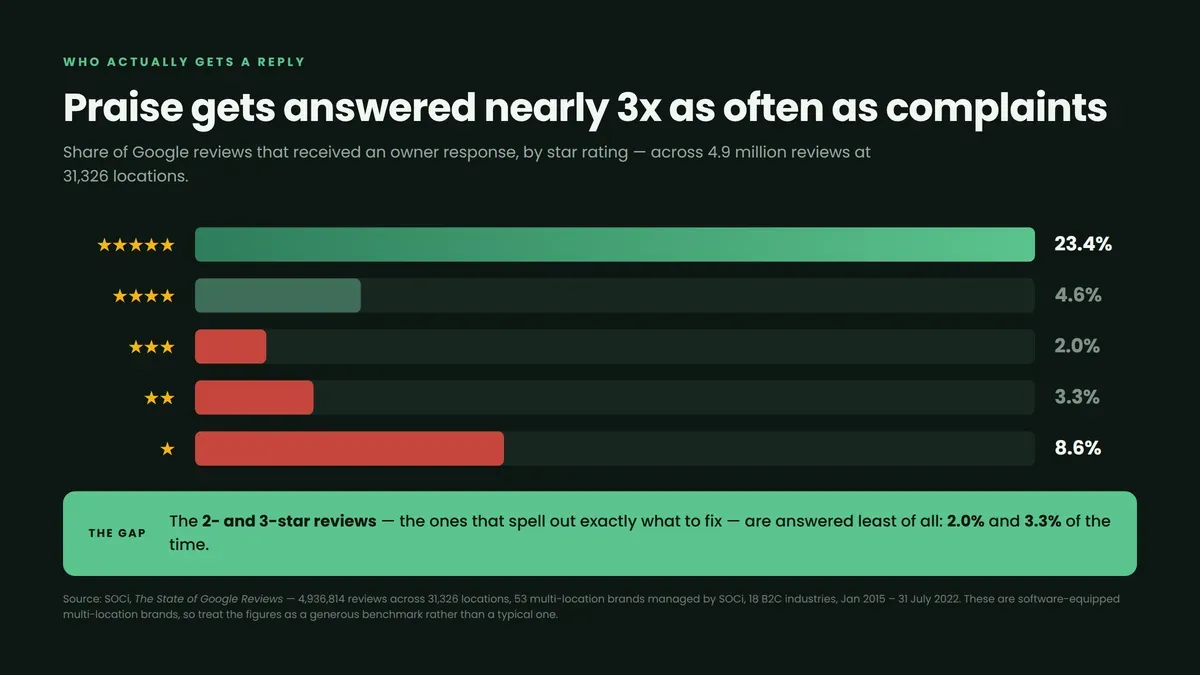
Two caveats: the data ends in 2022, and those locations are 53 multi-location brands managed by SOCi — the best-resourced end of the market, which makes it a generous benchmark rather than a typical one. The pattern shows elsewhere too: in a 2025 survey by practice-software vendor Tebra, 45% of healthcare providers said they never respond to negative reviews, on a small base of 203 provider respondents.
Among businesses that do reply, the reviews getting answered are the ones that need it least.
A defensible reply policy
Given all of the above:
Prioritise negative and critical reviews. This is where effects have been most consistent across studies, and where the Cornell report found constructive responses did more for ratings than acknowledging praise.
Don't ignore 2- and 3-star reviews. No study we found measured responses to mid-range reviews as a category, so treat this as our judgement rather than a finding: they're the least-answered in the SOCi data, and a three-star review usually spells out what to fix, where a one-star review often just tells you someone was angry.
Personalise your responses to complaints. The strongest evidence here is indirect: in the hotel-chain study of private satisfaction-survey responses, a managerial apology had no statistically significant effect on its own, and the measurable gains came from apologies that were personalised (a 19.1% higher chance of a top-box rating) or substantive. That isn't a study of public review replies, but it's consistent with BrightLocal's finding that templated replies put off half of consumers.
Treat five-star replies as an open question, not a rule. One study found tailored replies to positive reviews can backfire; a second — using private survey responses, not public replies — found thank-yous lifted online word-of-mouth; a third found template replies were the right call for some types of positive review. Reply where you have something to say.
Reply promptly, but don't buy the hour. Meeting the "within a week" expectation is a defensible standard. We found no evidence a 40-minute reply outperforms a 4-hour one.
Read replies as a feedback channel, not a broadcast. In the hotel data, the negative reviews that followed a reply policy were longer and more detailed — more useful, not less.
That last one is where most of the value sits, and it's what a public reply box handles worst. If a customer's real complaint only ever reaches you as a public review, you've already paid for it. Capturing it privately first — before it becomes a rating — is the problem MrRepo's QR feedback flow is built to solve. Public replies clean up what escaped; private capture stops it escaping.
Frequently asked questions
Does replying to reviews increase my star rating?
In hotels, responding was associated with a 0.12-star increase (Proserpio & Zervas, 2017). A separate hotel study using a different design found a significant positive effect on review volume but no evident effect on ratings. We found no equivalent study for local service businesses, so treat the number as a hypothesis rather than a forecast.
Does Google rank businesses higher for replying?
Google's local-ranking and review-management help pages make no such claim. They say more reviews and positive ratings can help local ranking, and that replies help you "stand out." Vendors routinely merge the two.
Should I reply to every review?
The evidence doesn't support it as a rule. A Cornell hospitality report — hotels, not peer-reviewed — found returns diminishing after roughly a 40% response rate, and over-responding worse than not responding at all. Set against that, 80% of consumers in BrightLocal's 2026 survey said they're likely to use a business that replies to everything. Our judgement: prioritise negative and mid-range reviews rather than chasing 100%.
Should I reply to five-star reviews?
The research is genuinely split. One study found responses to positive reviews carried a negative effect on subsequent reviews; a second, using private survey responses rather than public replies, found thank-yous raised online word-of-mouth; a third found the best approach depends on the type of positive review. Reply selectively and with something specific to say.
How fast do I need to respond?
BrightLocal's 2026 survey of 1,002 US adults found 81% expect a reply within a week and 19% the same day. We found no peer-reviewed study showing that replying faster improves ratings, volume or revenue — so don't sacrifice a considered reply to hit an arbitrary clock.
Will replying reduce the number of bad reviews I get?
In the hotel study, yes — but the authors attribute it to unhappy customers self-censoring short, indefensible complaints under expected scrutiny, not to fewer bad experiences. The negatives that remain are longer and more detailed.
Key takeaways
The famous "+0.12 stars, +12% reviews" result is hotel data from a 2017 Marketing Science study. A useful hypothesis for local businesses; not a promise.
A separate hotel study using a different design found responses raised review volume but had no evident effect on ratings. The rating claim is less settled than it's usually presented.
In hotels, responding was associated with fewer but longer negative reviews — which the authors attribute to self-censorship of drive-by complaints, not to fewer bad experiences.
Google's local-ranking and review-management help pages make no claim that replies affect ranking. They say reviews and ratings do.
The evidence on replying to positive reviews is genuinely mixed — one study found a negative effect on subsequent reviews, one (using private survey responses, not public replies) found a positive one, and a third found it depends on the review type. Don't let anyone sell you a rule here.
A Cornell hospitality report (hotels; not peer-reviewed) found returns diminishing past roughly a 40% response rate, with over-responding worse than not responding — even though 80% of consumers say they prefer a business that replies to everything.
We found no peer-reviewed evidence that replying faster improves outcomes. The consumer expectation is real; the measured payoff isn't established.
Among SOCi-managed multi-location brands, 1-star Google reviews were answered just 8.6% of the time versus 23.4% for 5-star. The reviews getting answered are the ones that need it least.