Does Fixing a Complaint Win the Customer Back? What the Research Actually Shows
A customer tells you something went wrong. Not on Google — to you, at the counter or in an email or through a feedback form. You apologise, you fix it, maybe you take it off the bill, and you go back to work feeling like you got away with one.
There is a story behind that feeling, and it has a name: the service recovery paradox — the idea that a customer whose problem you solve brilliantly ends up more loyal than one who never had a problem at all. The research on it is decades old, and it says something narrower than the story does.
What the paradox claims, and what the meta-analysis left of it
de Matos, Henrique and Rossi published a meta-analysis of the paradox in the Journal of Service Research in 2007, pooling results across many separate studies. Their framing before the findings: "empirical research testing the SRP has produced mixed results, with only some studies supporting this paradox."
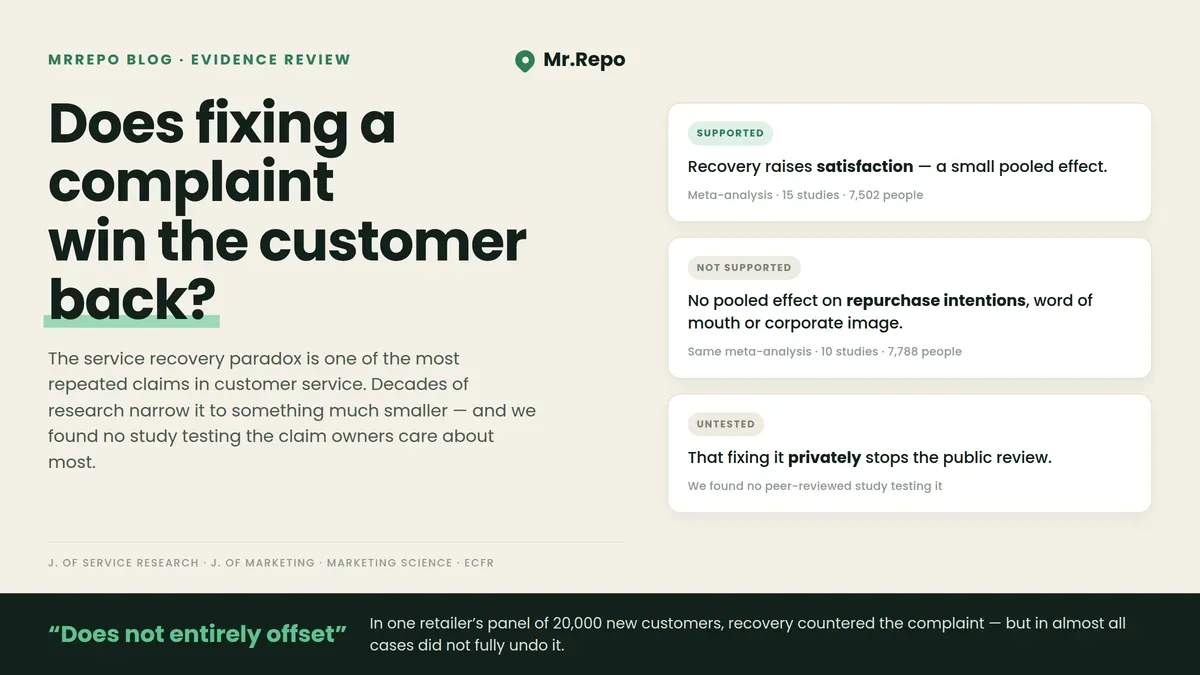
The pooled result splits four ways. The analyses show "that the cumulative mean effect of the SRP is significant and positive on satisfaction, supporting the SRP, but nonsignificant on repurchase intentions, word-of-mouth, and corporate image, suggesting that there is no effect of the SRP on these variables."
The paradox held for satisfaction — how good the customer says they feel — across 15 studies and 7,502 people, at an effect size of r = .125, which is small. It did not hold for repurchase intentions across 10 studies and 7,788 people, where the pooled effect was "negative and not significant." It did not hold for word of mouth or corporate image.
So the defensible claim is that a well-handled failure can leave someone feeling better about the encounter. It has not been shown to make them more likely to come back or to recommend you.
Two findings tighten it further. McCollough, Berry and Yadav ran two scenario-based experiments and found "[c]ustomer satisfaction was found to be lower after service failure and recovery (even given high-recovery performance) than in the case of error-free service." Michel and Meuter tested the paradox against more than 11,000 customer interviews in banking and reported that it "is a rare event, and the hypothesized mean differences are, albeit significant, not very large."
Real, small, and uncommon. Not a strategy.
The study that watched what people actually bought
Everything above measures what customers say. Knox and van Oest went after what they did. Writing in the Journal of Marketing in 2014, they note that "no study has measured the impact of actual complaints and recoveries on subsequent customer purchasing," then build a customer-base model calibrated "on panel data that track actual purchases, complaints, and recoveries for 20,000 new customers of an Internet and catalog retailer over 2.5 years."
Both halves of their result matter. The reassuring one: "unless the customer leaves the company after a complaint, or a second failure occurs shortly after the first, the relationship quickly returns to normal." Short of that, a complaint is not a permanent mark. The sobering one: "Recovery counters the effect of the complaint but, in almost all cases, does not entirely offset it."
Almost all cases. On this evidence, recovery is associated with moving the customer back toward where they were, and stopping short of arriving.
One caveat: this is a single online and catalogue retailer of 20,000 new customers, and nothing here extends it to a local service business. It measures churn and purchasing rather than satisfaction, so it does not contradict the finding above — the two measure different things.
When recovery might do more — and when it fades
If the paradox is rare, the useful question is: rare when? Magnini, Ford, Markowski and Honeycutt found it "is most likely to occur when the failure is not considered by the customer to be severe, the customer has had no prior failure with the firm, the cause of the failure was viewed as unstable by the customer, and the customer perceived that the company had little control over the cause of the failure."
Those conditions are largely outside your control on the day, and the last one is counter-intuitive: the paradox is likelier when the customer thinks the problem was not really your fault. Take all of it with the caveat the authors attach themselves — they name their limitations as "the use of undergraduate business students and the examination of only one service setting." It is the weakest design cited here.
The "no prior failure" condition has better support. Maxham and Netemeyer ran a repeated-measures field study over 20 months covering two failures and recovery attempts, measuring what customers said. "[t]hough satisfactory recoveries can produce a 'recovery paradox' after one failure, they do not trigger such paradoxical increases after two failures," and "recovery efforts are attenuated when two similar failures occur and when two failures happen in close time proximity." The same paper puts "double deviations" after two consecutive failed recoveries, or a failed recovery to a second failure.
Compensation, or the way you handle it?
Gelbrich and Roschk meta-analysed the complaint-handling literature and reported a split that is easy to misread, so here is their wording in full: "the common contention of distributive justice as the salient driver of service recovery is only true for transaction-specific satisfaction, which in turn reinforces positive WOM. Cumulative satisfaction, however, which is the primary antecedent of customer loyalty, even slightly more depends on interactional justice than on distributive justice."
In plain terms: distributive justice is what you give them — the refund, the credit, the redo. Interactional justice is how they were treated — courtesy, effort, an explanation, being taken seriously. Compensation drives satisfaction with that transaction, which feeds positive word of mouth; the broader satisfaction that predicts loyalty leans, in their phrase, "even slightly more" on how they were treated. That hedge is doing real work: this is not evidence that apologies beat refunds, but that the two do different jobs.
What you give still has to fit. In scenario experiments, Smith, Bolton and Wagner found that "customers prefer to receive recovery resources that 'match' the type of failure they experience in 'amounts' that are commensurate with the magnitude of the failure that occurs." A billing error wants a billing fix.
Does answering faster matter?
Partly, and less cleanly than you would expect. Istanbulluoglu surveyed 422 consumers who had complained on Facebook or Twitter and received a response, finding that "both a quicker first response and a quicker conclusive response lead to higher satisfaction with complaint handling." Participants "expected companies to reply to their complaints within 1-3 hours on Twitter and within 3-6 hours on Facebook" — stated expectations, not a measured cliff.
The complication comes from the same researcher. Istanbulluoglu and Sakman examined five dimensions of complaint handling — "timeliness, redress, apology, credibility, and attentiveness" — against repurchase intention, mediated by trust. Their result names four: "receiving a response and four dimensions of the response (redress, apology, credibility, and attentiveness) are related to stronger repurchase intention through the mediation of increased trust in company." Timeliness is the dimension the finding does not name.
Both studies are self-reported, cross-sectional, about public social media complaints, and share a first author — one line of work, not two independent confirmations. The pattern: speed tracks satisfaction with the handling; the second abstract does not name it for repurchase.
There is another lever in the same literature. Gunarathne, Rui and Seidmann (HICSS 2017) studied 1,500 complaint conversations with one airline on Twitter and found "the customers who do not experience handoffs during the conversation, are more likely to be satisfied about their complaining experience on social media." Handoffs are a driver that paper names; response time is not among them.
The claim we found untested
Here is the pitch reputation tools make, ours included: catch the unhappy customer privately, fix it there, and the one-star review never gets written.
We found no peer-reviewed study testing whether resolving a customer's private complaint changes whether that customer later posts a public review. Every piece of research on review behaviour we could verify starts from a review already posted. The claim is plausible. We could not find it tested.
Two adjacent findings should make you more careful with it. He, Lee and Rui studied what happens when a firm makes its private channel effortless. In a natural experiment "where the inconvenience of the private channel with the treated firm is suddenly eliminated," they "find evidence that customers prefer to complain through the public channel." The working-paper version studied US airlines on Twitter in 2016; it measured channel choice, not review posting, but removing the friction did not move complainers out of public view.
Then the mechanism question. Proserpio and Zervas found Texas hotels that started replying to reviews saw "a 0.12-star increase in ratings and a 12% increase in review volume" and "fewer but longer negative reviews." They explain it by arguing "unsatisfied consumers become less likely to leave short indefensible reviews when hotels are likely to scrutinize them." That is deterrence through visible scrutiny — the opposite of quietly handling things off-platform, and it is estimated on hotels that chose to start responding, not a promise about any business that starts today. We covered its limits in our post on replying to reviews.
Isn't a private channel just review gating?
It can be, and the line is worth stating precisely. Google's Maps policy says merchants may not "Discourage or prohibit negative reviews, or selectively solicit positive reviews from customers." Sorting customers by how happy they are and asking only the happy ones for a Google review is exactly that. Offering every customer the same two doors — a public review, or private feedback — sorts nobody by sentiment before the ask. Google's permission covers the ask: merchants may "Solicit or encourage the posting of content that does represent a genuine experience, without offering incentives to do so or attempting to influence the rating or the contents of the review." We covered that line in our post on review gating.
The other trap is the goodwill gesture. If you refund a customer and then ask for a review, keep the two visibly unlinked. The FTC rule at 16 CFR § 465.4 reaches compensation "in exchange for, or conditioned expressly or by implication on, the writing or creation of consumer reviews expressing a particular sentiment, whether positive or negative." By implication is the dangerous limb — "we've credited your account, hope you'll say something nice" is conditioning it. Google's ban has no sentiment condition — incentives "in exchange for posting any review" — so the two rulebooks differ, as our post on review requests unpacked.
What we would actually do
These are working rules drawn from the evidence above plus our own practice. They are not findings, and we have not tested this list as a protocol.
Treat a resolved complaint as damage limited, not value created. Recovery "does not entirely offset" the complaint in almost all cases, in the one retailer's purchase data here. Anything better is a bonus.
Spend the effort on the first failure. One field study found the paradox after a first problem but not a second, with recovery attenuated when failures are similar or close together. If your notes show this is their second, escalate who handles it.
Give one person the whole complaint. Handoffs are a driver that airline study names; response time is not.
Fix what broke, treat them well, and match the remedy to the type and size of the failure. Compensation and courtesy do different jobs; no study here tested the order.
Ask for the review separately from the fix — never in the same breath as the refund, and ask everyone the same way, whatever they told you privately.
Private feedback is worth collecting because it tells you what is breaking while you can still fix it — a different argument from the one about reviews. MrRepo shows every customer both options at the same moment, rather than sorting them by sentiment first. We do not claim it stops the bad review; we found no peer-reviewed study testing it. See how the routing works in the demo.
Frequently asked questions
Is the service recovery paradox real? In a narrow sense. The de Matos, Henrique and Rossi meta-analysis found a significant positive pooled effect on satisfaction (r = .125, small) and no significant effect on repurchase intentions, word of mouth or corporate image. Michel and Meuter, testing it against more than 11,000 customer interviews in banking, called it "a rare event." Real for how people feel; unproven for whether they come back.
If I fix the problem, will the customer stay? More likely than if you did nothing, less likely than if the problem had never happened. The one study here tracking actual purchases — Knox and van Oest, 20,000 new customers of one online and catalogue retailer over 2.5 years — reports recovery "counters the effect of the complaint but, in almost all cases, does not entirely offset it." That is one retailer in one sector.
Should I refund, or just apologise well? Both, and they do different things. Gelbrich and Roschk's meta-analysis found compensation drives satisfaction with that specific transaction, while the broader satisfaction linked to loyalty depends "even slightly more" on how the customer was treated. Smith, Bolton and Wagner add that the remedy should match the failure type and its size. These are findings about stated satisfaction and intentions.
Does responding faster stop a bad review? Nothing we verified measures review posting. Istanbulluoglu found quicker first and conclusive responses tracked higher satisfaction with complaint handling among people who complained on Facebook and Twitter — but that study measured satisfaction, not what anyone later published.
Can I ask a customer to update their review once I've fixed it? Google's help page says following up "may even encourage the customer to update their review," and we found no Google policy addressing a non-incentivised request to update a review. Both reach attaching value, though not identically: Google does not allow incentives "in exchange for posting any review," and 16 CFR § 465.4 reaches compensation conditioned "expressly or by implication" on a review expressing a particular sentiment. This is general information, not legal advice.
Key takeaways
The service recovery paradox survives in the pooled evidence only for satisfaction, at a small effect size, and not for repurchase intentions, word of mouth or corporate image.
In one retailer's purchase data rather than stated intentions, recovery "does not entirely offset" the complaint in almost all cases — though unless they leave, or a second failure follows soon after, the relationship quickly returns to normal.
In self-reported measures, the paradox appears after a first problem but not a second; recovery is attenuated when two failures are similar or close together.
Compensation and courtesy do different jobs: the refund drives satisfaction with the transaction, while the loyalty-linked measure depends slightly more on how the person was treated.
No peer-reviewed study we could find tests whether resolving a private complaint prevents a public review. Treat that claim — including from a vendor — as untested.