The Review Requests That Are Actually Against the Rules (2026)
Asking your customers for reviews is allowed. Google says so on its own help page: "To leave reviews, you can ask customers to visit a Google link or scan a QR code."
What the rules reach is not asking. It's the shape of the ask — the discount attached to it, the phrasing handed to a server, the list of people it goes to. But there are two rulebooks, and they do not draw the line in the same place.
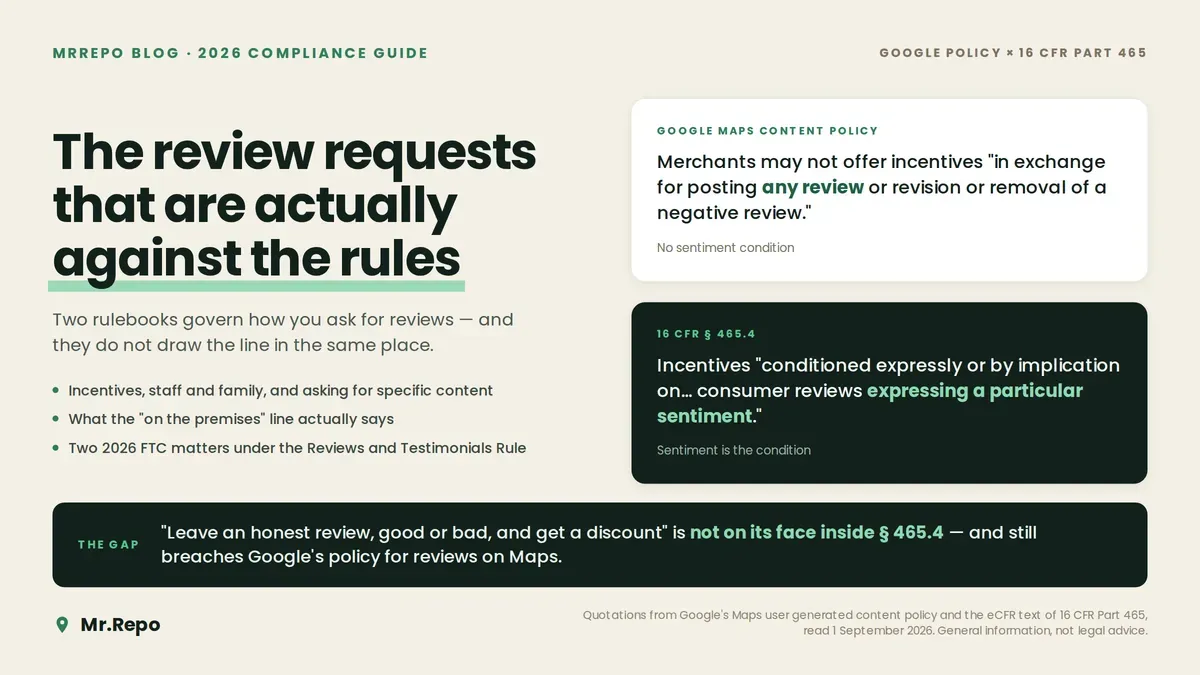
Google's policy governs what appears on Google Maps. The FTC's Reviews and Testimonials Rule, 16 CFR Part 465, reaches review practices anywhere, including your own website — § 465.4 names no platform at all. A request can clear one and fail the other.
This is general information about what two published rulebooks say, not legal advice.
Incentives: where the two rules diverge
Start with the discount.
Section 465.4 is narrower than it looks. The whole section is one sentence: it is an unfair or deceptive practice for a business "to provide compensation or other incentives in exchange for, or conditioned expressly or by implication on, the writing or creation of consumer reviews expressing a particular sentiment, whether positive or negative, regarding the product, service, or business that is the subject of the review."
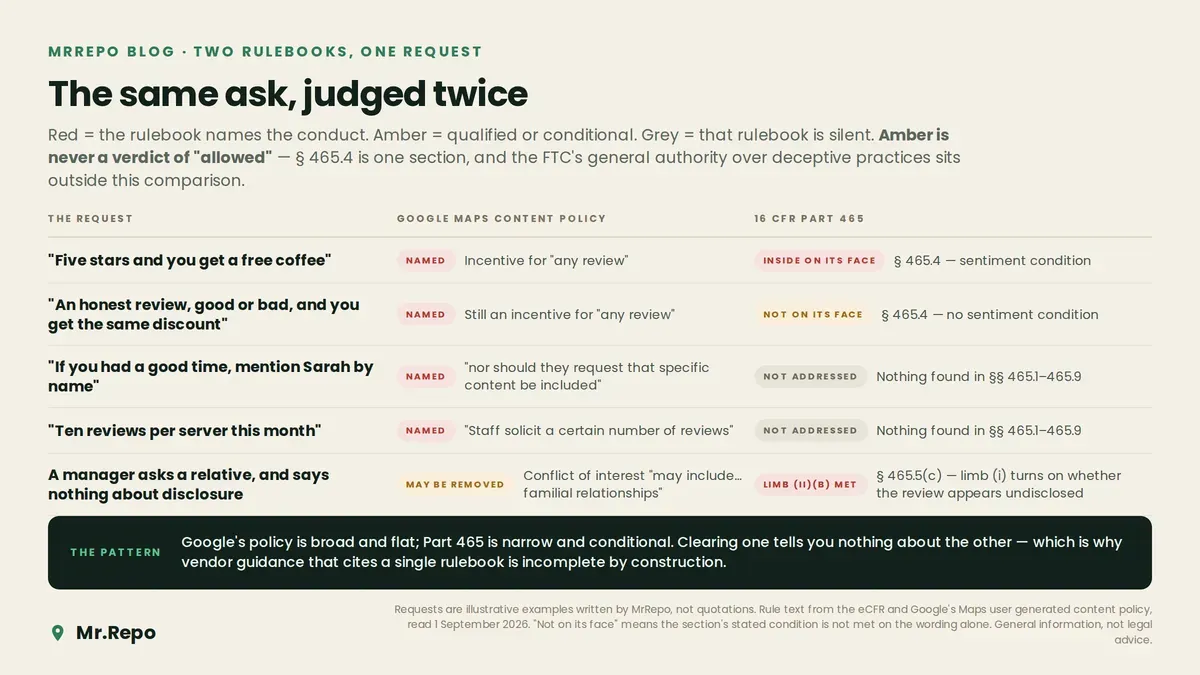
The condition is the sentiment. "Leave us a five-star review and get a discount" is on its face inside § 465.4. "Leave us an honest review, good or bad, and get the same discount" is not inside it on its face, because the incentive is not conditioned on what the review says.
Two things stop that from being a loophole. Section 465.4 reaches incentives conditioned "expressly or by implication," so dropping the words "five-star" from a sign beside your rating does not automatically remove the condition. And § 465.4 is one rule among many; the FTC's general authority over deceptive practices is separate, and an undisclosed incentive can raise questions this section never reaches.
Google's policy has no sentiment condition at all. Its Maps content policy says merchants may not "Offer incentives – such as payment, discounts, free goods and/or services - in exchange for posting any review or revision or removal of a negative review." Any review.
So a sentiment-neutral discount outside § 465.4 on its face still breaches Google's policy for reviews on Maps.
What enforcement looked like in 2026. In April 2026 the FTC took action against Vanilla Chip LLC (d/b/a TruHeight) and two individuals. The FTC alleged the company "offered consumers free and discounted products in exchange for leaving 5-star reviews on its own website and on third-party platforms," alongside thousands of website reviews it alleged were written by employees posing as customers. The complaint charged violations of the FTC Act and the Reviews and Testimonials Rule; a final order followed in July 2026.
The alleged incentive was tied to five-star reviews — an express sentiment condition, exactly what § 465.4 describes. And the order's $4 million judgment, partially suspended on inability to pay, covers a matter that was mostly about unsubstantiated health claims for children's supplements. It is not a price tag for a review violation.
Asking staff and family
Google names employment among possible conflicts of interest. Its policy lists, among content that will be removed, "Content that is based on a conflict of interest," and says a conflict "may include current or former employment, a contractual or consultory relationship, or other professional or personal affiliations that demonstrate a conflict of interest (such as industry competitors, familial relationships, etc.)." That language is illustrative, not exhaustive, but it names employment and family.
Section 465.2(c) is conditional. It covers a business procuring a review about itself or one of the products or services it sells, from "its officers, managers, employees, or agents, or any of their immediate relatives," for posting on a third-party platform or website — but only "when the business knew or should have known that the review materially misrepresented" that the reviewer exists, that they used the product or service, or what their experience was. An accurate review from an employee who genuinely ate at the restaurant does not meet that condition.
Section 465.5(c) is the one most guidance misses. It applies to an officer or manager who solicits a review from an immediate relative, employee or agent. It bites only when both limbs are met: the request produces a review posted without a disclosure of the relationship, and the officer or manager either encouraged non-disclosure, "did not instruct that prospective reviewers disclose clearly and conspicuously their relationship to the business," or knew or should have known of the undisclosed review and failed to take remedial steps. Paragraph (c)(2) exempts generalized solicitations to purchasers.
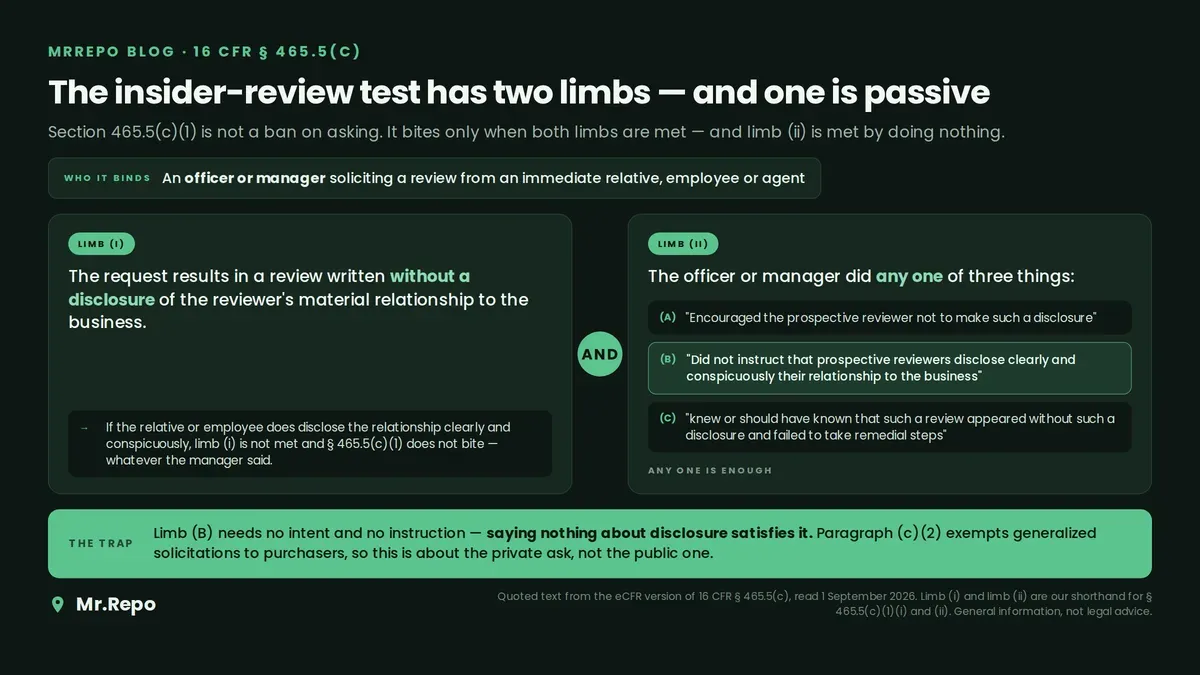
A manager who texts their brother "could you leave us a review?", never mentions the connection, and gets an undisclosed five stars has met both limbs. Silence is not a neutral position here: under limb (ii)(B), whether the reviewer was instructed to disclose is itself one of the triggers.
In United States and State of Illinois v. B.E.S.T. GDR, LLC, et al., d/b/a Premium Home Service, filed in the Northern District of Illinois in May 2026, the complaint alleges violations of the Rule "by writing, creating, buying, or selling fake reviews and seeking and using fake reviews from employees and relatives." Those are unproven allegations, and the reviews at issue were alleged to be fake — not authority that asking a real employee for an honest, disclosed review is unlawful.
Asking for specific content — Google's rule alone
Google's policy says that when soliciting reviews, merchants "should not require or pressure users to leave ratings or write reviews while on the premises, nor should they request that specific content be included." It gives two examples, both about what owners tell staff to do: "Merchants requesting that staff solicit a certain number of reviews" and "Merchants requesting that staff solicit reviews that include specific content, including content that identifies a staff member."
"If you had a good time, mention Sarah by name" sounds harmless. It is also, on the face of Google's policy, a request that specific content be included.
We read all of 16 CFR Part 465 — §§ 465.1 through 465.9, with 465.3 reserved — and found nothing addressing what you may ask a reviewer to include.
What the "on the premises" line actually says
The same sentence is misquoted as "Google doesn't allow you to ask for reviews in your store."
The operative verbs are require or pressure. Asking is not requiring, and Google's own Business Profile help page tells owners they can ask customers to scan a QR code. Two honest caveats: "while on the premises" is grammatically ambiguous about whether it attaches to the pressure or to the leaving of the review, and this bullet is phrased "merchants should not" while the list it sits in is headed "We do not allow merchants to." Google does not explain that difference on either page we read.
What the verbs reach is the hard version: a staff member watching someone type, a handset passed across the counter with the form already open, or anything a customer would reasonably experience as pressure.
Google's policy also bars selective solicitation, prohibiting merchants from "Discourage or prohibit negative reviews, or selectively solicit positive reviews from customers." We covered that at length in review gating.
Four requests to retire
These are our own heuristics; the line under each names its source.
Any offer, and especially any offer naming a rating. Google's bar covers any review; § 465.4 turns on sentiment.
Scripts that specify content. Google's policy says merchants should not request specific content, and names content identifying a staff member.
Per-person review targets. Google names staff review quotas as an example.
Officers or managers asking relatives or staff without mentioning disclosure. Under § 465.5(c), not instructing is a trigger when the review appears undisclosed.
What Google says it does allow
Google allows merchants to "Solicit or encourage the posting of content that does represent a genuine experience, without offering incentives to do so or attempting to influence the rating or the contents of the review."
Three conditions — genuine experience, no incentive, no influence on rating or content. Our scripts and templates guide has the wording; where you put the QR code covers placement. Our responding to negative reviews guide covers the aftermath.
It is also why MrRepo shows every customer the same thing. A scan opens one screen with two equal options — a public Google review, or private feedback straight to the owner and published nowhere — with no question in front of it deciding who sees which. Nobody is filtered by predicted sentiment and nothing is offered in exchange. That is, on its face, the "solicit or encourage… content that does represent a genuine experience" conduct Google says it allows: no incentive, no influence on rating or content.
Frequently asked questions
Can I offer a discount for an honest review, positive or negative? Not if the review goes on Google — its policy bars incentives "in exchange for posting any review," with no sentiment condition. Under § 465.4, which turns on incentives conditioned on reviews "expressing a particular sentiment," a genuinely sentiment-neutral offer is not inside that section on its face. It may still raise issues under the FTC's broader deception authority, which this post does not analyse.
Can I ask my employees to leave a review? Employment is among the conflicts of interest Google may remove content for. Under the FTC rule, § 465.2(c) is conditional on the business knowing the review misrepresented something material; § 465.5(c) binds officers and managers and turns on disclosure.
Is it against the rules to ask for a review in my shop? Google's policy says merchants "should not require or pressure users" to leave reviews while on the premises, and its Business Profile help page tells owners they can ask customers to scan a QR code. The wording targets pressure, not asking; its grammar is ambiguous.
Can I ask customers to mention a specific staff member? Google's policy names that example directly. We found nothing on it in Part 465.
What are the actual penalties? Google's policy says violating content "will be removed from Maps." On the FTC side, 16 CFR § 1.98 currently sets the maximum civil penalty under Section 5(m)(1)(A) of the FTC Act at $53,088 — a maximum per violation, not a standard amount, and civil penalties under that provision require a knowing violation.
Key takeaways
Asking is allowed: Google's help page tells owners they can use a link or a QR code.
The two rulebooks diverge on incentives: Google bars them for any review; § 465.4 turns on sentiment.
The FTC's insider provisions are conditional, and one condition is passive: under § 465.5(c), an officer or manager who does not instruct a relative or employee to disclose has met one of the triggers.
On requesting specific content, Google's policy says merchants "should not," and names staff quotas as an example. We found nothing on it in Part 465.
The premises rule addresses requiring and pressuring, not asking. Google's permission reduces to three conditions: a genuine experience, no incentive, no influence on rating or wording.