Competitor Analysis With Google Reviews: What Four Comparisons Can Tell You, and What They Cannot
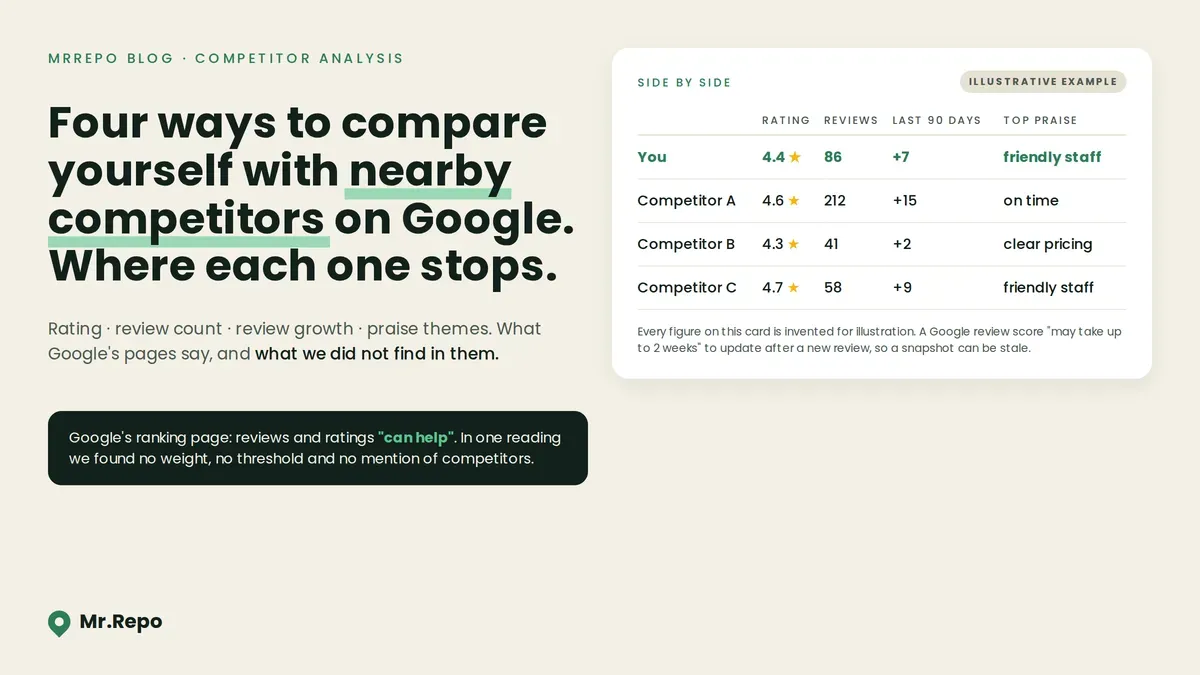
On Google Maps, your profile can appear beside other businesses' star ratings and review counts. A competitor analysis built on Google reviews works from that same public information.
This post takes four comparisons an owner can make from public reviews (rating, review count, review growth and review themes) and asks two things of each. What does a source we can quote say about it? And where does the comparison stop being evidence?
A disclosure first. MrRepo sells a tool that includes a Competitor Analysis feature, described near the end. As with any vendor's page, the quotations can be checked against the sources listed at the bottom.
What Google's ranking page says, and what we did not find in it
Google's help page on local ranking says: "Local results are mainly based on relevance, distance, and popularity." The same page defines a factor it calls prominence (its list says "popularity"): "Prominence means how well-known a business is." It also says: "This factor's also based on info like how many websites link to your business and how many reviews you have." And: "More reviews and positive ratings can help your business's local ranking."
Two limits apply. Its "can help" names no weight and no threshold, in our reading. And in one reading of that page we did not find the word competitor, nor a sentence comparing your review count with anyone else's. We also ran two site-restricted searches for such a statement from Google and found none. The same page says: "There's no way to request or pay for a better local ranking on Google."
We treat a competitor analysis as a description of public information, not a ranking calculator.
Comparison 1: the star rating
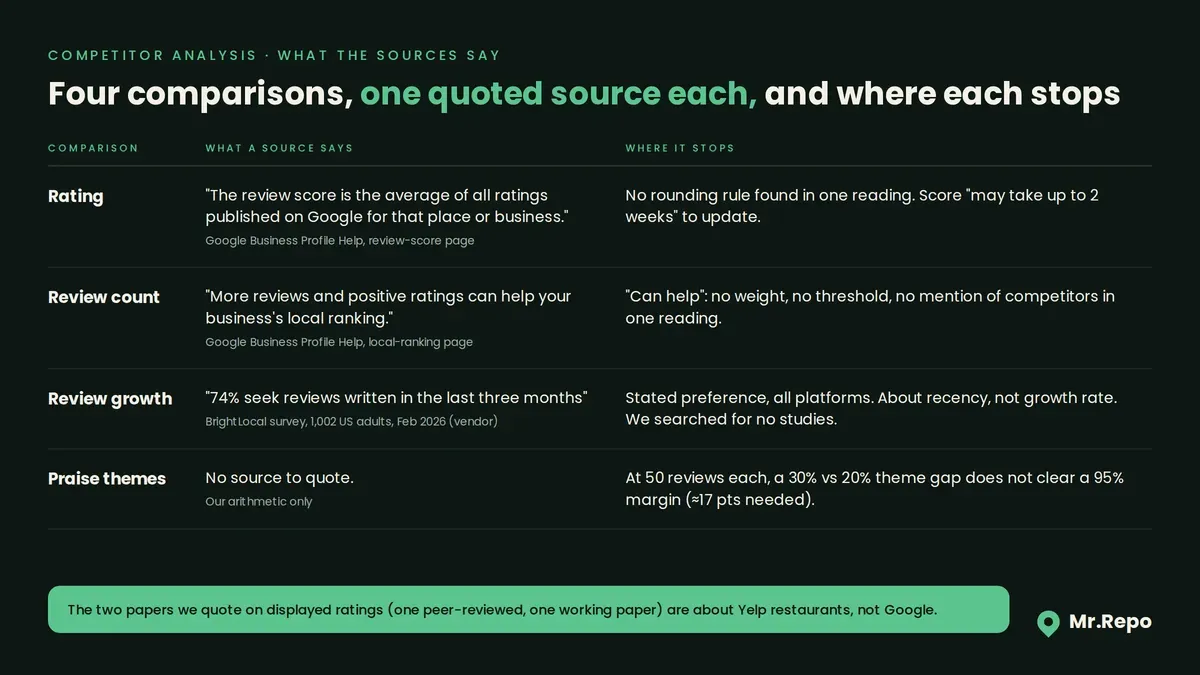
Google's review-score page says: "The review score is the average of all ratings published on Google for that place or business." In one reading of that page we found no mention of rounding or weighting, so we state no rounding rule.
The same page also says: "After someone leaves a new review, it may take up to 2 weeks to get an updated review score." A snapshot of your score beside a rival's may be out of date. We treat a small gap seen once as a reading to repeat, not a result.
Does a displayed rating change what customers do? The studies we can quote are about Yelp and restaurants, not Google. Anderson and Magruder (2012), in The Economic Journal, used Yelp's half-star rounding and report: "An extra half-star rating causes restaurants to sell out 19 percentage points (49%) more frequently, with larger impacts when alternate information is more scarce." Their paper describes 328 San Francisco restaurants observed from July to October 2010. The outcome was reservation availability, not revenue. A Harvard Business School working paper by Luca (2011, revised 2016), not peer-reviewed, reports from 2003–2009 Seattle restaurant data that "a one-star increase in Yelp rating leads to a 5-9 percent increase in revenue", that "this effect is driven by independent restaurants", and that "ratings do not affect restaurants with chain affiliation".
Neither study is about Google, and Anderson and Magruder compare no named rivals. The narrow point: for Yelp restaurants, the displayed rating affected sell-outs in one study and revenue in the other. These papers do not test a plumber on Google Maps.
What do consumers say? BrightLocal, which sells local SEO tools, surveyed a panel of 1,002 US adults for its Local Consumer Review Survey 2026; the page gives no field dates or question wording. In that survey, 31% said they will only use a business rated 4.5 stars or more. That is a stated preference covering all review platforms, not measured behaviour and not a Google rule. One reading, ours and not the survey's: a hypothetical 4.4 and 4.6 fall on opposite sides of the 4.5 that 31% of respondents named.
What it costs to close a rating gap
This part is arithmetic, not research. To lift a true average from R to a target T with five-star ratings only, you need N × (T − R) ÷ (5 − T) new ratings, where N is your current count of ratings. From 4.4 to 4.6 that is N ÷ 2: 20 at 40 ratings, 40 at 80, 100 at 200. It assumes every new rating is five stars and none is removed, which we would not expect. We worked through the formula in our star-rating maths post. On those assumptions, the more ratings you already have, the more a given decimal gap takes to close.
Comparison 2: the review count
Google's prominence sentence names "how many reviews you have" among the info it uses; "can help" names no weight or threshold in our reading. On the consumer side, BrightLocal reports that "47% of consumers won't use a business with fewer than 20 reviews, and only 9% are willing to use one with five or fewer." Again: a vendor's US stated preference, all platforms, not a Google threshold.
A count tells you how many reviews are published, not how they were obtained. Google's Maps content policy lists under "Fake engagement": "Reviews or ratings that have been paid for, directly or in kind." The policy applies to any count, including yours. A count comparison cannot tell you whether the reviews on either side meet that policy.
Comparison 3: review growth
Growth is the change in a count over time. Google's ranking page, as we read it, does not mention review recency or the rate at which reviews arrive. We ran no search for studies of review growth and ranking, so we make no claim about either.
What we can quote is a consumer preference: in the same vendor survey, "74% seek reviews written in the last three months". That figure is about recency, not growth rate, and it is a stated preference across all platforms.
We treat a rival's growth as a reason to check our own request routine, not as a number to chase.
Comparison 4: what customers praise
We can quote no source on reading a competitor's reviews for recurring praise (say, punctuality or clear pricing). What we can offer is arithmetic on how little a small batch of reviews supports.
Suppose, as a made-up example, you sort 50 of your reviews and 50 of a competitor's by theme, and friendly staff appears in 30% of yours and 20% of theirs. Assuming random samples, the gap needed to exceed the 95% margin of error on the difference is about 17 percentage points at 50 reviews each, about 12 at 100, and about 8 at 200. Of those sizes, the 10-point gap here clears it only at 200.
Two cautions belong with those figures. They are our arithmetic, not a published benchmark. And reviews are self-selected, not a random sample of customers: the formula is a floor on uncertainty. See also the review benchmarks post.
We use themes qualitatively: one common in a competitor's reviews and absent from yours is a question for your own customers, not a finding.
A line Google's policy draws
Google's Maps content policy lists, among things it does not allow: "Post content on a competitor's place or business to undermine that business' or product's reputation." The sentence we retrieved governs posting, not reading. Competitor analysis is reading; posting on a competitor's profile to undermine it is what that clause names.
Working practices we use (our heuristics, not research findings)
Pick competitors your customer would see. Search your main service from the area where your customers are and note who appears beside you.
Record the date with every reading.
Compare counts and ratings together. Use the arithmetic above to translate a decimal gap into ratings.
Read themes as questions. At 50 reviews each, as in our example, differences are descriptive.
Change only your own inputs. How often you ask, how you reply, what you fix.
How MrRepo's Competitor Analysis fits
Our features page describes it this way: "Mr.Repo finds competitors near you on Google. Pick three to track and compare ratings, review counts and review growth side by side, see when a rival overtakes you, and find out which themes customers praise in their reviews and in yours." The page lists it as available on all plans.
That description names the four comparisons in this post. The feature carries this post's limits too: three competitors describe three businesses, not your market; any Google review score compared may lag by up to two weeks; and we read themes as prompts for questions. We make no claim that tracking competitors changes your ranking, your rating or your revenue. The description is on the features page.
FAQ
Does Google rank my business against my competitors' review counts? Google's ranking help page says "More reviews and positive ratings can help your business's local ranking." In one reading of that page and two site-restricted searches, we found no statement that your count or rating is compared with a competitor's.
How many competitors should I track? We did not search for research on this, so we have no sourced answer. Three is what MrRepo's feature tracks, not a recommendation. With any small number, we treat the results as describing those businesses, not your market.
A competitor's rating is 0.2 higher than mine. Does that matter? In a survey of 1,002 US adults by BrightLocal, a local SEO vendor, 31% said they will only use a business with 4.5 stars or more. Whether a gap across 4.5 matters more is our inference. That is an all-platform stated preference, not behaviour. Closing a 4.4 to 4.6 gap takes half your current count in five-star ratings, if every new rating is five stars and none is removed.
Can I post on a competitor's profile? Google's Maps content policy lists as not allowed posting content "on a competitor's place or business to undermine that business' or product's reputation." That clause governs posting, not reading.
Is there a study showing competitor review tracking works? In two web searches we found no peer-reviewed study that tests Google-review competitor benchmarking for small local businesses. The studies quoted here are about Yelp and restaurants.
Key Takeaways
Google's ranking page says more reviews and positive ratings "can help"; one reading found no mention of competitors or a threshold in it.
Google's review-score page defines the score as an average of published ratings and says an updated score "may take up to 2 weeks". We date every comparison.
The peer-reviewed evidence we quote, that a displayed rating affected restaurant sell-outs, is from Yelp in San Francisco in 2010, not Google.
BrightLocal's 4.5-star and 20-review figures are US stated preferences from a vendor survey, not Google rules.
Google's ranking page, as we read it, does not mention review growth; we searched for no studies of it.
In our 30%-versus-20% made-up example at 50 reviews each, a gap needs about 17 points to clear a textbook 95% margin; real uncertainty is no smaller. We read themes as questions.