The Review Rules That Reach Your Own Website — Not Just Google
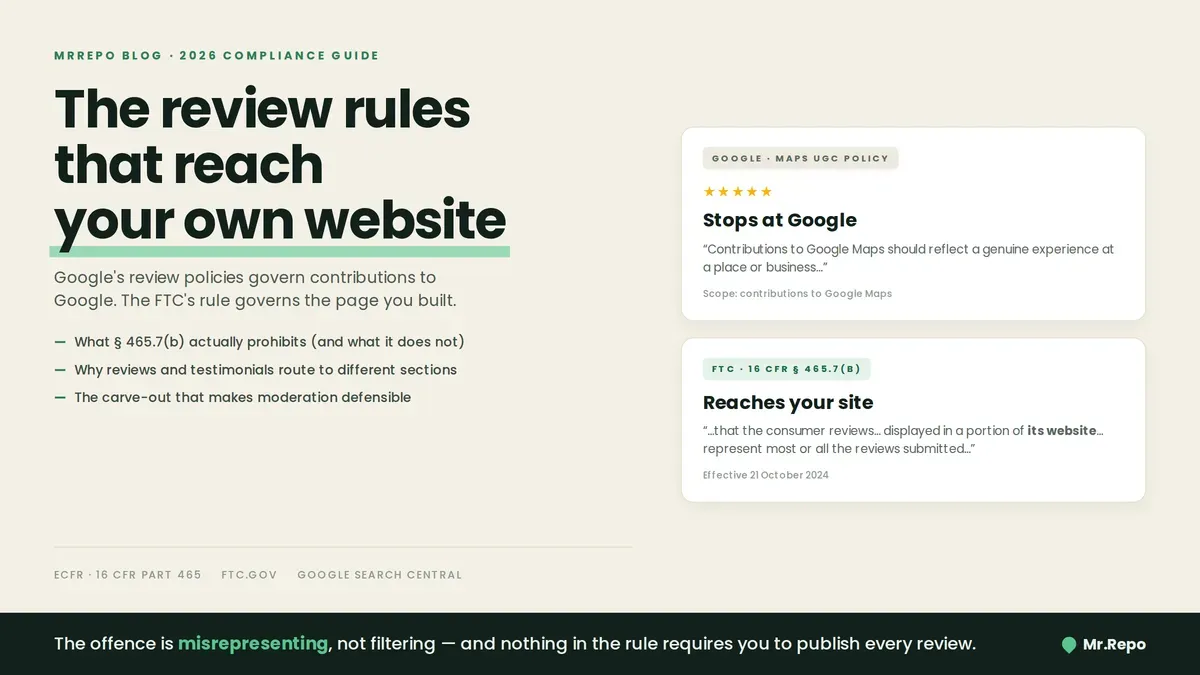
Review compliance guidance tends to be about Google: what you may ask for, what you may not offer, what gets a profile suspended. But a second set of rules applies to a surface you control — your own website, its testimonials page, the star widget in the footer.
Google's rules stop at Google. The FTC's do not.
What Google's review policies do — and do not — govern
Google's Maps user-generated content policy opens by saying that "Contributions to Google Maps should reflect a genuine experience at a place or business, and a review or rating should reflect an actual experience with a business, and be genuine and unbiased." We searched that policy, Google's Business Profile policy hub and its developer domains on 2 September 2026 for a rule governing which of your reviews you display on your own site. We found none.
Google reaches your website in two narrow ways, and neither is about which reviews you show. Its review snippet documentation, last updated 24 July 2026, states that "If the entity that's being reviewed controls the reviews about itself, their pages that use LocalBusiness or any other type of Organization structured data are ineligible for star review feature" — an eligibility rule, not a penalty and not a conduct rule (review widgets). And if you pull Google's review data through the Places API, those developer terms require a "clear notice that describes how reviews are being ordered and filtered".
The FTC rule that names your website
The FTC's Rule on the Use of Consumer Reviews and Testimonials, 16 CFR Part 465, took effect on 21 October 2024. Several of its sections name conduct on a business's own site. Read § 465.7(b) in full. It is an unfair or deceptive act or practice and a violation, the section says, "For a business to materially misrepresent, expressly or by implication, that the consumer reviews of one or more of the products or services it sells displayed in a portion of its website or platform dedicated in whole or in part to receiving and displaying consumer reviews represent most or all the reviews submitted to the website or platform when reviews are being suppressed (i.e., not displayable) based upon their ratings or their negative sentiment."
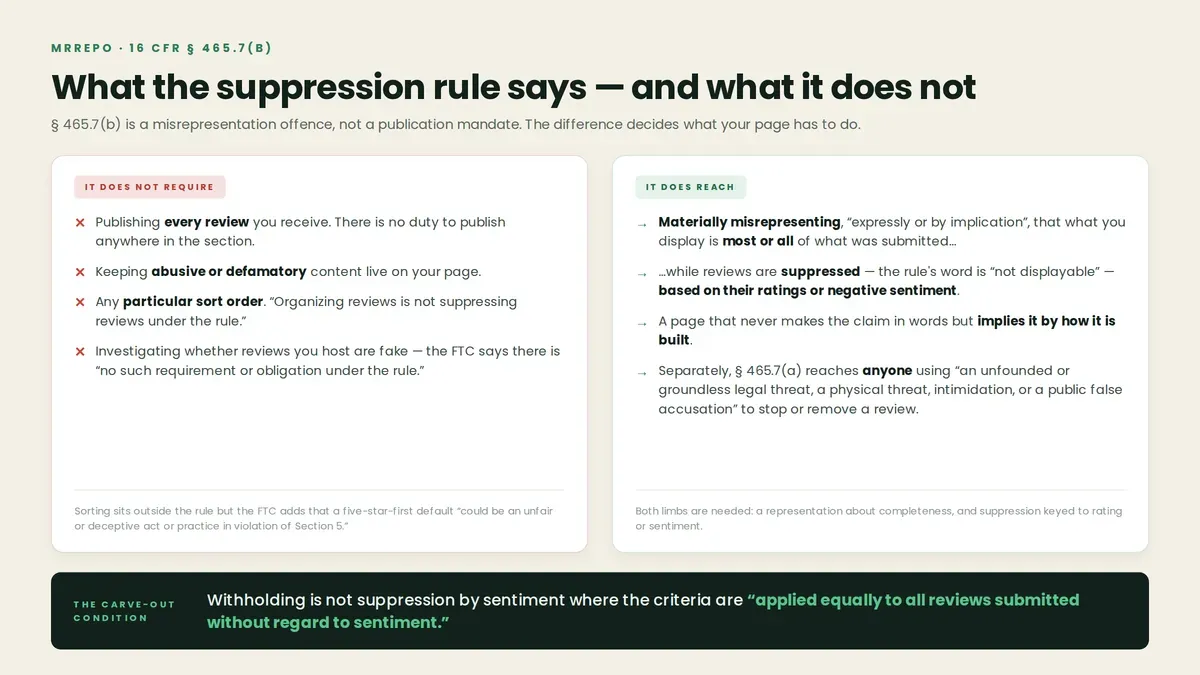
The offence is misrepresenting, not filtering. Nothing in § 465.7(b) requires you to publish every review you receive. What it names as an unfair or deceptive act is materially holding out a filtered set as though it were most or all of what came in — and "or by implication" means a page that never makes the claim in words can still make it by how it is built.
The section then carves out a wide category of filtering. A review is not considered suppressed based on rating or negative sentiment "if the suppression occurs based on criteria for withholding reviews that are applied equally to all reviews submitted without regard to sentiment, such as when" it contains confidential commercial or financial information, defamatory or abusive content, another person's personal information or likeness, discriminatory content, or content that is clearly false or misleading; when the seller reasonably believes it is fake; or when it is wholly unrelated to what the site sells. "Such as when" makes that list illustrative rather than exhaustive. A moderation policy that only ever removes one-star reviews is not sentiment-blind.
Sorting is a different question, and the FTC answers it in its guidance for the rule: "Organizing reviews is not suppressing reviews under the rule." On a default sort that puts five-star reviews on top, it says "The rule does not cover that situation" — while adding, in the same answer, that such a default "could be an unfair or deceptive act or practice in violation of Section 5 of the FTC Act." Outside the rule is not outside the law.
One neighbouring section runs the other way on surface: § 465.2(c), on procuring reviews from staff and their immediate relatives, is expressly limited to posting "on a third-party platform or website." We covered the requesting side in the review requests that are actually against the rules.
What this looked like before the rule existed
In January 2022 the FTC announced that Fashion Nova would pay $4.2 million to settle allegations that it "misrepresented that the product reviews on its website reflected the views of all purchasers who submitted reviews, when in fact it suppressed reviews with ratings lower than four stars out of five." According to the FTC, from late 2015 until November 2019 it did not approve or publish "hundreds of thousands of lower-starred, more negative reviews."
It settled allegations rather than establishing liability in court, and it concerned an online apparel retailer's own product review section, not a local service business. It was brought under Section 5 of the FTC Act, because Part 465 did not exist yet.
The conduct § 465.7(b) now names was already actionable as ordinary deception. The rule did not create the exposure; it made it explicit, and added a civil penalty route. Under 16 CFR § 1.98 the maximum penalty under Section 5(m)(1)(A) of the FTC Act is $53,088 per violation, and penalties on that route require a knowing violation.
Reviews and testimonials route to different sections
Part 465 defines a "consumer review" by submission and surface: a consumer's evaluation "submitted by the consumer or purported consumer" and "published to a website or platform dedicated in whole or in part to receiving and displaying such evaluations." A "consumer testimonial" is defined instead as "an advertising or promotional message" that consumers are likely to believe reflects a real customer's experience.
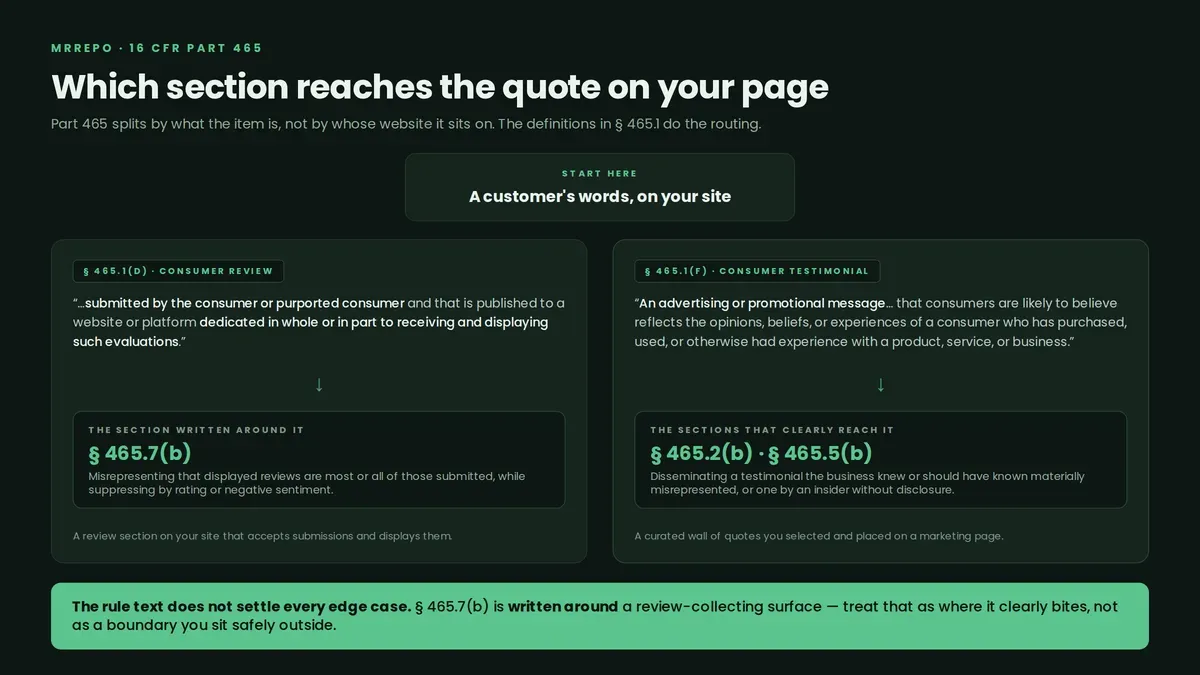
So a review section that accepts submissions and displays them is the surface § 465.7(b) is written around. A curated wall of quotes on your homepage reads as advertising, and the sections that clearly reach it are § 465.2(b) and § 465.5(b). The FTC puts it plainly: "A business that puts testimonials on its own website is disseminating them and is not merely 'hosting' them. If those testimonials are fake or false, the business could be liable." Under § 465.2(b), disseminating a testimonial about what you sell that the business "knew or should have known" materially misrepresented, "expressly or by implication," the person's existence, their use of your service, or their experience is a violation of the part.
§ 465.5 handles quotes that came from inside the business. Paragraph (a) binds officers and managers who write a review or testimonial about the business or what it sells without a clear and conspicuous disclosure of their material relationship to it — with an escape for testimonials only, and only where the relationship "is otherwise clear to the audience." Paragraph (b)(1) binds the business for disseminating such a testimonial by "one of its officers, managers, employees, or agents" without that disclosure, where the relationship is not otherwise clear to the audience and the business knew or should have known. Under § 465.5, employees are reached through the business that publishes the quote, not directly.
Finally, § 465.6 reaches materially misrepresenting, "expressly or by implication," that a website you control "provides independent reviews or opinions, other than consumer reviews", about a category that includes your own business. Those four words matter: it is not a ban on running a review site. It addresses holding out an "independent" comparison you own and appear in.
Four working rules for your own site
These are our own working heuristics, not a legal test, and not a substitute for advice on your setup.
Write your moderation criteria down before you need them. The carve-out turns on criteria "applied equally to all reviews submitted without regard to sentiment." Criteria you can produce are easier to show were applied equally than criteria you improvised.
Check what your page implies, not only what it says. The words "expressly or by implication" are in the text. A widget captioned "Our reviews" implies it is showing them.
Label the internal ones. If a quote came from an officer, manager, employee or agent, say so next to it.
Keep the source visible. If a testimonial is a real customer's words, record where and when they said it.
Where MrRepo sits in this
MrRepo puts a QR code in front of the customer and lets them choose: leave a public Google review, or send private feedback to the business. Both options are shown, with no screening question in front of them (review gating).
It is fair to ask how private feedback sits against § 465.7(b), which addresses materially misrepresenting what a review-display surface shows. Feedback a customer chose to send privately, into a channel that is not a public review surface, is not on its face the surface that provision describes. What a routing tool has to keep answering is whether the choice is genuinely equal at the moment the customer makes it, and whether anything you publish elsewhere implies a completeness it does not have. Worth asking of any tool, ours included — the interactive demo shows the flow.
Frequently asked questions
My site just embeds a Google reviews widget. Does any of this apply? Whether an embedded widget is a portion of your site "dedicated in whole or in part to receiving and displaying consumer reviews" is not something the rule text settles, so do not treat it as putting you outside § 465.7(b). Google's structured-data rule does apply: a page carrying LocalBusiness or Organization markup with reviews the entity controls is ineligible for the star review feature.
Can I remove an abusive review from my own website? The carve-out covers withholding criteria "applied equally to all reviews submitted without regard to sentiment," and lists defamatory, harassing, abusive, obscene, vulgar or sexually explicit content among its examples. The carve-out holds only if the same policy applies to an abusive five-star review.
A review on our site names one of our staff. Can we take it down? Nothing in § 465.7(b) grants or withholds a right to remove a review; it addresses misrepresenting that what a review surface displays is most or all of what was submitted. Its illustrative list does include a review containing another individual's "personal information or likeness," but only where the criterion is "applied equally to all reviews submitted without regard to sentiment."
My manager wrote one of the quotes on our homepage. Is that a problem? § 465.5(a) reaches an officer or manager writing a review or testimonial without a clear and conspicuous disclosure of their material relationship — unless, for a testimonial only, it is otherwise clear to the audience. § 465.5(b)(1) reaches the business for publishing such a testimonial where the relationship is not otherwise clear to the audience and the business knew or should have known.
Has the FTC brought a case under § 465.7? We searched on 2 September 2026 and found no FTC enforcement action brought specifically under § 465.7. Part 465 has been charged in other matters, and Fashion Nova shows the FTC pursuing review suppression under Section 5 before the rule existed. The absence of a case under one section is not a safe thing to build on.
Key takeaways
Google's review policies govern contributions to Google. Part 465 reaches what you publish on your own website. Only one of the two rulebooks is federal law.
§ 465.7(b) is a misrepresentation offence, not a publication mandate. The question is whether a review surface materially holds out a filtered set as most or all of what you received.
Its carve-out is broad, and its condition is one phrase: criteria "applied equally to all reviews submitted without regard to sentiment."
Reviews and testimonials are different things under the rule and route to different sections. § 465.2(b) and § 465.5(b) clearly reach testimonials on your own site.
The FTC pursued review suppression on a business's own site under Section 5 in 2022, before Part 465 existed.