Three Counts Show AI Assistants Citing Directories. We Found No Controlled or Peer-Reviewed Study Linking Listings to Recommendations.
Mr.Repo Team · 9 min read ·
Three companies have counted the web pages that AI assistants cite. Directory listings appear in all three counts. Each company also sells local SEO, listings or citation services, so the counts deserve a close reading: what each one measured, who ran it, and what, in what we read, none of them tested.
This post is for the owner deciding whether to pay for directory listings on AI grounds. The short version: the counts are published, they use different categories, each publisher sells marketing services, and none, in what we read, tests whether directory listings change which businesses an assistant recommends. MrRepo sells a tool for collecting Google reviews and private feedback; read us the same way.
What "cited" means here
When an assistant answers "who is a good plumber near me," it may list web pages it drew on. Those are citations. A count of citations tells you which pages were listed. It is not a test of why a business was named.
Count one: Steady Demand, Gemini and ChatGPT
Ben Fisher of Steady Demand, a local SEO agency, published "What AI Actually Cites" on August 6, 2026 (updated September 9, 2026). He describes asking Gemini "questions 1,500 times across 50 U.S. metros and 10 local-service categories, logged every real source it grounded its answers in, pulled out the actual businesses it recommended, and checked their real Google ratings."
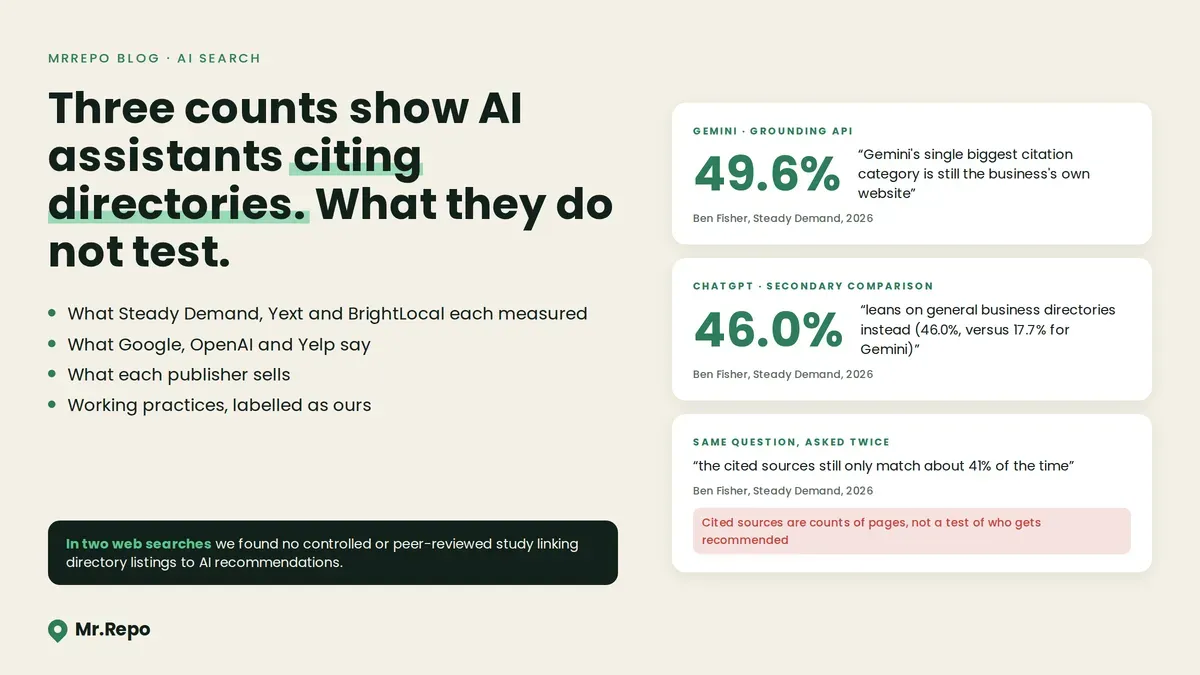
"Gemini's single biggest citation category is still the business's own website (49.6%, down from 58.8% in July)."
"ChatGPT barely goes there at all (10.5%) and leans on general business directories instead (46.0%, versus 17.7% for Gemini)."
His page does not name which directories ChatGPT cited.
Two more results:
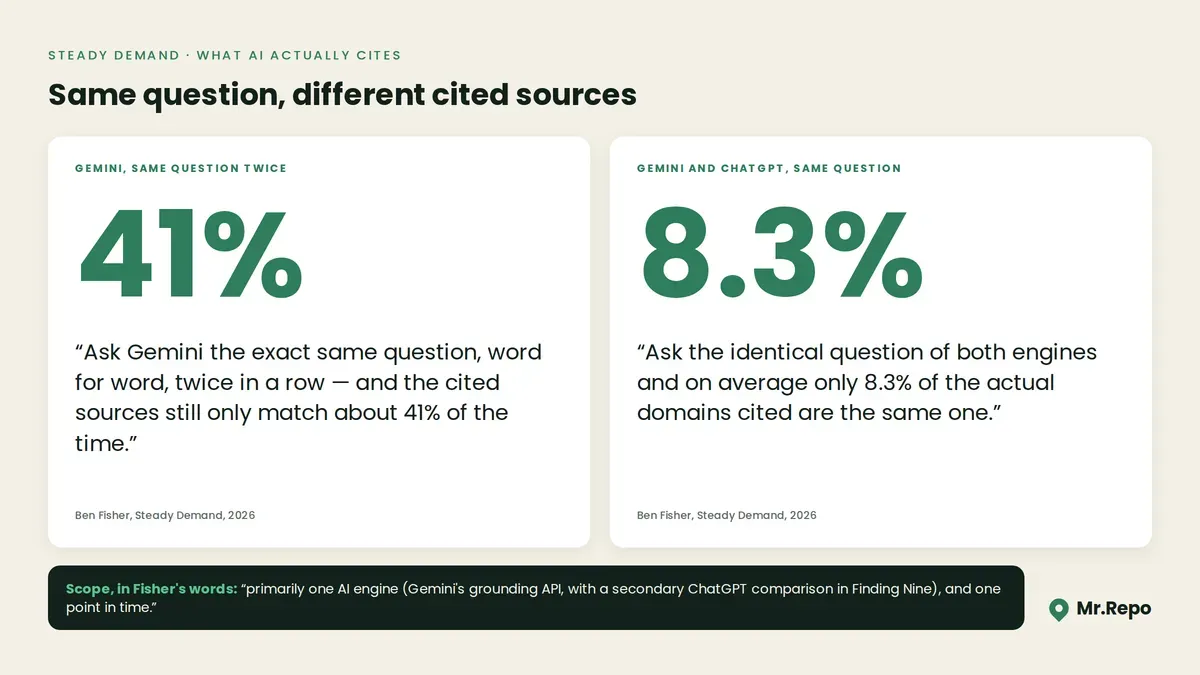
"Ask Gemini the exact same question, word for word, twice in a row — and the cited sources still only match about 41% of the time."
"Ask the identical question of both engines and on average only 8.3% of the actual domains cited are the same one."
Fisher states the scope: "This analysis covers the 50 largest U.S. metros, primarily one AI engine (Gemini's grounding API, with a secondary ChatGPT comparison in Finding Nine), and one point in time." That is the grounding API, not the consumer app.
This count does log recommended businesses, and what it reports about them is their Google ratings: "98% of recommended businesses sit at 4.0 stars or better, 91% at 4.5+". Fisher puts the average Google rating at 4.76 for recommended businesses and 4.82 for his plain-search baseline. In two readings of the page, it does not compare businesses by directory presence.
Count two: Yext, three assistants
Yext's Oct. 9, 2025 press release describes its sample: "The results in this report are based on an analysis of 6.8 million AI citations collected from 1.6 million queries per model across ChatGPT (OpenAI), Gemini (Google), and Perplexity between July 1 and August 31, 2025."
It says: "The research shows that 86% of citations come from sources brands already control, such as websites and listings." The breakdown: "First-party websites generated 2.9M citations (44%), ahead of listings (2.9M / 42%) and reviews/social (545K / 8%)." And by assistant: "Gemini favors websites (52.1%), OpenAI leans on listings (48.7%), and Perplexity diversifies across MapQuest and TripAdvisor."
Three cautions. First, Yext files directory listings under sources "brands already control"; the 86% includes listings. Second, the sample: "Data was gathered using the Yext Scout platform across thousands of client and prospect locations worldwide." Those are Yext's own client and prospect locations. Third, Yext sells listings management and sells Yext Scout. The press release states no limitations (we read the release, not the full report).
Count three: BrightLocal, four assistants
BrightLocal's Kate Herbert-Smith published "AI Search Makes Local Listings More Important Than Ever" on July 22, 2025. The method: "We performed 20 different searches across 10 different industry niches." One result: "Yelp was used as a source in 33% of our overall searches."
"Each search was repeated on Google AI Mode, Google Gemini, Perplexity AI, and ChatGPT Search". The article states no limitations. The same page advertises BrightLocal's Citation Builder service.
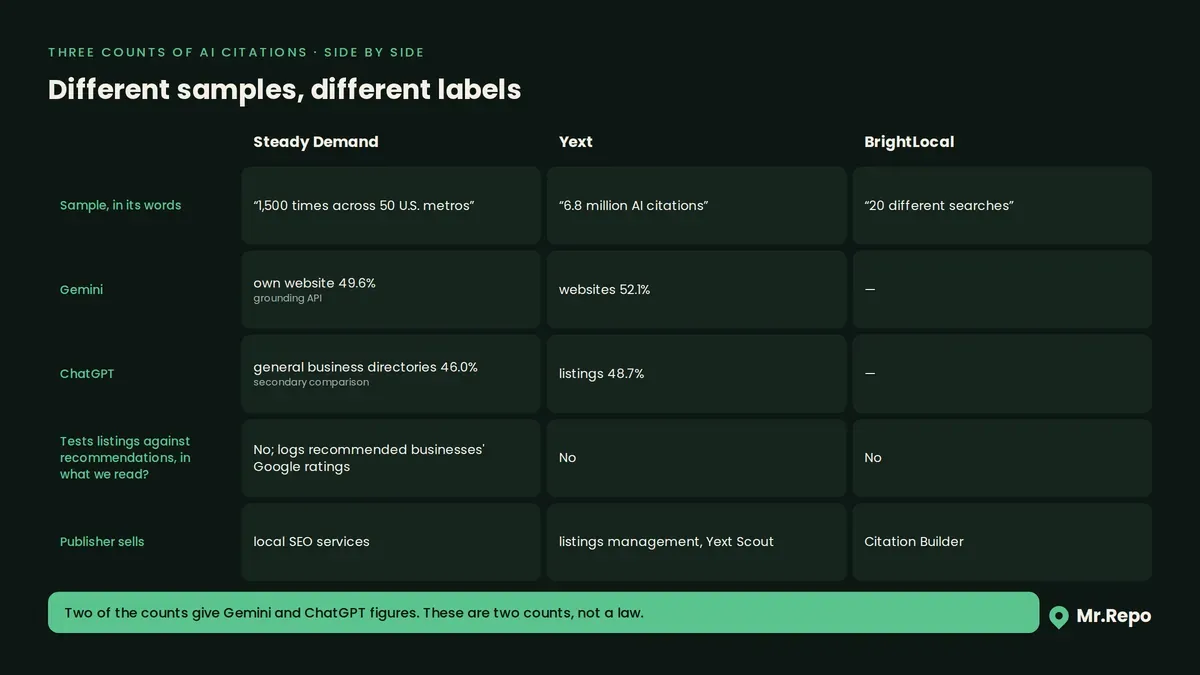
How the three counts compare
Steady Demand
Yext
BrightLocal
Sample
"1,500 times across 50 U.S. metros"
"6.8 million AI citations"
"20 different searches"
Gemini
own website 49.6% (grounding API)
websites 52.1%
—
ChatGPT
general business directories 46.0% (secondary comparison)
listings 48.7%
—
Tests listings against recommendations, in what we read?
No; logs recommended businesses' Google ratings
No
No
Publisher sells
local SEO services
listings management, Yext Scout
Citation Builder
Steady Demand and Yext use different category labels, samples and dates. For Gemini, Steady Demand reports the business's own website at 49.6% and Yext reports websites at 52.1%. For ChatGPT, they report general business directories at 46.0% and listings at 48.7%. These are two counts, not a law.
A preprint sorts sources differently. Chen, Wang, Chen and Koudas (arXiv:2509.08919, submitted 10 Sep 2025) write that "AI Search exhibit a systematic and overwhelming bias towards Earned media (third-party, authoritative sources) over Brand-owned and Social content" (sic, "exhibit"). Yext counts a directory listing as brand-controlled, so the two are not directly comparable, and we do not read either as refuting the other.
What Google, OpenAI and Yelp say
Google. Its Search Central page "AI features and your website" (last updated 2025-12-10) covers AI Overviews and AI Mode in Search. It says: "There are no additional requirements to appear in AI Overviews or AI Mode, nor other special optimizations necessary." Among the SEO fundamentals it lists: "Checking that your Merchant Center and Business Profile information is up-to-date". That page does not name Yelp, directories or citations. One web search also found no Google statement that third-party directory listings influence its AI answers about local businesses. That is an absence of a statement, not evidence either way.
OpenAI. Its help page says: "To provide relevant responses to your questions, ChatGPT search sometimes partners with other search providers." It also says: "It can also use location information to find local results, including restaurants, news, and weather." Its launch post of October 31, 2024 says ChatGPT search "leverages third-party search providers, as well as content provided directly by our partners". Neither page names a search provider or a local-data provider.
Yelp. On August 10, 2026, Yelp's Chad Richard wrote that its reservations and waitlist feature builds on "our existing content integration, which provides ChatGPT users with reliable local recommendations by surfacing Yelp's trusted reviews, ratings", along with photos and business details. That is Yelp's description, not OpenAI's; one search of openai.com found no OpenAI announcement. Yelp's post describes its content being surfaced. The post is a claim, not a test. Yelp sells advertising to businesses.
What the experts thought, labelled as opinion
Whitespark's 2026 Local Search Ranking Factors report, by Darren Shaw, says: "3 of the top 5 AI Search visibility factors are citation factors."
Here is how that number was made: "This edition, I added a new column to the factor scoring section of the survey." And: "For each factor, the experts also had to now score it based on what they thought the visibility impact was in AI search responses." The report also says: "None of the experts have special access to the internal workings of Google's local search algorithm." It is a survey of what invited practitioners thought, and the "3 of the top 5" sentence does not say which citation factors it means.
In Shaw's own example the score differs by assistant. Scoring a Google Business Profile factor, he writes: "I would score it a zero for ChatGPT, but might score it a 3 for Google's AI Mode & Gemini because Google would have access to this data while other LLMs would not." Whitespark sells a Listings Service.
What the three counts do not test
In two web searches we found no controlled or peer-reviewed study linking directory listings to which local businesses an AI assistant recommends. In what we read, none of the three counts tests whether directory listings change which businesses an assistant recommends.
So assistants cite directories is supported, with the caveats above. More directory listings will get you recommended by AI is not tested, in what we read, by any of the three counts.
Working practices (ours, not a finding)
In no priority order.
Keep your own website's facts current.
Keep your Google Business Profile current. Google's page lists it among SEO fundamentals.
Claim and correct your Yelp page if you have one. Yelp says its reviews and ratings are surfaced in ChatGPT. Correct is the goal; we make no claim about ranking there.
Ask the assistants about your own business, more than once. Note which pages they cite and whether the facts are right.
Be skeptical of a listings package sold for AI. Ask the seller which controlled or peer-reviewed study shows listings affect recommendations. In two web searches we found none.
Where reviews sit in this
Reviews appear in Yext's count, grouped with social: "reviews/social (545K / 8%)". Yelp names reviews and ratings among what it says ChatGPT surfaces. Our post AI Search Is Reading Your Reviews covers reviews and AI search. Nothing in this post tests whether reviews change which businesses an assistant recommends.
What MrRepo does: a QR code gives each customer the same two options, leave a public Google review or send feedback privately to you. We make no claim it affects AI answers. You can see the flow in the demo.
FAQ
Do AI assistants cite directory listings? Three counts of cited sources include them. Steady Demand reports ChatGPT citing "general business directories" at 46.0% in a secondary comparison; Yext reports "OpenAI leans on listings (48.7%)". Both figures count citations.
Will adding more listings get my business recommended by ChatGPT or Gemini? In two web searches we found no controlled or peer-reviewed study that tests it; in what we read, none of the three counts does.
Which does Gemini cite more, websites or directories? On Steady Demand's count, the business's own website was Gemini's largest citation category at 49.6%, from Gemini's grounding API; Yext reports "Gemini favors websites (52.1%)". Two counts, two companies.
Has Google said directories affect its AI answers? One web search found no Google statement that third-party directory listings influence its local AI answers. Google's AI-features page names Business Profile and Merchant Center information and says no "special optimizations" are necessary for AI Overviews or AI Mode.
What does the count that logged recommended businesses report? Steady Demand reports their Google ratings: "98% of recommended businesses sit at 4.0 stars or better, 91% at 4.5+". Its plain-search baseline averaged 4.82; recommended businesses, 4.76. In two readings, it does not compare businesses by directory presence.
Key Takeaways
Three companies counted the sources AI assistants cite. Directory listings appear in all three; each company sells local SEO, listings or citation services.
For Gemini, Steady Demand reports 49.6% (own website, grounding API) and Yext 52.1% (websites). For ChatGPT, 46.0% (general business directories, secondary comparison) and 48.7% (listings). Different labels, different samples.
Steady Demand reports Gemini's cited sources matching "about 41% of the time" when the same question is asked twice.
Whitespark's "3 of the top 5" comes from a survey of what experts "thought".
In two web searches we found no controlled or peer-reviewed study showing that adding directory listings changes which local businesses an assistant recommends.