How MrRepo Approaches Local SEO — and the Three Things We Will Not Promise
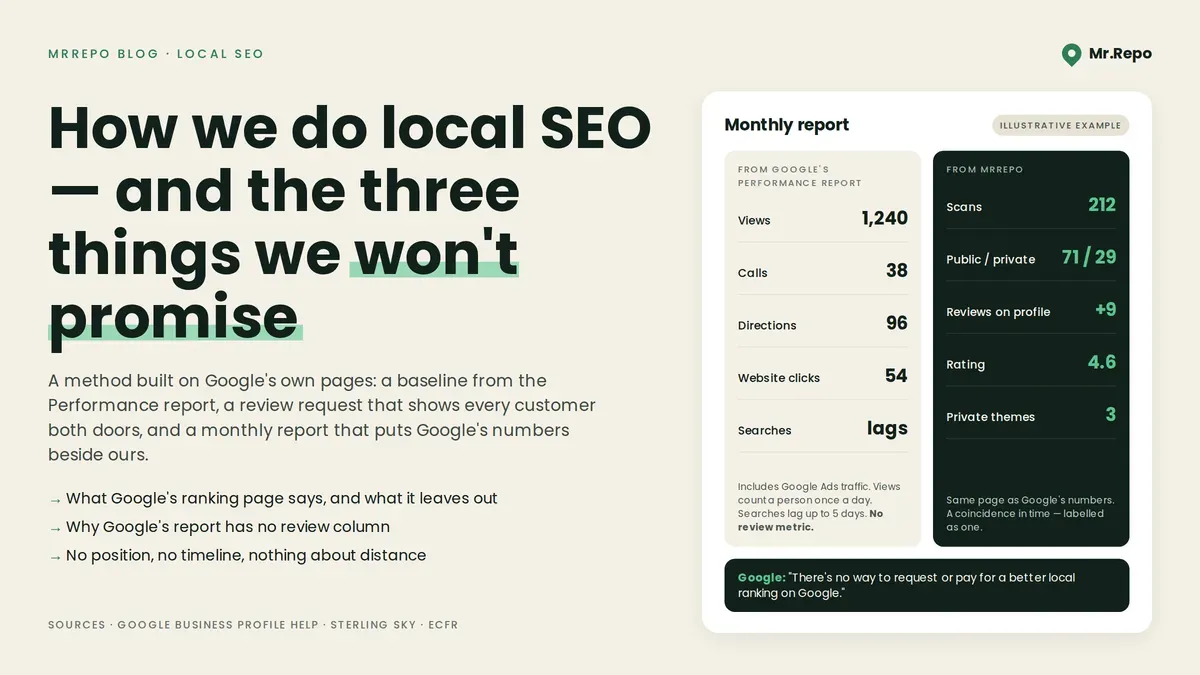
A local SEO pitch could start with a ranking. Ours starts with a sentence from Google's own help page: "There's no way to request or pay for a better local ranking on Google." If you take that sentence seriously, a local SEO service cannot be a promise about where you will appear. It has to be a method — and the method has to be visible enough that you can check it.
This post is that method, written for an owner deciding whether to buy it. It is built on Google's pages and named sources.
What Google says local ranking is based on
Google's page "Tips to improve your local ranking" lists three headings for local ranking: Relevance, Distance and Prominence. Each heading is worth reading for what it leaves an outside service to do.
Relevance — "how well a Business Profile matches what someone is searching for." The page's advice is to keep the profile complete and accurate: "Businesses with complete and accurate info are more likely to show up in local search results." A separate Google page adds that "The categories you select affect your local ranking on Google." These are things the profile owner controls, and we cover them in our post on categories.
Distance — how far your business is from the person searching. We do not change this.
Prominence — "how well-known a business is." Google says this factor is "also based on info like how many websites link to your business and how many reviews you have," and then gives the sentence that ties reviews to ranking in Google's own words: "More reviews and positive ratings can help your business's local ranking."
It says can help, not will raise. It names reviews alongside links. And it gives no weight and no timeline. That is the page's strongest statement about reviews, and it is a hedge.
So the shape of our service, on Google's terms, is narrow: keep the profile complete, work one input Google names under prominence, and measure what happens with the instrument Google provides.
Step one: we measure before we start
Google's Performance report is for verified profiles — "Performance data is available only for verified Business Profiles." It counts, among other things, Views, Searches, Calls, Directions and Website clicks. We build your baseline from it before any review work begins: if you cannot say what the numbers were in the month before, nothing that happens afterwards can even be compared.
We also print Google's own caveats on that baseline. Three matter most:
It includes paid traffic. Google's page says: "Performance data includes views, searches, and actions from both organic search results and Google Ads." If you run Ads, the report does not separate them; Joy Hawkins of Sterling Sky puts it flatly — "There is currently no way to track Google Ads data separately from regular organic data." Tell us when Ads ran and the report marks it, so a rise in Views is not read as a rise in organic reach.
Views are people, not looks. "A person can only be counted once a day. We don't count multiple visits on the same day."
Searches lag. "The searches metric is updated at the start of each month. It might take up to 5 days to show up." A report dated the first of the month can be missing its Searches column.
There is a fourth limit that shapes everything we do. Google's Performance report has no review metric. It defines Interactions, Searches, Views, Directions, Calls, Website clicks, Messages, Bookings, Booking clicks, Products, Menus and Offers — and nothing about how many reviews arrived, what they said, or what your rating did. Google names reviews as a prominence input and then gives you no column for them.
We explain each of those metrics in more detail in our guide to the Performance report. The point here is what it means for a service: the baseline is Google's, the caveats are Google's, and the gap is where our own data has to go.
Step two: we work an input Google names, without steering it
The review side of MrRepo is the product itself. A customer scans a QR code and sees two options at the same moment: leave a public Google review, or send feedback privately to you. Nobody is sorted by mood first. If a customer chooses the private route, you get an alert by email or SMS and the message lands in an inbox where it can be read and marked resolved.
Two things about that design are worth stating.
First, the request is the same for every customer: we attach no incentive and do not select who sees it. For reference, the FTC's consumer review rule carves "generalized solicitations to purchasers" out of § 465.2(b)–(c) (16 CFR § 465.2(d)), and § 465.4 bans incentives "conditioned expressly or by implication on, the writing or creation of consumer reviews expressing a particular sentiment." We state what the product does, not a verdict; whether a given business's wider practice sits inside any rule is a question for that business and its adviser, and we cover why sorting customers by sentiment is a problem in its own right in our review gating post.
Second, private feedback is a complaint you might otherwise not have heard, which is the subject of our silent customer post. Scans lead to public reviews only by the customer's choice. We do not claim a rate at which that happens, because the rate is yours, and it is one of the things the monthly report exists to show you.
Step three: the monthly report puts Google's numbers next to ours
Because Google's instrument has no review column, our report has two halves.
The left half is Google's: Views, Searches, Calls, Directions and Website clicks from the Performance report, with the Ads and lag caveats printed beside them. The date range is limited by what Google exposes — Hawkins reports that the selector "allows you to select from one to six months of history" — so we keep a copy of each month's figures to build a series longer than that selector offers.
The right half is ours: scans, the split between public and private choices, the review count and rating on your profile over the period, and the themes in private feedback. Google's report cannot tell you whether a rise in Calls came in the same month as a run of new reviews. Ours can put the two on the same page. It cannot prove one caused the other, and the report does not say it did.
A report that puts an input and an outcome side by side is showing you a coincidence in time. Sometimes that is all the evidence you will have, and it is worth having. But the report labels it as what it is.
A note on how we read our own report, since these are working practices rather than findings from any study:
We do not comment on direction from a single month.
Any month you tell us Google Ads ran is marked before it is read. Google's report mixes the two and we cannot unmix it.
We read Calls as clicks on the call button, not conversations. Google defines it as clicks; Hawkins adds: "A click to call also doesn't mean the person actually initiated the call."
The review count is read from the profile, not from Google's report.
Where a number moved and nothing in our half of the report moved with it, we say so rather than reach for an explanation.
The three things we will not promise
A position. Google's page names three headings and states no weights. We cannot tell you how much of a ranking is reviews, and we will not print a "reviews are X% of the algorithm" figure, because Google publishes no such figure. Our post on how reviews affect local SEO goes into what third-party studies can and cannot show.
A timeline. Google's page contains no timeline, nor does our report.
Anything about distance. If a searcher is closer to a competitor, Google's page says that matters, and nothing we do changes where either of you stands.
What we will do is show you Google's numbers with Google's caveats, work one input Google names by asking every customer the same way, and put the two beside each other every month so you can see for yourself whether anything moved. If that sounds small, it is. It is also the part that can be checked.
Frequently asked questions
Does MrRepo edit my Google Business Profile? No. The local SEO service is reporting and the review product. Categories, hours, description and photos stay with you.
Will more reviews raise my ranking? Google's words are "More reviews and positive ratings can help your business's local ranking." That is a hedge, and we repeat it as one. The monthly report shows what happened to your Views, Calls and Directions over the same period as your review count.
Why does the report say Google Ads traffic is included? Because Google's page says Performance data comes "from both organic search results and Google Ads," and Joy Hawkins of Sterling Sky reports no way to separate them. Tell us the months you ran Ads and we mark them.
How far back does the report go? Joy Hawkins of Sterling Sky reports a selector of one to six months. We keep each month's export, so your series with us grows past that limit.
Is this the same as asking for reviews? It is a request, made the same way to every customer, with a public and a private option on one screen. It carries no incentive and is not aimed at chosen customers. What it is under any particular rule is a question for you and your adviser.
Key takeaways
Google's ranking page names three headings — Relevance, Distance, Prominence — and one hedged sentence about reviews. We work inside that.
Google's Performance report includes Ads traffic, counts Views once per person per day, lags on Searches, and has no review metric at all.
MrRepo's local SEO service is a baseline from Google's report, a review request that shows every customer both doors, and a monthly report that puts Google's numbers beside our own.
The report shows inputs and outcomes on the same page and labels the relationship as a coincidence in time, not a proof.
We promise no position, no timeline, and nothing about distance; Google's page supports none.
Want to see what the two-door request looks like from the customer's side? Try the interactive demo.