Google Says Use the Fewest Categories. The SEO Industry Says Use More. Here Is What Each Side Can Show.
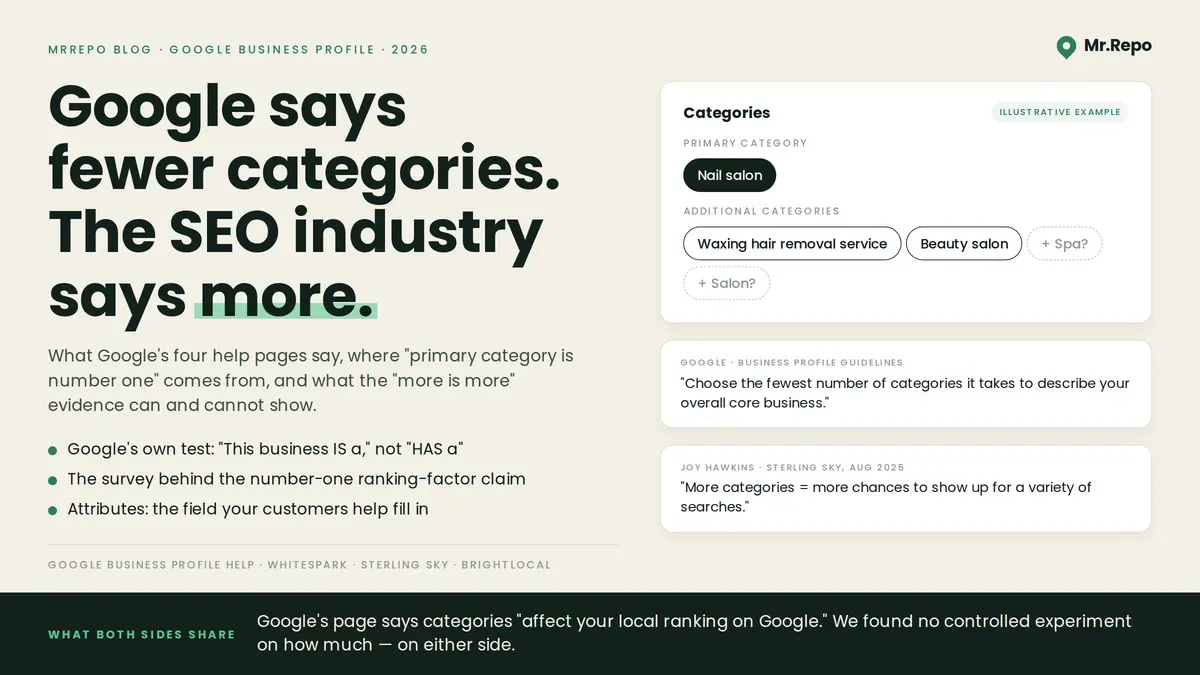
Open the category field on your Google Business Profile and you meet two pieces of advice that appear to contradict each other. Google's own guideline says to choose "the fewest number of categories it takes to describe your overall core business." The local-SEO industry says add more: more categories, more searches you can appear for, and the primary category at the top of its ranking-factor table.
This post sets out what Google's pages say, where the industry's claims come from, what survives a look at the evidence, and where attributes fit. It is the second post in our Google Business Profile series, after the Performance report explainer.
What Google's own pages say
Four Google help pages are cited below, and none carries a last-updated date, so their quotations are as read on 8 September 2026.
The category management page is direct. It says categories "inform your customers about what your business does," and then: "The categories you select affect your local ranking on Google." The same page says to "Select a primary category that best describes your business," and to prefer the specific over the general: "instead of 'Salon,' choose 'Nail salon.'"
On additional categories it says two things together, and both matter: "To inform your customers about special departments or services, select additional categories. Do not select a category for every product or service."
The guidelines page is where "fewest" lives. Its test for a category is whether it completes the statement "'This business IS a' rather than 'this business HAS a.'" It says to "Use as few categories as possible to describe your overall core business", and adds prohibitions: "Do not use categories solely as keywords or to describe attributes of your business," and do not use categories that belong to a business inside yours or one that contains you.
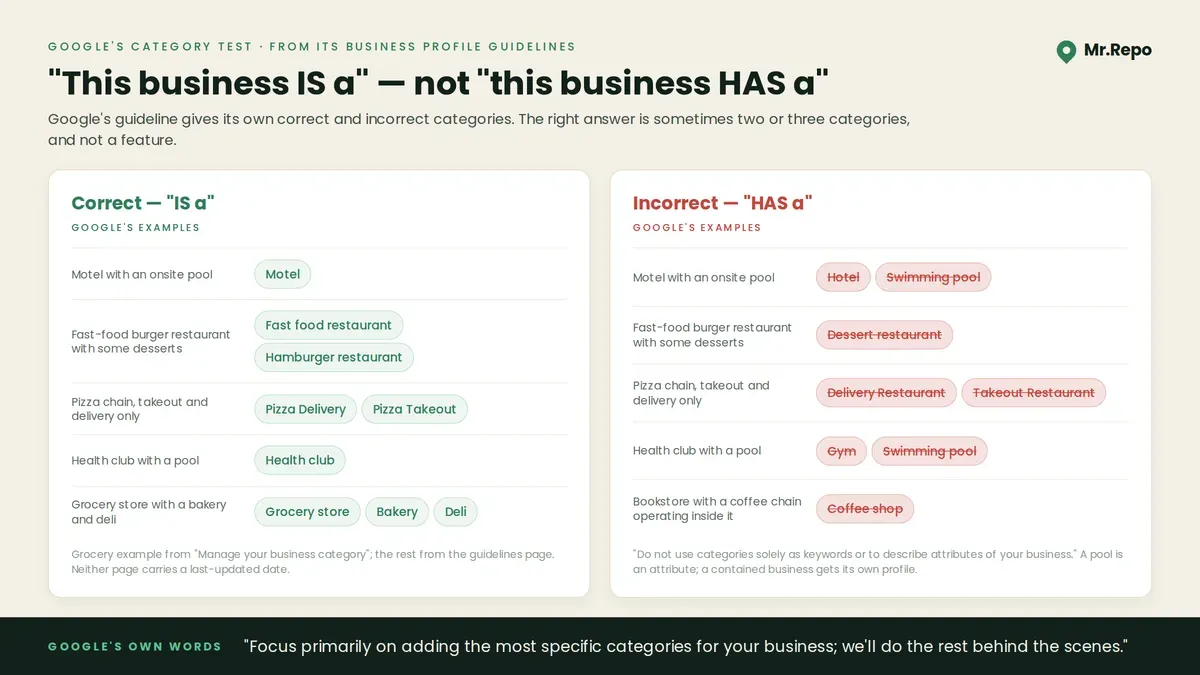
Then comes the sentence that softens "fewest": "Focus primarily on adding the most specific categories for your business; we'll do the rest behind the scenes." Its example is 'Golf Resort': there, "Google implicitly includes more general categories like 'Resort Hotel', 'Hotel', and 'Golf Course.'"
The ranking page lists your category and your attributes under complete information, says "Businesses with complete and accurate info are more likely to show up in local search results," and describes its factors under the headings Relevance, Distance and Prominence. It does not rank categories against anything else.
Where "primary category is the number-one factor" comes from
The claim traces to one table: Whitespark's Local Search Ranking Factors report, whose 2026 edition was published on 6 November 2025. In its Local Pack table, "Primary GBP Category" sits first with a score of 227. "Additional GBP Categories" sits eighth at 173. Ratings are sixth and review count ninth.
The report says "47 of the best and the brightest local search experts are invited to complete a comprehensive 2-hour survey, weighing and scoring 187 factors," and that the scores "are summed and ranked by total score to determine which factors the experts believe have the greatest impact." The top three entries are separated by four points: 227, 225 and 223. The table puts primary category at the top of a close group, in the judgement of the practitioners surveyed. It does not measure an effect.
What the "more is more" evidence is
A vendor snapshot of competitors. BrightLocal's June 2023 study "studied the local rankings of 1,050 business locations" across seven primary categories. "The lowest average map ranking of 7.6 comes from businesses that aren't using any additional categories," and "Businesses using four additional categories rank better, with an average of 5.9." Its takeaway: "when it comes to GBP categories, more is generally more… helpful." The study states no correlation caveat, so here is one: it is a snapshot of who ranks where, and a business that has filled in its categories may have filled in everything else too.
A large vendor dataset, with the confound stated by its author. In August 2026 Darren Shaw, Whitespark's founder, reported in Search Engine Land that "Whitespark studied 1.8 million Google Business Profiles across 4,209 categories," and that "having well-chosen, specific additional categories correlates with higher rankings (by 6-17 rank positions) when compared to businesses that only have a single primary category." He then wrote the caveat himself: "However, correlation isn't causation. Business owners who add additional categories are more likely to take care of their local SEO in general (to optimize their GBPs, to ask for reviews, to do SEO work outside of their Google Business Profile, etc.). So, of course, their rankings reflect that."
Case studies. Colan Nielsen of Sterling Sky, in a piece first published in 2020 and updated in September 2025, reports from case studies that "Adding additional GMB categories won't hurt the rankings for your main category/keywords as long as they are relevant to your business," while "Changing the primary GMB category DOES have major impact on ranking." Joy Hawkins's August 2025 piece argues that "More categories = more chances to show up for a variety of searches" and states that "You can pick up to 10 categories on your Google Business Profile (GBP)." We found no Google help page that states a maximum; the figure of ten appears on practitioner and vendor pages.
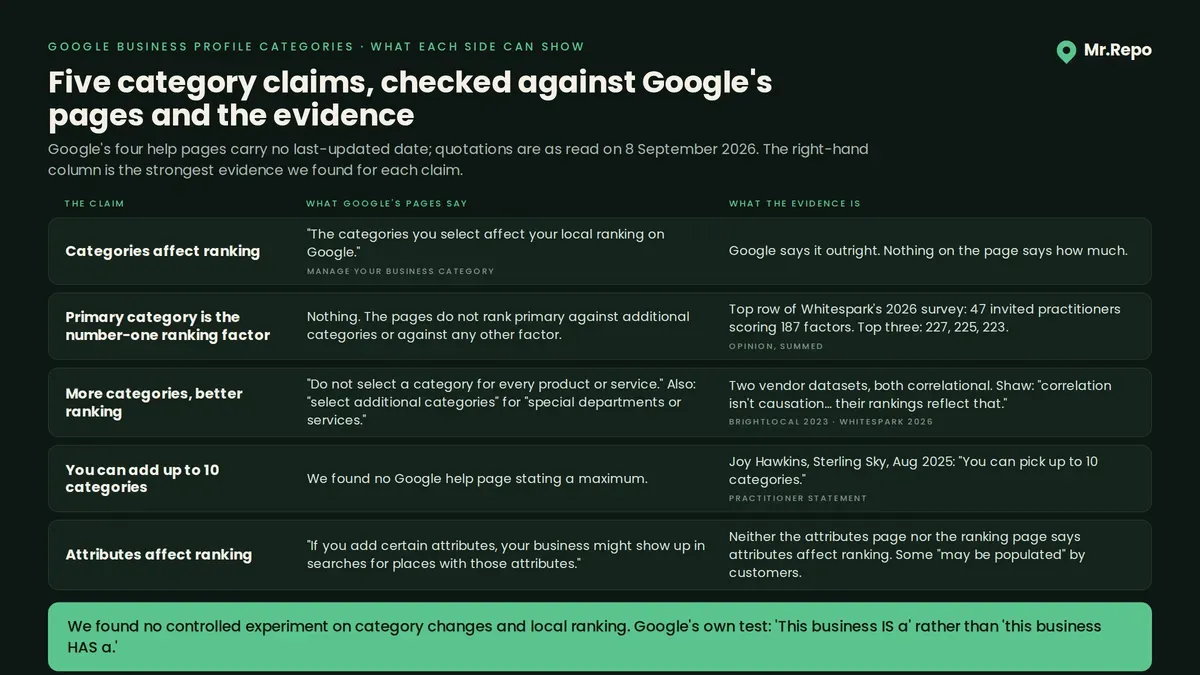
We found no controlled experiment and no peer-reviewed study on category changes and local ranking. The evidence for "more is more" is a practitioner survey, two correlational datasets and a set of case studies, and the author of the larger dataset supplies the causation warning himself.
The two sides are closer than the headlines
Google does not say to use one category. It says "fewest," and its category page gives a grocery store three. It tells you to "select additional categories" for "special departments or services." What it rules out is narrower: categories used "solely as keywords," categories that describe attributes rather than what the business is, and categories belonging to a nearby, related, contained or containing business. Hawkins's framing, that "Google's advice" would have a dentist add only "dentist," is a stricter reading than Google's pages support.
Where the two sides part company is the ceiling. Google says stop when the business is described. The industry says keep going while the categories are relevant, up to whatever the field allows. The sources are thin: Shaw's piece offers no optimal count, and the BrightLocal figures we cite cover zero additional categories and four. In both datasets, businesses with additional categories ranked better, and Shaw says why that could be true without the categories doing the work.
One more thing Google's pages do not say: that the primary category counts for more than the additional ones. That belief rests on the survey and on practice, including Nielsen's report that changing the primary category moves rankings.
Attributes: the other field, and the one you do not fully control
Google's guideline rules out categories used "solely as keywords or to describe attributes of your business," which raises the question of what attributes are for. The attributes page says they exist "[t]o help your business stand out online and let your customers know details about your business," and makes a visibility claim, not a ranking one: "If you add certain attributes, your business might show up in searches for places with those attributes." Neither the attributes page nor the ranking page says attributes affect ranking.
The line to notice is this one: "You can directly edit some attributes about your business, but there are attributes that may be populated based on inputs from customers who visit your business." The page does not say which attributes those are, and it describes no way to dispute one.
A working checklist
These are our own working heuristics, drawn from the documents above.
Pick the primary category by the "IS a" test, and make it the most specific one available. Google's guideline says so, and Shaw reports the same.
Add an additional category only if it also passes "IS a." Google's guideline puts the burden on the description, not the keyword.
Never use a category to say what you have. Pools, Wi-Fi and parking belong in attributes. Google's guideline says not to, and its examples list "Swimming pool" as an incorrect category for a motel.
Change the primary category deliberately. Google's page says editing a category might mean re-verifying, and Nielsen reports "major impact" on ranking from changing it.
Read the attributes Google shows for you, not only the ones you set. Some may be customer-populated and the page gives no dispute process, so the check is periodic and manual.
Where reviews sit in all of this
Categories are one thing Google says affects ranking. Reviews are another, and the ranking page names them directly: "More reviews and positive ratings can help your business's local ranking."
MrRepo's part is the reviews: a QR code at the point of service that shows every customer the same two options at the same moment, a public Google review or a private message to the owner. You can see how that works in the interactive demo.
FAQ
Does Google say categories affect ranking? Yes. The category management page says: "The categories you select affect your local ranking on Google." It does not say how much, or whether the primary category counts for more than additional ones.
How many categories should I add? Google says "as few categories as possible to describe your overall core business"; its examples use one to three. Joy Hawkins says you can add up to ten and that "More categories = more chances to show up for a variety of searches." We found no Google help page stating a maximum; Google's guideline is that each category complete its "IS a" statement.
Is "primary category is the number-one ranking factor" true? It is the top entry in Whitespark's 2026 survey of invited practitioners, two points ahead of proximity. That is expert opinion, summed. Google's pages say categories affect ranking and say nothing about primary versus additional.
Will adding categories hurt me? Google's guideline says "Do not use categories solely as keywords or to describe attributes of your business," and its category page says "Do not select a category for every product or service." Sterling Sky's case studies report no harm from relevant additional categories.
Can I remove an attribute a customer added? Google's attributes page says some attributes "may be populated based on inputs from customers who visit your business" and describes no way to remove or dispute them. You can "directly edit some attributes."
Key Takeaways
Google's category page states that categories "affect your local ranking on Google." It does not say how much, or rank them against anything else.
Google's guideline says "fewest," not one; its category page gives a grocery store three and pairs "select additional categories" with "Do not select a category for every product or service." The live disagreement is the ceiling.
The "primary category is number one" claim is the top row of a practitioner survey whose top three scores are 227, 225 and 223.
The "more is more" datasets are correlational, and the author of the larger one says so himself: businesses that add categories are more likely to do everything else too.
Some attributes may be customer-populated, with no documented dispute route, and neither the attributes page nor the ranking page says attributes affect ranking.