Google Ads vs Meta Ads for a Local Business: Which Should You Start With?
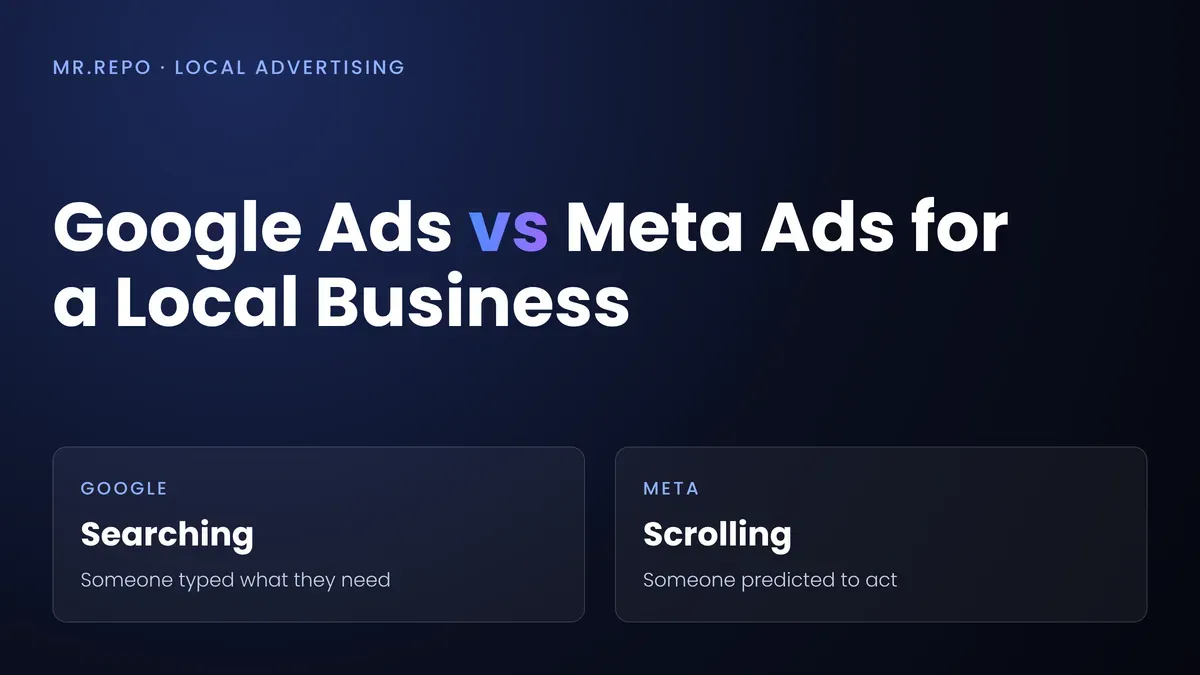
If you run a local business and have one ad budget, the question is rarely "which platform is better?" The better question is who you are trying to reach: someone who is already looking for what you sell, or someone who would want it if they saw it. Google Ads and Meta Ads are built around that difference, and your answer decides which one to start with.
One limit before we go further. In two web searches, we found no peer-reviewed study that compares Google Ads and Meta Ads head to head for a local business. Anyone quoting you a clean "Google beats Meta by X%" for your industry is quoting something we could not find. What follows is based on parts of each platform's own documentation, plus a small amount of experimental evidence about advertising in general. Where we offer a rule of thumb, we label it as ours.
The core difference: searching versus scrolling
Google's help documentation describes Search campaigns as a way to reach "people actively searching online for your products and services." You pick keywords, and those keywords determine which searches your ads are likely to appear on. The person typed a question, and your ad is an answer to it.
Meta works the other way round. Meta's developer documentation says Facebook uses your ad set's optimization goal to "decide which people get your ad." Its own example: if you optimize for app installs, delivery goes to people more likely to install the app. Nobody typed a query. Per that documentation, delivery goes to people more likely to take the action you chose.
For a local business, this is our framing of the practical difference:
Google catches demand that already exists. A burst pipe, a broken phone screen or a tooth that hurts all produce searches. If you are not on the page when the search happens, you are not in the running.
Meta can create demand that has not been expressed yet. A new café, a seasonal offer, a class that starts next month or a product people don't know they want rarely produces a search. Meta gives you a way to put it in front of someone who never asked.
Neither is "better" in general. They solve different problems.
What each platform asks you to decide
Google: keywords, conversions and a measurement requirement
Google's Search campaign setup states that at least one conversion goal is required. A conversion goal is the action you want, such as a call, a form or a booking. If you cannot record it, you are paying for clicks you cannot judge.
This matters even more if you want Google to adjust bids for you. Google's Smart Bidding documentation says you need conversion tracking enabled to use it. The same page gives guidance on how long to wait before judging results: it recommends measuring performance over longer periods, with "at least 30 conversions" in the window you evaluate. That figure is Google's guidance for evaluating Smart Bidding, not a minimum to start a campaign. The implication for a small business: with only a few conversions a month, a verdict after one week rests on very little data.
On location, Google's setup offers an option to target "people searching for your targeted locations." For a plumber or dentist, that maps well onto how customers behave: the person is looking for a service, and you want them to be near you.
Meta: an objective, an optimization goal and a location setting
Meta asks you to choose an objective first. When Meta simplified its ad objectives in 2023, it consolidated eleven original objectives into six. In the Marketing API they appear as awareness, traffic, engagement, leads, app promotion and sales. For a local business, the useful ones are usually traffic, leads and sales, because they point at an action rather than just visibility.
The objective then feeds the ad set's optimization goal, which, per Meta's developer documentation, defaults to a goal associated with your objective. That is the mechanism behind the "decide which people get your ad" quote above. In our reading, that means the goal matters: optimizing for an easy action such as a click points delivery at people likely to click, which may not be the people likely to book.
Location targeting is more flexible than many owners expect. Meta's targeting documentation lets you set a custom radius from 0.63 to 50 miles (1 to 80 kilometres), and it distinguishes between two kinds of location. "Recent" means people whose recent location is in the area, "as determined from mobile device data." "Home" means people whose stated current city on their profile is in the area. The default is both. For a business that depends on foot traffic, that choice changes who sees the ad, so check which setting a campaign uses.
What the evidence does, and does not, say
Because the question of Google versus Meta has no clean experiment behind it, it helps to know what kind of evidence does exist, and how far it reaches.
A field experiment on Yelp ads and restaurants. Dai, Kim and Luca ran a field experiment with Yelp across 18,294 restaurants, of which 7,209 were randomly chosen to receive Yelp's standard ads package for free for three months. On average they found a 7 to 19 percent increase in purchase-intention outcomes and a 5 percent increase in customer reviews, with "independent and higher-rated businesses observing larger gains." Cautions: it tested Yelp's own ad package, not Google or Meta; it covered restaurants only; and the authors disclose consulting for technology companies including Yelp, saying their compensation and ability to publish did not depend on the results. It suggests Yelp's ad package raised outcomes for these restaurants, with larger gains for independent ones, and no more.
Measurement warnings from large advertisers. Blake, Nosko and Tadelis ran field experiments at eBay and found that the returns to paid search were a fraction of non-experimental estimates. Gordon and colleagues compared 15 advertising experiments at Facebook with observational methods and found that the observational methods often failed to reproduce the randomized results; two of the authors were affiliated with Facebook. Both are large-scale experiments at eBay and Facebook, not a local shop. Their value is the warning: observational estimates can differ from randomized results.
Vendor claims. A 2017 press release from an advertising vendor reported a study of more than a thousand local campaigns and said adding Facebook ads to search campaigns gave greater results. We could not see the underlying data and give no figures from it, so we do not rely on it, and we mention it only because you will see claims like it.
One more claim you will meet: that Meta needs about 50 optimization events before delivery stabilises. Every page we found giving that number was an agency or tool-vendor page. We found no Meta-published page that states it, though Meta's Help Center is closed to our tools, so we cannot say Meta never has. Treat it as unconfirmed until you see it in Meta's own words.
A working heuristic: our rule of thumb, not research
Given the above, here is how we would think about the first channel. This is our house heuristic, built from the mechanics described earlier. No study tested it.
| Your situation | Start with | Why |
|---|---|---|
| People search for what you sell when they need it (emergency repair, dentist, locksmith) | Google Search | The demand is already expressed, and keywords match it. |
| Few people would think to search for what you sell (new venue, seasonal offer, event, visual product) | Meta | There is no query to match, and Meta's delivery works toward people predicted to take your chosen action. |
| You cannot yet record a call, form or booking | Fix tracking first, on either | Google requires a conversion goal, and without one you cannot judge either channel. |
| Your budget is so small that splitting it leaves both channels with a handful of conversions a month | One channel only | Google's guidance on needing enough conversions to judge results suggests thin data is hard to read. |
Once the first channel is producing readable results, consider adding the second, since each platform reaches people in a different frame of mind. That is a reasoning pattern, not a measured effect, so test it on your own numbers.
Three habits make either choice safer:
Pick one action and count it. A phone call, a form or a booking. Without that, the platform and you are both guessing.
Judge over a window, not a day. Use Google's "at least 30 conversions" as a reminder of how much data a fair verdict needs, even if you cannot reach that number on one campaign.
Change one thing at a time. If you alter the audience, the offer and the budget together, you will not know which one mattered.
Where Mr.Repo fits
Mr.Repo has Google Ads and Meta Ads features. According to the features page, you connect your own Google Ads account to create Search, Performance Max, Demand Gen and Shopping campaigns. For Meta, you connect Facebook and Instagram advertising to create paused-by-default traffic, leads and sales campaigns, manage budgets and targeting, and review delivery insights before you enable spend. Both are available on Premium and Pay As You Go. Because you use your own ad account, Google and Meta bill you directly for ad spend, and Mr.Repo never takes a cut of it, as the pricing page puts it.
Per the features page, Meta campaigns stay paused until you enable spend.
Key takeaways
Google is built around people searching; Meta is built around people a model predicts will act. Match the channel to which one your customers are.
Whichever you choose, define a conversion first. Google requires a conversion goal, and neither platform can be judged without one.
We found no peer-reviewed Google versus Meta study for local businesses, so treat any universal "winner" claim with suspicion.
The experimental evidence we cite concerns Yelp ads, restaurants, and large-scale experiments at eBay and Facebook. It shows measured gains in specific settings and that non-experimental estimates can diverge, but it does not rank the two platforms.
Start with one channel, give it enough budget to produce readable results, then add the other and compare on your own numbers.
Frequently asked questions
Is Google Ads or Meta Ads cheaper for a local business? We did not search for cost benchmarks, so we will not quote one. Costs depend on your industry, location and competition. The sound approach is to run a small, tracked test and compare cost per conversion on your own account.
Can I run both at the same time? Yes, but only if each gets enough budget to produce data you can read. Splitting a small budget across two channels can leave both without a fair verdict. Start with one and add the second when the first is stable.
Do I need conversion tracking before I start? For Google, yes: its Search campaign setup states that at least one conversion goal is required, and Smart Bidding requires conversion tracking. For Meta, we did not verify a specific requirement, but the principle holds, because you cannot judge a campaign you cannot measure.
How long before I can judge results? Google's guidance for Smart Bidding is to measure over longer periods with at least 30 conversions. It is Google's figure for its own system, not a Meta rule.
What if my customers don't search for what I sell? Then there is little for Google Search keywords to match, and by our heuristic Meta is the more natural first test. Check first whether local searches for your service exist at all before ruling Google out.