Do You Need a Separate Page for Every City You Serve? What Google’s Doorway Page Rules Say
Say your plumbing company is based in one town and takes jobs in six nearby ones. Someone offers to build six extra pages, one per town, so you show up in each. It sounds logical. It may also touch something Google has a policy about.
This post reads Google's own documents, not ranking tests. We read five Google pages on 15 October 2026 (listed at the bottom), and everything we call Google's position comes from them. We ran no experiment on whether city pages help rankings, and we say below what that leaves you with.
The short answer
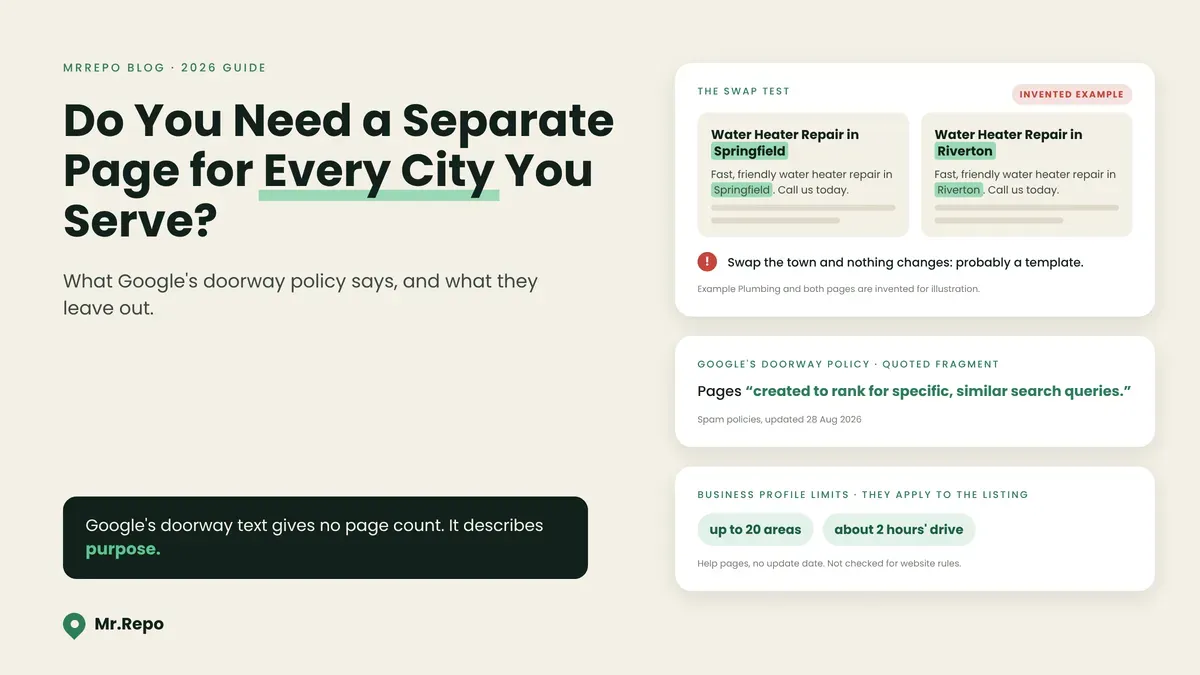
The doorway and listing pages we read do not say you need one page per city. In the doorway section we read, nothing says whether such a page is allowed. What that policy describes is purpose: pages created to rank for specific, similar searches.
So the useful question is not "how many city pages am I allowed?" It is "what is each of these pages for?" The sections below show the wording, what the Business Profile rules do and don't cover, and a short check you can run on any page. The check is ours, not Google's.
What Google's doorway rule says
Google's spam policies page (last updated 28 August 2026) calls it doorway abuse when sites or pages are "created to rank for specific, similar search queries." It adds that visitors end up on stepping-stone pages worth less than where they wanted to go.
Google lists four examples. One concerns city or region pages that send users to a single page; another, very similar pages that resemble search results.
Two details matter for city pages.
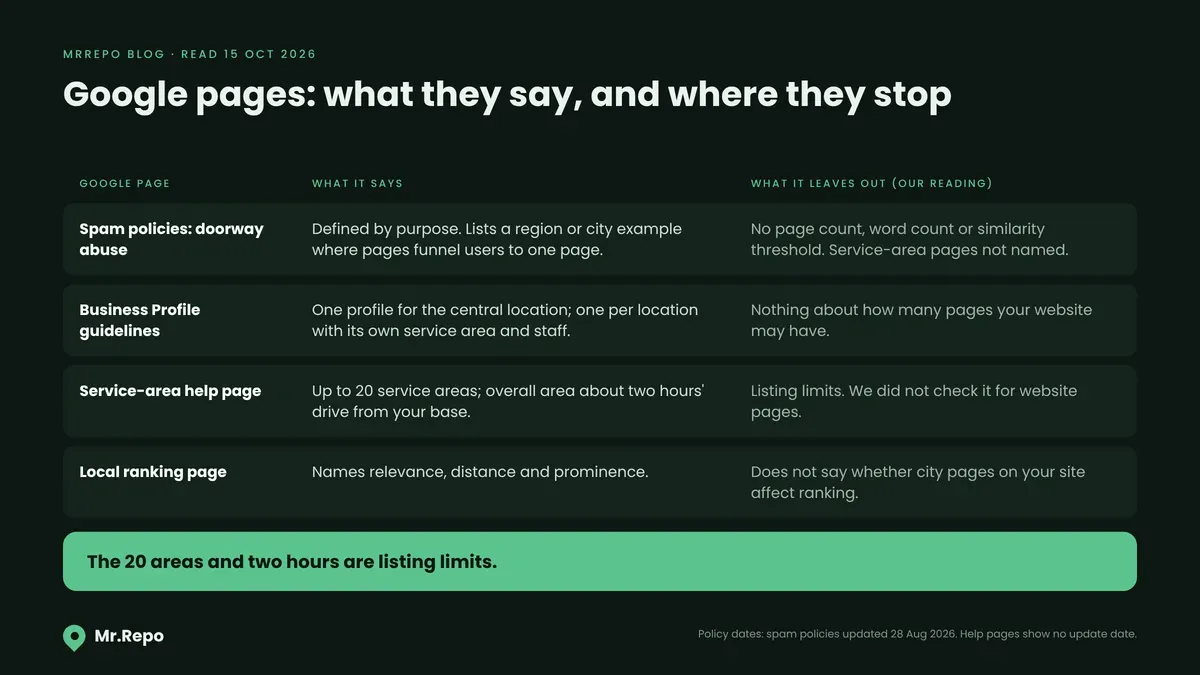
First, the city example is about pages that funnel users to one page. In our reading, that section does not say whether a city page with its own useful content is allowed. It gives no page count, word count or similarity threshold, and it does not mention service-area pages by name.
Second, the consequence. The page's introduction says sites that break any of its policies may rank lower or not appear at all.
A second policy city pages may resemble
The same page defines scaled content abuse: pages made chiefly to game rankings, not to help users. Its examples include generating many pages with AI tools without adding value, and keyword-heavy pages that make little sense.
A list of towns run through a template, with only the town name changed, may resemble what both policies describe. That is our reading, not Google's statement. Whether a particular set of pages counts is a judgment we cannot make for yours. The page's detection paragraph mentions human review and manual action.
What the Business Profile rules do and don't cover
Two things are easy to blend: the Business Profile (your Google listing) and the pages on your own website. Google's service-area rules are about the first.
Google's Business Profile guidelines (the page shows no update date) say a service-area business should have one profile for its central location. A business with separate locations, each with its own service area and staff, can have one profile per location. A service-area business can't list a virtual office unless it is staffed during business hours, and a rented mailing address you don't operate from is not eligible.
A separate help page allows "up to 20 service areas" by city, postal code or other area. It says the overall area shouldn't be more than about two hours' driving from your base. The guidelines page adds that larger areas may suit some businesses. If you don't serve customers at your address, the help page says to remove it from your profile.
Those limits are for the listing. In our reading, the guidelines page says nothing about how many pages your own website may have, and we did not check the help page for that. They are listing limits, and we draw no web-page conclusion from them.
Does a town page change your base?
Google's page on local ranking, which is about listings, names three factors: relevance, distance and prominence. On distance it says "Distance refers to how far each business is from the customer who's searching." A town page does not change where you are based. That is our point, not Google's.
In our reading, that page does not say whether pages on your website, or city pages, affect local ranking, so we cannot tell you whether they do. It cites links to your business and reviews under prominence.
Google's quality questions, and our city-page reading
Google's page on helpful, people-first content (last updated 5 October 2026) lists questions to ask about your own content. One is "Is the content primarily made to attract visits from search engines?" Others ask about publishing broadly in the hope something ranks, heavy automation, mass production, and value compared with other results.
Google frames these as questions to ask yourself, not rules. A city page made only because a town was on a keyword list answers the first one weakly, in our view. A page about real work there may answer it better. No guarantee comes with either.
A five-question check for each city page
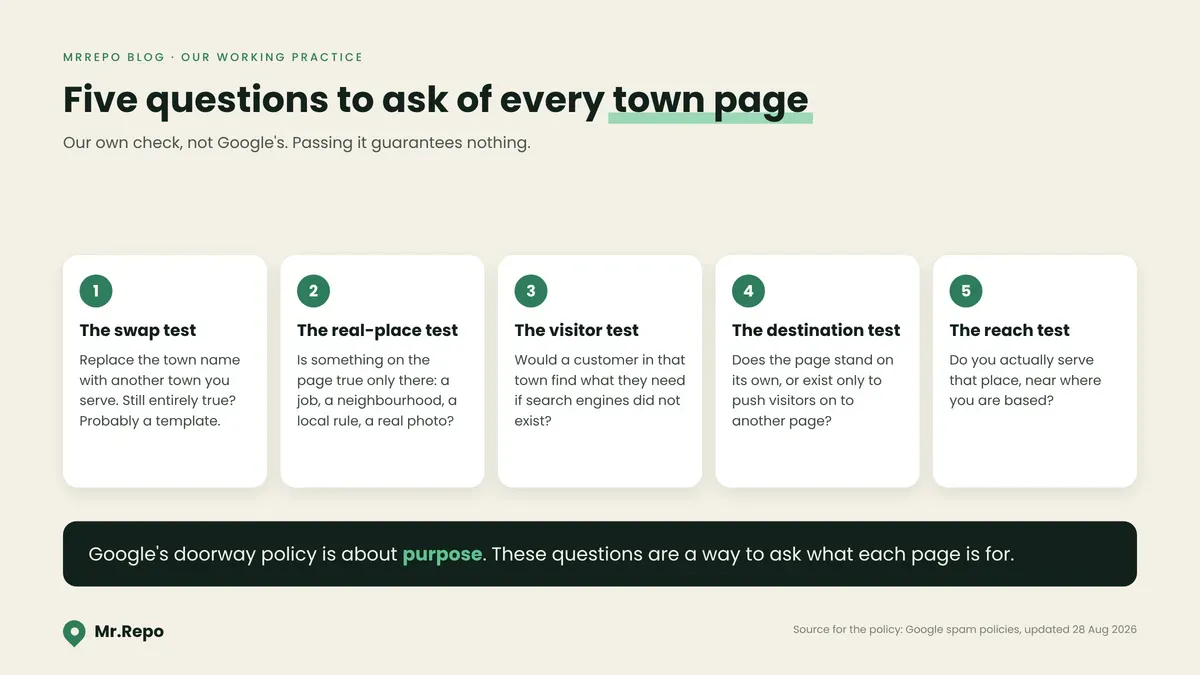
This is our own working practice. Google does not publish it, and passing it guarantees nothing.
The swap test. Replace the town name with another town you serve. If the page is still entirely true, it is probably a template.
The real-place test. Does it contain something true only there, such as a job you did, a neighbourhood you have worked in, a local rule that affects the work, or a photo from a real site?
The visitor test. Would a customer in that town find what they need if search engines did not exist?
The destination test. Does the page stand on its own, or exist only to push visitors on to another page?
The reach test. Do you actually serve that place, near where you are based? The profile's two-hour guide is a listing guide, not a web-page rule that we found.
Here is how it looks on an invented example. Example Plumbing is a made-up business, and so is every detail below.
Fails the swap test: "Water Heater Repair in Springfield" and "Water Heater Repair in Riverton" share one paragraph, apart from the town name.
Passes it: the Riverton page describes a townhouse water heater replacement Example Plumbing says it did there, with a real photo and the real turnaround time, and links back to the main water heater page. Swap in "Springfield" and the page stops being true.
What to build, by situation
This table is our suggestion. Google has not endorsed it.
| Your situation | What the Google pages we read say | What we would build (our view) |
|---|---|---|
| One base, jobs in nearby towns | One profile; service areas set on the profile | One page per service, plus one page listing the areas you serve |
| A second, staffed location | A separate profile is allowed when each location has its own service area and staff | A page for each real location |
| A town where you have done distinctive work | Doorway section defines a page's purpose; names city pages as funnels | A page only if it passes the five checks; otherwise a section on the areas page |
| A long list of towns with identical text | Closest examples: funnel pages, substantially similar pages | We would skip it |
What this post can't tell you
We ran no tests for this post, and we did not review any ranking experiments. The doorway section gives no page-count threshold. Policies change: the two Google Search pages we cite carry update dates of 28 August and 5 October 2026.
We have no clean-up procedure to offer, and we did not look for one in these pages. If you already have many city pages, review them one at a time with the five checks Our self-check guide may help with looking over your own site.
Where Mr.Repo fits
Mr.Repo's features page describes a Site Audit that crawls every page of your website, following its robots.txt, and checks for problems including thin pages, broken links, redirects, titles, descriptions and HTTPS issues. Each finding lists the pages it affects with a suggested fix. See the features page for details.
That description names thin pages, but not doorway, city or near-duplicate pages. Whether a page was made to help people or to rank is a question about purpose, and we would treat it as a human decision. It checks for thin pages; it is not described as spotting city pages. Our SEO audit explainer is related reading.
Mr.Repo also lists Local SEO as work handled by its SEO team.
Key takeaways
The doorway and listing pages we read do not say you need one page per city, and the doorway section does not say whether a city page is allowed.
The doorway policy turns on purpose: pages created to rank for similar searches, which lead visitors to less useful intermediate pages.
Profile limits (up to 20 areas, about two hours' drive) apply to the listing; we did not check the help page for website rules.
Our view: a town page needs something true only there. The swap test can help spot a template.
This post rests on Google's documents. It cannot say whether city pages help your rankings.
FAQ
Is a page for every city a doorway page?
Not necessarily, on these pages' wording. Google's definition is about purpose, and its city example is about pages that send visitors on to one page. Whether your pages fall inside the policy is a judgment we cannot make.
How many service areas can I list on my Business Profile?
Google's help page says up to 20, by city, postal code or other area, with an area of about two hours' drive; the guidelines page says larger may suit some businesses. Profile limits only; we didn't check this page for website rules.
Should I remove my address?
If you don't serve customers at your business address, Google's help page says to remove it from your Business Profile.
Can I use AI to write city pages?
Google's scaled content abuse examples include AI-generated page sets without added value. We read that as about value, not the tool, but pages with only the town name changed add little either way.
What if I already have dozens of city pages?
We did not check these pages for a clean-up procedure, so we won't invent one. Review each page with the five checks; they are our test, not Google's.