What an SEO Audit Can Tell You — and Which Warnings Google Plays Down
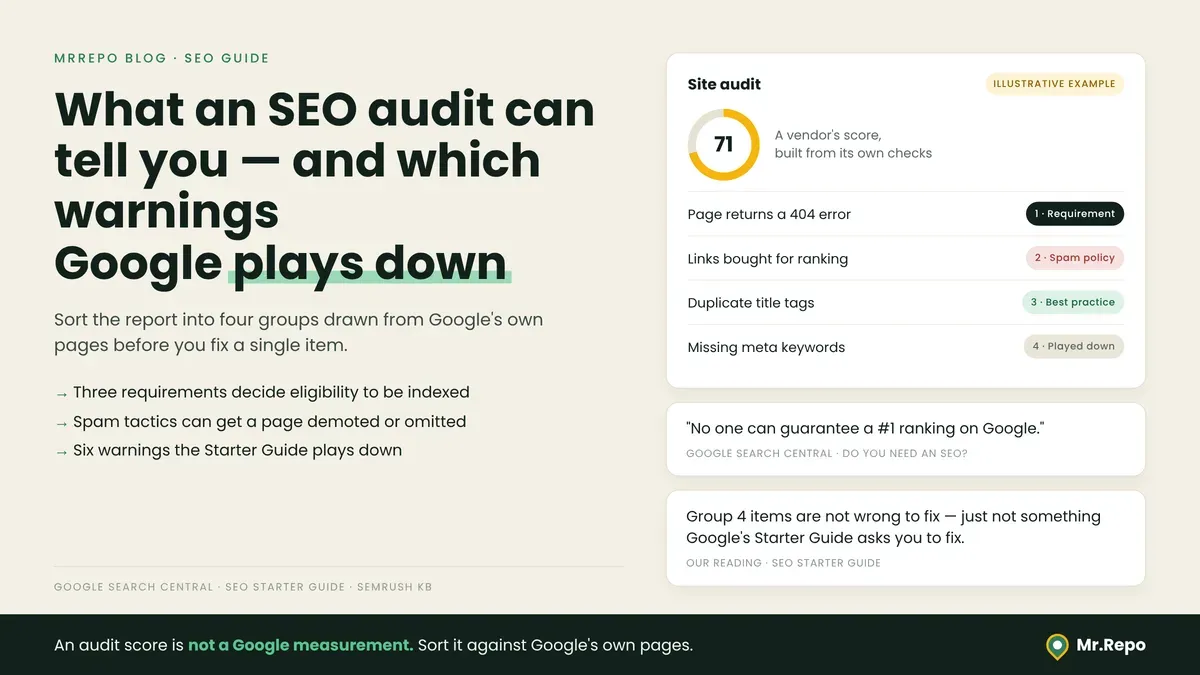
You run an SEO audit on your website and get back a score — say 71 out of 100 — and a long list of "issues". The score does not tell you which of those issues Google cares about, because the tool that produced it is not Google.
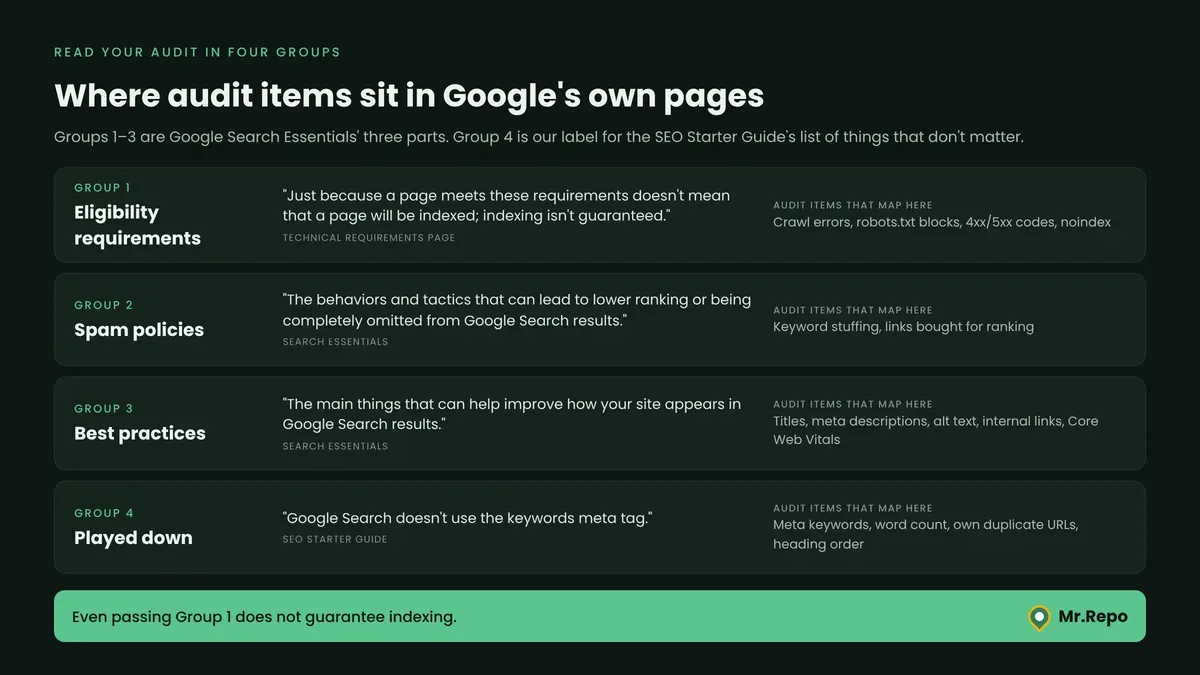
Google publishes its own rulebook for Search, Search Essentials, and it is organised in three parts: technical requirements, spam policies and key best practices. We add a fourth group from Google's SEO Starter Guide: things it says don't matter for ranking. Read an audit against those four groups and the report becomes much easier to sort.
What an audit score actually is
An audit tool crawls your pages and runs a fixed list of checks. Semrush, for example, says its Site Audit "has over 140 checks", and that its Site Health Score "is based on the number of your total errors and total warnings that were found on the pages crawled on your site". It adds: "Errors have more impact on your Site Health Score than warnings".
That design is the vendor's own. The score is built from the errors and warnings the vendor's checks find, weighted the way the vendor chose. It is not a Google measurement.
The same goes for the "authority" numbers that some reports include. Semrush describes its Authority Score as "our compound metric that grades the overall quality of a website or a webpage", built on link power, organic traffic and spam factors. In four searches we found no Google help page that mentions them. Treat each as its vendor's estimate.
Group 1: Google's three eligibility requirements
Google's technical requirements page lists three minimums for a page to be eligible for indexing:
"Googlebot isn't blocked."
"The page works, meaning that Google receives an HTTP 200 (success) status code."
"The page has indexable content."
In an audit report these show up as crawl errors, pages blocked by robots.txt, 4xx and 5xx status codes, broken redirects and pages marked "noindex". These requirements decide whether a page is eligible to be indexed.
Even here, Google is careful about what passing means: "Just because a page meets these requirements doesn't mean that a page will be indexed; indexing isn't guaranteed."
Group 2: what can get you demoted or omitted
Google's Search Essentials describes spam policies as "The behaviors and tactics that can lead to lower ranking or being completely omitted from Google Search results." So a page that meets every Group 1 requirement can still be demoted or omitted under Group 2.
Two policies overlap with what audits flag. The Starter Guide says "keyword stuffing is against Google's spam policies", so a keyword-density warning deserves a look if the page really is stuffed. And the spam policies define link spam as "the practice of creating links to or from a site primarily for the purpose of manipulating search rankings", with examples including "Buying or selling links for ranking purposes" and "Low-quality directory or bookmark site links".
The definition turns on purpose: links created primarily to manipulate rankings. An audit's "toxic" list is the tool's judgement of inbound links, not Google's finding that anyone created them for that purpose.
Google's sampled view of who links to you is the Links report in Search Console. Google says it "isn't a comprehensive list of every link on your site" and "shows a sample of internal and external links".
Group 3: the best practices
Search Essentials calls these "The main things that can help improve how your site appears in Google Search results." Titles, descriptions, alt-text and link checks map here, and Google's Starter Guide says what good looks like:
Titles: "A good title is unique to the page, clear and concise, and accurately describes the contents of the page." Duplicate or missing-title warnings are worth acting on.
Meta descriptions: "A good meta description is short, unique to one particular page, and includes the most relevant points of the page."
Image alt text: "a short, but descriptive piece of text that explains the relationship between the image and your content."
Links: "The vast majority of the new pages Google finds every day are through links", so a page nothing links to may go undiscovered.
Core Web Vitals often appear alongside these checks. Google's page experience page says "Core Web Vitals are used by our ranking systems", and Google's separate Core Web Vitals page gives the targets: Largest Contentful Paint "within the first 2.5 seconds of the page starting to load", Interaction to Next Paint "less than 200 milliseconds" and Cumulative Layout Shift "less than 0.1".
The page experience page adds two caveats an audit score does not show you. First: "There is no single signal." Second: "getting good results in reports like Search Console's Core Web Vitals report or third-party tools doesn't guarantee that your pages will rank at the top of Google Search results". If a slow page is driving customers away, fix it for them. Do not expect a green speed score to move you up on its own.
If your audit flags third-party widgets as a speed cost, our post on review widgets and Google's rules covers that trade-off.
Group 4: warnings Google's Starter Guide plays down
Google's SEO Starter Guide has a section on things that don't matter, and several of them match audit warnings:
| Audit warning | What Google's Starter Guide says |
|---|---|
| Missing meta keywords | "Google Search doesn't use the keywords meta tag." |
| Low word count | "The length of the content alone doesn't matter for ranking purposes" — "there's no magical word count target, minimum or maximum" |
| Duplicate URLs (own content) | "If you have some content that's accessible under multiple URLs, it's fine; don't fret about it." And: "It's inefficient, but it's not something that will cause a manual action. Copying others' content, however, is a different story." |
| Headings out of order / heading count | Semantic order helps screen readers, but "from Google Search perspective, it doesn't matter if you're using them out of order", and "There's also no magical, ideal amount of headings a given page should have." |
| No keyword in domain or URL | The keywords in a domain name or URL path "alone have hardly any effect beyond appearing in breadcrumbs" |
| E-E-A-T score or checklist | Under the heading "Thinking E-E-A-T is a ranking factor", the guide's answer is "No, it's not." |
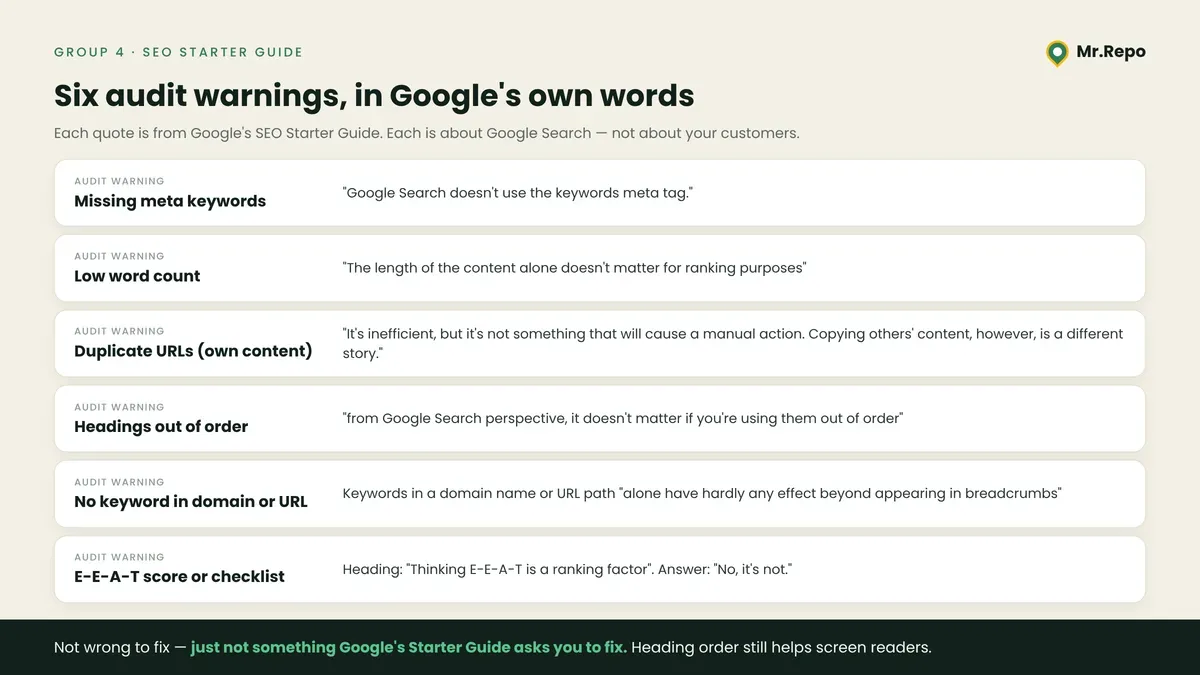
Each row is about Google, not about your customers. Heading order still helps screen-reader users, and a short page may still fail to answer a customer's question. A warning in this group is not wrong to fix — just not something Google's Starter Guide asks you to fix.
Does a higher audit score mean higher rankings?
In two searches we found one peer-reviewed study that tested something close. Yüksel, Sümbültepe and Tolon (2021), in the Turkish journal İşletme Araştırmaları Dergisi, compared Google Lighthouse's SEO score with ranking position for 160 pages across shopping-category searches and found only a weak relationship. That is one small study, of one tool's score, in one category, read at abstract level, so it settles nothing.
Two Google sentences sum up its broader position. From its Starter Guide: "There are no secrets here that'll automatically rank your site first in Google (sorry!)." From its page on hiring an SEO: "No one can guarantee a #1 ranking on Google."
How to read your audit: our working practices
These are our own working practices, not findings from any study:
Sort before you fix. Put every item into one of the four groups above. Setting Group 4 aside can shorten the to-do list.
Fix Group 1 first. Blocked pages, error status codes and noindex tags on pages you want found decide whether a page is eligible to be indexed.
Check Group 2 for anything you or a contractor did on purpose. Links bought for ranking and stuffed copy are among the practices Google's spam policies cover.
Work through Group 3 for customers first. Clear titles, accurate descriptions, alt text and fast pages help people choose you, whatever they do for ranking.
Give it time. Google's Starter Guide says "Some changes might take effect in a few hours, others could take several months."
Where MrRepo fits
MrRepo's SEO offer is local SEO, not website audits. Our features page describes it as "Local search work handled by the Mr.Repo SEO team, with a dashboard that shows it", where you "Follow your local visibility score, Google rating and review velocity, spot gaps in your Google listing, and see the keywords, listings and work our team records for you." Local SEO is "A managed service", priced separately from the plans. A visibility score, like every score here, is not a promise of rank.
See what is included on our features page, or how Local SEO is priced on pricing.
Key Takeaways
An audit score is built from a vendor's own checks, weighted its own way. It is not a Google measurement.
Sort the report into Google's three Search Essentials parts plus the Starter Guide's list of things that don't matter. The technical requirements decide eligibility for indexing — and meeting them does not guarantee indexing.
Spam tactics can get a page demoted or omitted even if it meets every technical requirement.
Google's SEO Starter Guide plays down meta keywords, content length alone, duplicate URLs of your own content, heading order and E-E-A-T as a ranking factor. Fix those for customers, not for Google.
Core Web Vitals are used by Google's ranking systems, but Google says there is no single signal and good scores do not guarantee top rankings.
Frequently Asked Questions
Is a "toxic backlinks" warning a Google penalty? Not in itself. A toxic list is the tool's judgement, not a Google finding. Google's link-spam policy covers links created primarily to manipulate rankings, such as links bought for ranking.
Does Google use Semrush's Authority Score? Semrush calls it "our compound metric". In four searches we found no Google help page that mentions third-party authority scores.
Should I chase a perfect Core Web Vitals score? Google's page experience page says "trying to get a perfect score just for SEO reasons may not be the best use of your time." Fix what slows real customers down.