Review Velocity: What a Monthly Review Count Can Tell You, and How Much Could Be Chance
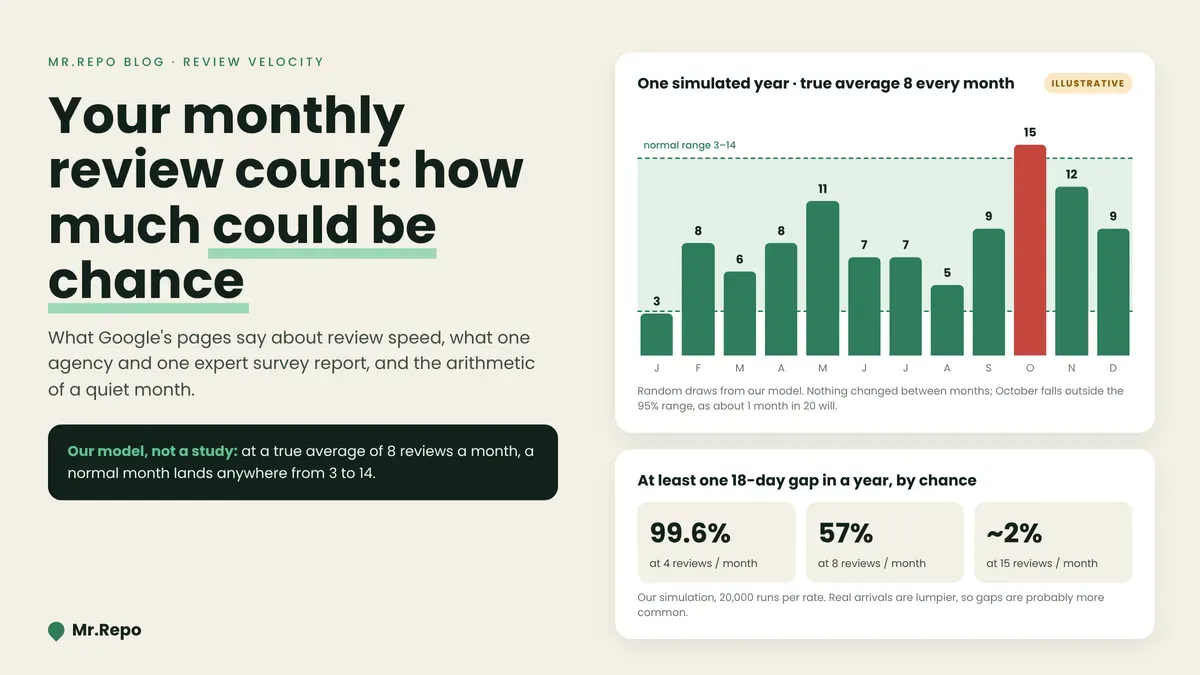
Last month you got eleven Google reviews. This month you got five. A competitor down the road got nine. Is something wrong?
Not necessarily, and this post shows why using a simple model of chance. "Review velocity" means how fast new reviews arrive, and our own features page lists it. But a single month's count is a small number, and small numbers move around on their own.
We sell a review-collection product, including the QR codes discussed below, so read us with that in mind.
What two Google pages say, and do not
Google's page on local ranking says: "Local results are mainly based on relevance, distance, and popularity." On reviews, the page says: "More reviews and positive ratings can help your business's local ranking." It also says: "There's no way to request or pay for a better local ranking on Google."
That page, in our reading, does not contain the words "recent", "recency", "velocity" or "frequency". Google's "Tips to get more reviews" page also says nothing, in our reading, about how often or how evenly reviews should arrive.
So claims that Google ranks on review speed do not come from these two pages. In two web searches we found no peer-reviewed study of review recency or velocity and Google's local rankings.
What practitioners report
An expert survey. Whitespark's 2026 Local Search Ranking Factors report invites 47 local search experts to score 187 factors. In the local pack and Maps list, "Recency of Reviews" ranks 11th and "Sustained Influx of Reviews Over Time (rather than bursts)" ranks 14th. This is a survey of opinion; the report notes: "None of the experts have special access to the internal workings of Google's local search algorithm." Whitespark sells local SEO software and services.
One agency's reports. Sterling Sky, a local SEO agency, published a study of 8,186 businesses across 200 cities for five home-service "near me" searches, with data partner Places Scout. It states: "The number of reviews you've gotten this month matters more than your total number of reviews." In our reading, the page does not describe how that comparison was made or state limitations.
The same post adds an anecdote. A dental client "who pulled in 60+ reviews a month" stopped: "Then they stopped. For 18 days." The post continues: "Their rankings fell off a cliff." That client is not part of the 8,186-business dataset, which covered home-service searches. It is one client, one episode, reported by the agency that served it.
A different Sterling Sky page has a related line in its summary box: "The 18-Day Rule: Rankings can 'fall off a cliff' if you stop receiving reviews for even three weeks; stay consistent." The body of that page tests review count (for example, going from 9 to 10 reviews), and an older (2024) Sterling Sky reply in its comments says: "For this particular study, the focus was on the number of reviews, not necessarily the recency of them."
None of this shows velocity does nothing. It shows the evidence we found is an expert survey and one agency's observations, and that the only basis we found for the 18-day number is a single business receiving 60 or more reviews a month.
How much a monthly count can move by chance
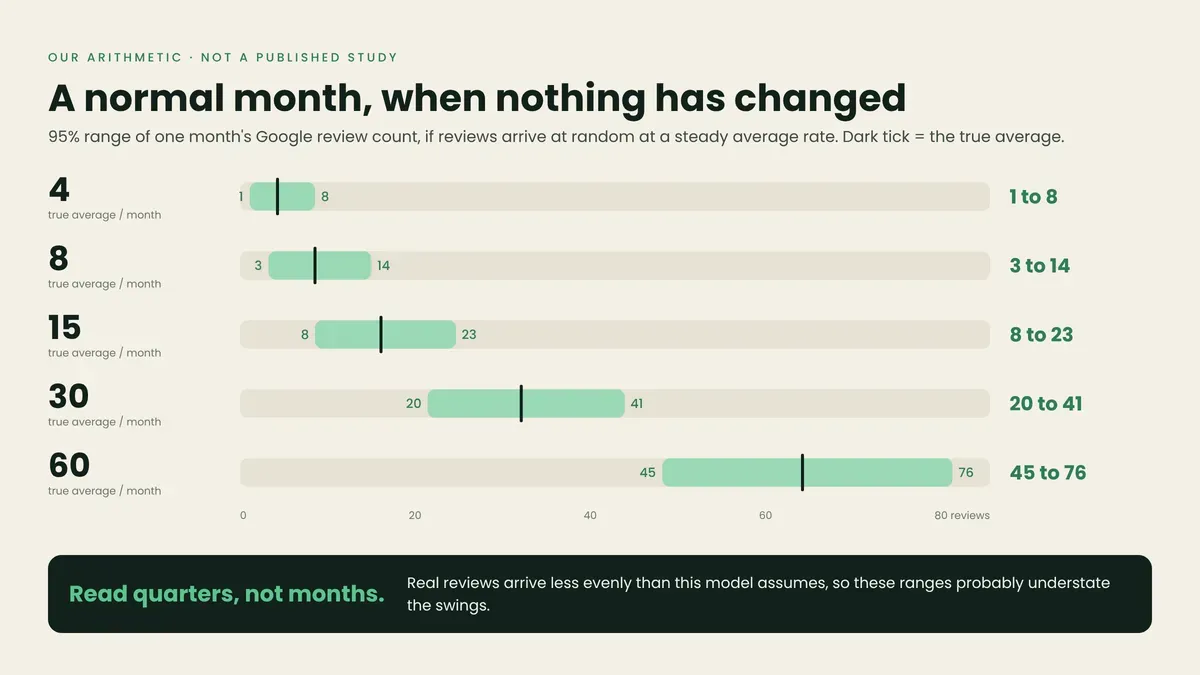
To see what chance alone does, we used a simple model: reviews arrive at random, at a steady average rate. This is our own arithmetic, not a published study, and real reviews usually arrive less evenly than the model assumes. So treat these ranges as probably understating the swings.
One month's count, when nothing has changed.
| True average per month | A normal month (95% range) |
|---|---|
| 4 | 1 to 8 |
| 8 | 3 to 14 |
| 15 | 8 to 23 |
| 30 | 20 to 41 |
| 60 | 45 to 76 |
Eleven reviews one month and five the next sits inside the normal range for a business averaging 8.
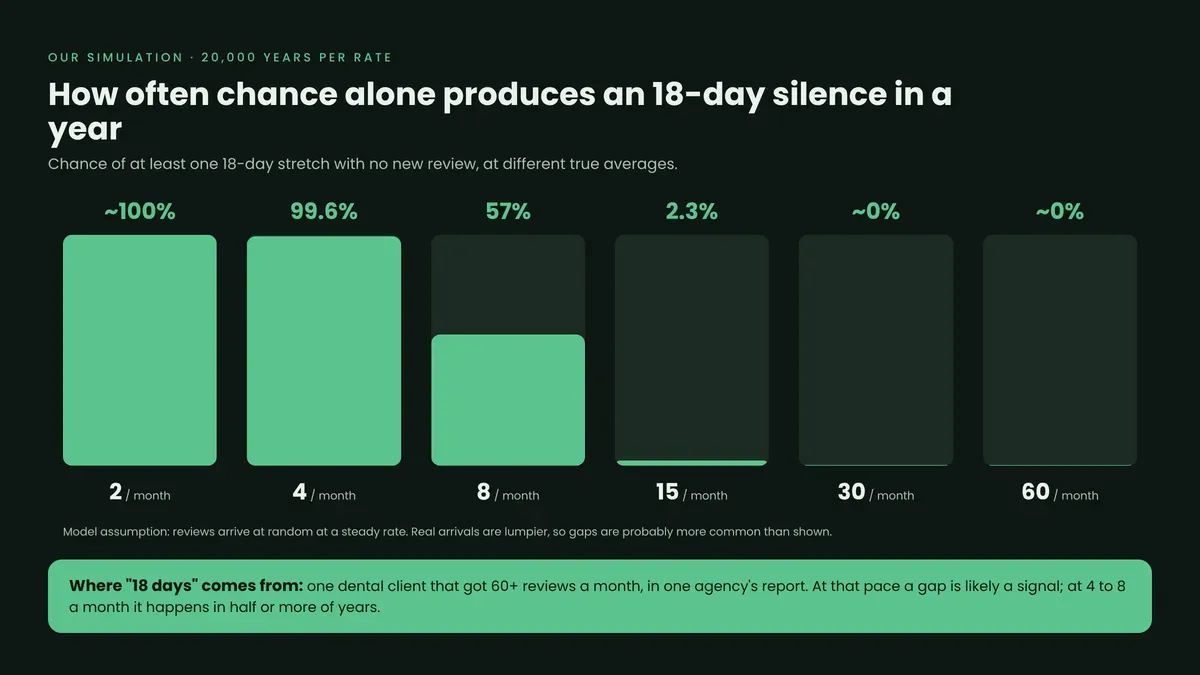
Quiet stretches. The 18-day anecdote involved a business getting 60 or more reviews a month. In our model, 18 days without a review at that pace almost never happens by chance; a real gap probably reflects a change. At 4 reviews a month, the chance that any given 18-day window passes with no review is about 9%. Across a whole year, our simulation found at least one 18-day gap in 99.6% of runs at 4 a month, and in 57% of runs at 8 a month. At 15 a month it fell to about 2%.
For a high-volume business, an 18-day silence is likely a signal. At 4 to 8 a month, our model produces one by chance in half or more of years, so an "18-day rule" used as a universal threshold would often raise false alarms.
A rival who looks faster. Suppose you and a competitor both truly average 8 reviews a month. In any single month, the chance that the competitor's count beats yours by four or more is about 19%, roughly one month in five. By five or more, about 13%.
How long it takes to see a real difference. Now suppose the competitor really does average 12 a month to your 8. After one quarter, the gap you would expect to see (12 reviews) is still smaller than the noise margin (about 15). On our arithmetic it takes around five months of totals before the expected gap clears the margin, and even then an observed gap clears it only about half the time.
The practical reading: at 4 to 15 reviews a month, a single month's count swings widely by chance in our model. Quarters are better, though even a quarter can miss a real gap. Comparing with the same quarter last year can offset a stable seasonal pattern, but both quarters are noisy, so their difference swings more than either.
The other side: review surges
Two published accounts bear on review surges.
Google announced in April 2026: "If we do see a sudden spike in spam reviews, we'll quickly remove the fake content, pause new reviews on the profile, alert the Business Profile owner and display a notification banner to let consumers know why contributions are temporarily paused." The trigger in that sentence is a spike in spam reviews, not any spike. Google's restrictions page lists, among possible restrictions for policy violations: "Business Profile will not be able to receive new reviews or ratings for set period of time".
Claudia Tomina, writing on Sterling Sky's blog (the same site as the two posts above), describes "review blocks" she has tracked. She lists the patterns she sees: "Reviews being left inside the business", "QR codes used at the counter/tables/checkout", and "Bursts (ex: 10+ reviews in a single day)". She adds: "Individually, none of these signals are necessarily problematic." In one case, a business with a baseline of 72 reviews a month received 179, 235 and 181 in three consecutive months, "a 2.75× increase over the baseline", before a block; 342 of 595 reviews in that period were removed. On which reviews were removed, she adds: "this is my assumption based on five businesses that have had this block applied." She founded Reputation Arm, a reputation vendor.
Two cautions from our side. First, these are one practitioner's observations, not Google's stated rule. Second, we sell QR codes designed for table tents and front desks, a placement on her list. We cannot tell you how Google's systems weigh any of these signals, and we make no claim either way.
Working practices (our heuristics, not research)
These are our own working rules, not tested findings.
Read velocity by quarter, not month. Even at 30 a month, our model has one month ranging from about 20 to 41.
Check a quiet stretch against your own volume before worrying. In our model, an 18-day gap occurs in almost every year at 4 a month and in about half of years at 8.
Ask every customer the same way, every time. This avoids deliberate bursts, though in-store asking and counter QR codes are on Tomina's list.
Do not reward customers for reviews or run one-off review drives. Google strictly prohibits incentives in exchange for reviews; bursts are on Tomina's list.
Before reacting to a rival's jump, compare quarters, and know even those can miss real gaps. Between equals at 8 a month, a rival leads by four or more in about one month in five.
Where Mr.Repo fits
Competitor Analysis lets you "Pick three to track and compare ratings, review counts and review growth side by side, see when a rival overtakes you". Our managed Local SEO service lets you "Follow your local visibility score, Google rating and review velocity". Read those numbers with the same caution: over short periods, an overtake or a dip, yours or a rival's, can be chance.
Our features page also says: "We don't offer customers discounts or rewards for reviewing you, and we don't recommend that you do either." We make no claim that a steadier flow of reviews changes your ranking.
Key takeaways
The evidence we found for velocity as a ranking input is an expert opinion survey and one agency's observations. In two searches we found no peer-reviewed study.
The "18-day" story is one dental client receiving 60+ reviews a month. At 4 to 8 a month, our model puts 18-day gaps in half or more of years.
At 8 reviews a month, a normal month ranges from about 3 to 14 (our arithmetic). Read quarters, not months.
Google announced it would pause reviews after spikes in spam reviews. One practitioner lists surges among patterns she saw before review blocks; her account is observational.
FAQ
Does review velocity affect Google rankings? Google has not said so on the pages we read. Local SEO experts rank recency highly in an opinion survey, and one agency reports case examples. In two searches we found no peer-reviewed study.
How many reviews a month should I aim for? We do not know of a defensible target. Your own volume decides how long you need to watch before a change means anything.
I went 18 days without a review. Should I worry? At about 4 a month, our model puts an 18-day gap in almost every year. If you normally get dozens a month, a gap that long is more likely a real change, such as staff no longer asking.