Search Console and Your Business Profile Count Different Things, Even When Both Say “Clicks”
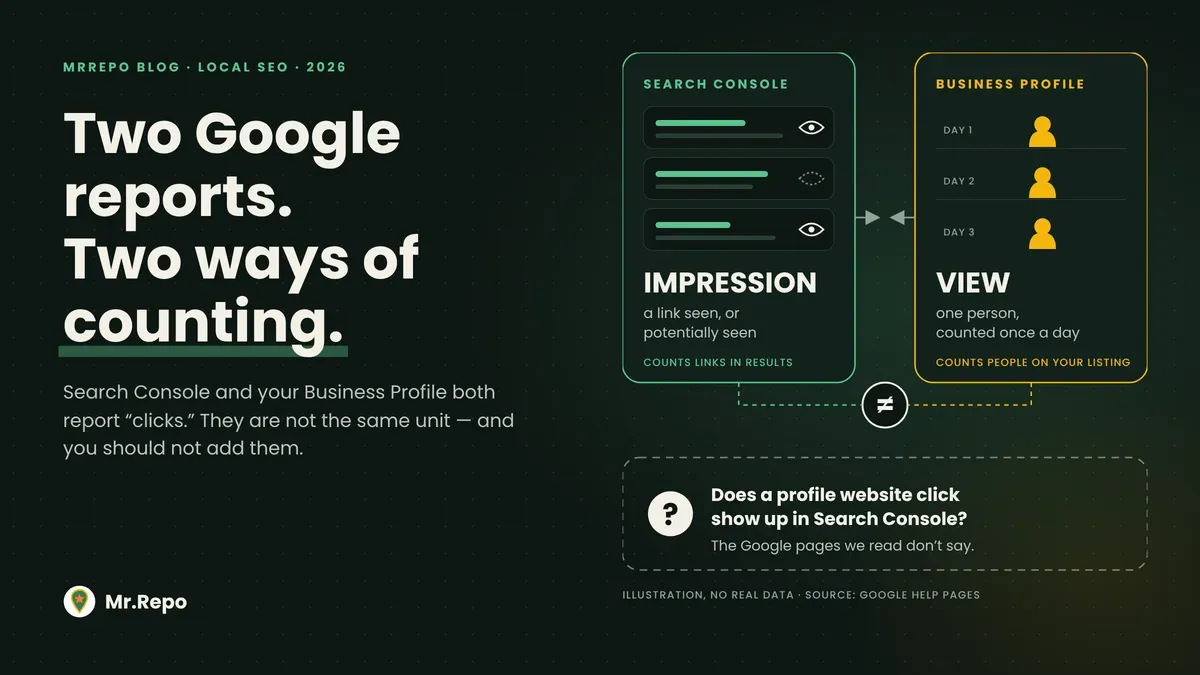
You open Search Console and see one set of clicks and impressions. You open your Google Business Profile performance report and see views, calls and website clicks. Both come from Google, both cover how people find you, and the totals may differ. The natural conclusion is that one of them is wrong.
That conclusion skips the definitions. The two reports define their counts differently, in different units. This post sets the definitions side by side, marks a question the pages we read leave open, and offers working practices for reading both.
What Search Console counts
Search Console reports on how your website's pages appear in Google results. Google's help pages describe an impression as a user having seen, or potentially seen, a link in Search, Discover or News. Per Google, an impression is counted when an item appears in the current page of results, and scrolling away and back during one query or session does not count it twice.
A click, in Google's definition, is any click that takes the user to a page outside Google Search, Discover or News. Position is the relative ranking of your link, with 1 as the topmost, and it applies to Google Search results.
Two further details change how you should read the totals:
Search type. The report can be filtered to text-based web searches, multimodal web searches, Image, Video and News. Figures depend on the search-type filter.
Aggregation. Chart data is aggregated by property, while a table grouped by page is aggregated by page.
What the Business Profile report counts
The Business Profile performance report covers your listing. Google's help page defines views as the number of unique visitors who viewed your profile on Search and Maps, and says a person is counted once a day. It adds that the metric covers views of the Business Profile only, not overall views of your business on Google.
The interaction metrics count different units again:
Calls count clicks on the call button on your profile, and need a phone number on the profile.
Website clicks count clicks on the website link on your profile.
Messages count distinct conversations.
Bookings count completed bookings and depend on a booking provider.
Directions use a counting method Google says it changed to account for multiple taps, cancelled requests and spam.
The searches metric lists the search terms people used to find your business. Google says you cannot directly manage those queries, that the metric updates at the start of each month, and that it can take up to five days to appear. We found no minimum-volume threshold for a term to appear on that page.
The two reports side by side
| Search Console | Business Profile report | |
|---|---|---|
| What it is about | Your website's links in Google results | Your Business Profile listing |
| Exposure unit | Impression: a link seen or potentially seen | View: a unique visitor, once a day |
| Action unit | Click: any click leaving Google Search, Discover or News for another page | Calls, website clicks, directions, messages, bookings, each defined separately |
| Time behaviour | Newest data may be preliminary and change | Searches metric: updates monthly, up to five days to appear |
| What can be missing | Anonymized rare queries omitted from the query table; some long-tail rows may be omitted | No minimum volume stated for search terms |
An impression and a view are not the same event measured twice. One counts a link seen or potentially seen, the other counts people per day. We do not add or divide them.
A question our sources leave open
The obvious next question is whether a click on your profile's website link shows up in Search Console's click total. We could not answer it from our sources. We read the Search Console Performance report page and its data-discrepancies page and found no mention of Google Maps or Business Profile on either. We also found no sentence on those pages or on the Business Profile page saying whether website-link clicks from a profile appear in Search Console.
A third-party guide offers a partial answer. BrightLocal's guide to Business Profile UTM tracking, written by Claire Carlile, a Business Profile Platinum Product Expert, says traffic from a profile shows in Google Analytics as either direct or organic when you add no UTM tags. It does not say how Search Console treats those clicks. That is one publisher's account of one tool, and it leaves the Search Console half unanswered.
So the honest position is that the relationship is undocumented in the pages we read. A claim that the two totals should reconcile is not supported by the pages we read.
Why one tool's numbers can differ
Even inside Search Console, the same dates can give different numbers. Google's data-discrepancies page lists reasons the report can differ from other tools: privacy protections mean the report does not show all data; processing, such as removing duplicates, can change totals; there can be a lag before numbers are visible; different time zones shift daily views; and some tools only track users with JavaScript enabled.
Inside the report, Google says the query table can display a maximum of 1,000 rows, and that anonymized rare results are omitted from it. The newest day can be preliminary. By default the report shows complete days.
Working practices for reading both
These are our own working practices, not Google guidance or a study.
Name every number with its tool and unit. "Search Console clicks" and "Business Profile website clicks" are different metrics; write them that way in every report you share.
Don't add or divide across the two tools. Impressions and views are different units. Keep each tool in its own column.
Compare each tool with itself, over identical date ranges. A rise in Search Console clicks says something about your site's links in Google results. Calls are a separate metric.
Use complete days. If you include the newest data, expect it to change.
Consider tagging your profile's website link. BrightLocal says untagged profile traffic shows in Google Analytics as direct or organic. If you add UTM tags, note the date.
Keep a change log. Record when you edited the profile, changed the site, started or paused ads, or got a burst of reviews. A log helps avoid inventing a story when two reports move differently.
When the two disagree, don't assume one is wrong. Ask what each unit counts.
Where this fits in a Local SEO routine
If you use any dashboard, ours included, ask the same questions of every figure: which tool counted it, in what unit, over what window, and is it preliminary. MrRepo's Local SEO service is run by our SEO team and includes a dashboard tracking visibility score, Google rating, review velocity, listing gaps and keywords. It is priced separately; the features page lists what is included.
Frequently asked questions
Why does Search Console show a different click count from my Business Profile website clicks? Their definitions differ. Search Console counts clicks from your site's links in Google results that lead to a page outside Search, Discover or News. The Business Profile report counts clicks on the website link on your listing. The pages we read do not say how the two relate, so a gap alone settles nothing.
Are Business Profile views the same as Search Console impressions? No. A view is a unique visitor to your profile, counted once a day. An impression is a link seen or potentially seen in results. Different units.
Why does my Search Console total change when I switch from the chart to the table? Google says charts aggregate by property and page tables by page, and tables show at most 1,000 rows.
Does Search Console include Google Maps? Unknown. The two Performance report pages we read do not mention Google Maps or Business Profile.
Why do my Business Profile searches update monthly? Google's help page says the searches metric updates at the start of each month and may take up to five days to appear.
Key takeaways
Search Console counts links seen or potentially seen in results and clicks leaving Search, Discover or News; the Business Profile report counts unique profile viewers and specific profile actions.
An impression and a view are different units. Don't add or divide them.
Google's pages we read do not say whether profile website clicks appear in Search Console. Treat that as unknown.
One tool's totals can differ because of aggregation, omitted rows and preliminary data.
Name each figure with its tool, unit and date range, and compare each tool with itself.