Best Review Management Software for Small Businesses: What to Check Before You Pay
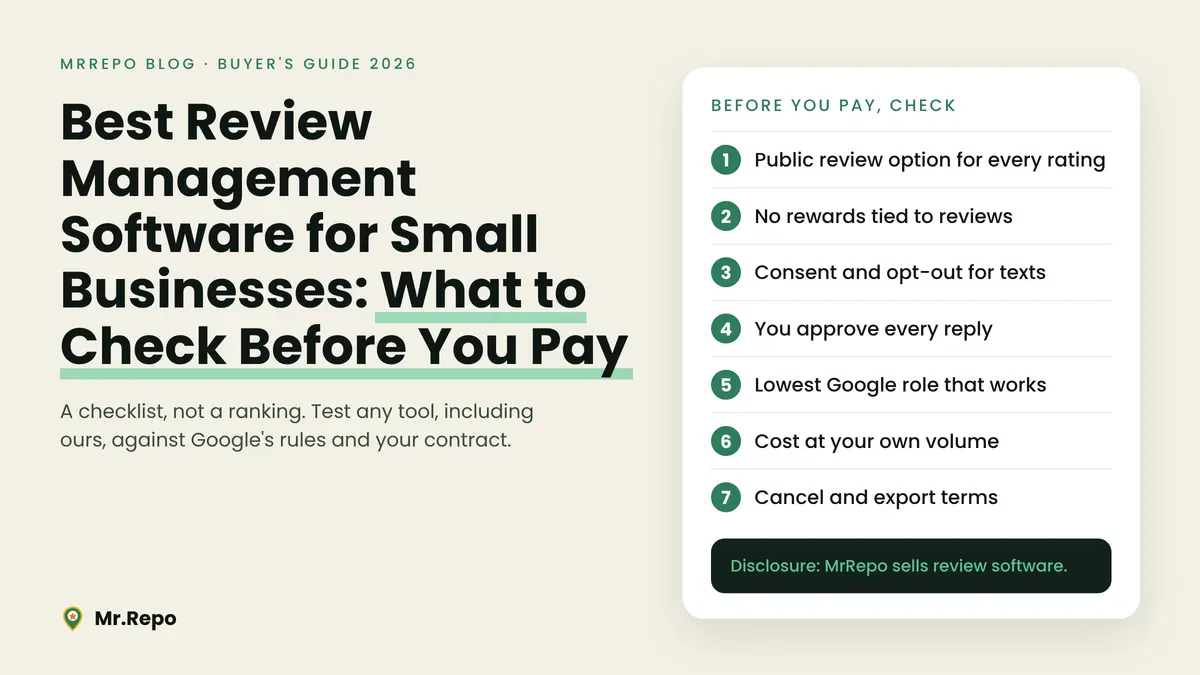
Disclosure first: MrRepo sells review software, so we are one of the vendors you might be comparing. This is a checklist, not a ranking, whatever the title suggests. A ranking written by one of the sellers is a comparison a careful reader should discount. We did not test any other vendor's product, so everything below about other tools is a question to ask, not a finding.
This is not legal advice.
1. Does every customer still see the public review option?
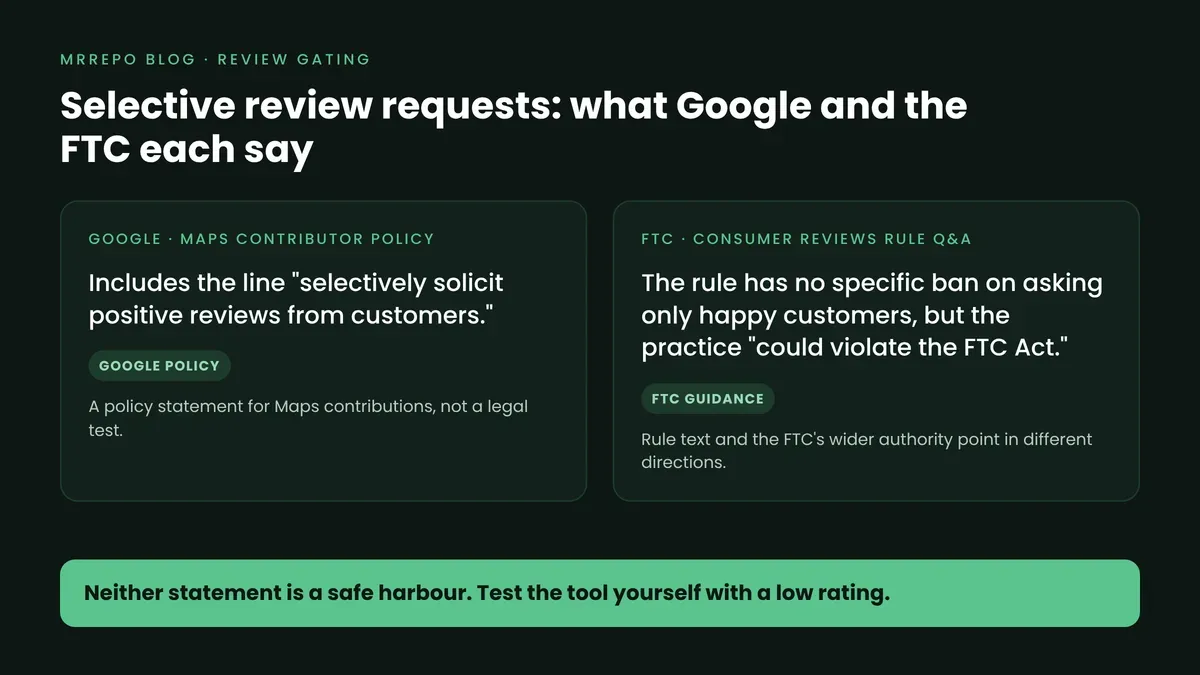
This is the first check. A tool could ask customers to rate their visit, then send happy customers to Google and unhappy ones to a private form (review gating; see our explainer). Google's Maps content policy includes the line "Discourage or prohibit negative reviews, or selectively solicit positive reviews from customers."
The FTC is less direct. Per its Q&A, the review rule (16 CFR Part 465) has no specific prohibition on asking only customers you think are happy, but the practice "could violate the FTC Act." Another part, 465.7(b), bars misrepresenting the reviews you show as all or most when some were suppressed for their ratings or negative sentiment. So the rule has no specific ban, the FTC says the FTC Act may apply, and neither clears the practice.
What to ask a vendor:
After a low rating, is the public review link still shown, with the same prominence as after a high one?
Can any setting hide or reorder that option, and who controls it?
Can you test it yourself, with a deliberately low rating, before you pay?
2. How does it ask customers, and who has consented?
Google allows asking: its help page says you can ask customers to visit a Google link or scan a QR code. It also says offering incentives for reviews is "strictly prohibited." The FTC rule separately covers incentives for reviews expressing a particular sentiment, positive or negative; the FTC says that applies on your site or third-party platforms. (Our post on requests that break the rules compares the two.) So check for reward features, such as discount codes or prize draws tied to leaving a review. Google prohibits them, whatever the sales page calls them.
Text requests are a separate question. Ask how the vendor records consent and handles opt-outs. The wireless industry's guidelines (CTIA) call for express written consent for marketing messages and for customers to be able to revoke consent. Twilio's documentation says senders on 10-digit business numbers (10DLC) must register, and unregistered traffic gets extra carrier fees; that is one vendor's documentation, not a carrier rule. Whether a review request counts as marketing, we did not verify from a primary source (we could not read FCC order 12-21), so we state no rule. See our text-message post and ask a lawyer if you text at volume.
3. What access does it need to your Google profile?
Tools that answer reviews for you may connect to your Business Profile.
Roles matter. Google describes owners as having full control. Managers have mostly the same access, except they cannot add or remove users or remove the profile. Our suggestion (opinion, not a Google rule): ask which role a tool needs, and avoid handing over primary ownership. Whether a tool works at Manager level is for that vendor to confirm.
Vendors using Google's API must apply too. Google's API documentation requires applicants to manage a verified, active profile for 60 or more days and to apply for access. Its policy says tools may manage listings you own or are authorized to manage. You can ask whether a vendor connects through Google's official API.
Automatic replies need your express consent. The same policy says a tool must not automate or trigger review replies without the user's prior, specific and express consent. Search Engine Land reported in March 2026 that Google was testing AI-generated review replies that users can edit and submit; that is a secondary report of a test. Our two searches found no Google help page on AI-written replies, so ask:
Does every reply need your approval before it posts?
Can you switch automatic posting off?
Who is accountable if a reply says something wrong about a customer?
4. What will it cost, and what happens at the limits?
Sticker prices can hide three things: how usage is counted, what happens at a limit, and how you cancel.
Usage counting. Is the price per location, per user, per request sent, or per response received? These give different bills for a business with seasonal traffic.
A worked example. ILLUSTRATIVE: our arithmetic on MrRepo's prices listed on 21 October 2026; not a benchmark. Premium is listed at $99 a month ($79 a month billed annually). Pay As You Go is $1 per feedback response, with all Premium features, free scans and no monthly fee. At $1 a response, pay-as-you-go costs less than monthly Premium below 99 responses a month, and less than the billed-annually price below 79. Above those, Premium is cheaper if it has no response cap (none is stated); Pro ($29, or $23 annual) has fewer features and is not compared here. Count your own responses. We did not check credit packs, expiry or switching terms.
Limits. Ask what happens when a plan ends or a cap is hit. On MrRepo's free plan, the pricing page says the feedback page pauses at the end of the trial or after five responses. A printed QR code could then lead customers to a paused page. Ask any vendor what a customer sees when your account lapses.
Cancelling. ROSCA, a US law on online recurring charges, requires clear disclosure of material terms, express informed consent before charging, and simple mechanisms to stop recurring charges. We did not confirm whether it covers a business buyer, so do not assume it does.
The FTC's 2024 "click-to-cancel" amendments were vacated by a federal appeals court in July 2025; the FTC issued an advance notice in March 2026, and we located no proposed or final rule by 21 October. So read the contract closely: the renewal clause, how you cancel (a settings page or an email), and any refund terms for annual billing.
5. What leaves with you when you leave?
Google displays public reviews on your profile. A vendor may hold the rest: private feedback, its own analytics history and any reply drafts. Ask:
Can you export all of it, in what format, and on which plans?
How long is data kept after you cancel?
Where is customer data stored, and who can see it?
We did not confirm that any law gives your business an export right, so treat export as a contract term.
6. Which promises should you discount?
"We remove bad reviews." Google's content policy sets what gets removed, so removing honest reviews is not a promise a vendor controls. The FTC rule also covers groundless legal threats, intimidation or false accusations used to remove or prevent a review. Our features page says we cannot remove honest reviews from Google.
"Guaranteed rating increase." Ask what the guarantee covers and what remedy follows if ratings do not rise.
"We generate reviews." Google requires reviews to reflect a genuine experience, and fake engagement is not allowed.
Vendor rankings. Be wary of any with no first-hand evidence. Google's product-review guidance asks for evidence of your own experience. It is not written for software, and we rank no one.
A one-page scorecard (our working heuristic, not research)
Score each tool 0 (no or unknown), 1 (partly) or 2 (yes). Treat a 0 on questions 1, 2 or 3 as a reason to ask more. The scale is ours and untested.
Public review link equally prominent after any rating.
No reward or discount tied to reviews.
Consent and opt-out handled, or it does not text customers.
Replies need your approval.
Access role is the lowest the vendor confirms works.
Price is based on something you can predict.
A lapsed account fails gently.
Cancellation steps are stated up front.
Full data export exists on your plan.
Support answered a written question during your trial.
Where MrRepo fits
Product details are as of 21 October 2026, from MrRepo's own pages (not an independent test). MrRepo generates QR codes for a feedback page where customers choose a public Google or Yelp review or private feedback. The features page claims the public option is not hidden for low ratings (test it, per section 1), and says MrRepo does not write, buy or post reviews, or offer customers discounts for reviewing. Private feedback goes to an inbox; email and SMS alerts to you are on Premium and Pay As You Go.
The features page lists Google Business Profile management as coming soon. We found one listed export, a PDF report (Premium and Pay As You Go). The pricing page says no contracts or cancellation fees and cancelling from membership settings; we found no auto-renewal or refund wording on those two pages (terms not read). We have not scored MrRepo on questions 3, 7 and 10. You can try the free plan. See features, pricing and how feedback software works.
FAQ
Is review management software worth paying for? It can be, if you will use what it reports. A tool helps you ask for and read feedback. Use a free trial, if offered, scored against the scorecard.
Can software reply to my Google reviews automatically? Google's API policy requires your prior, specific and express consent before a tool automates replies. Approving each one is our suggestion, not Google's rule.
Where can I learn how to ask customers well? See our scripts and templates guide.
Key takeaways
Test gating yourself: submit a low rating and check the public link appears. One test is not proof.
Google prohibits review incentives; the FTC rule separately covers incentives tied to sentiment.
Ask which Google access role a tool needs, and whether replies need your approval.
Work out cost from your own response volume, and ask what happens when an account lapses.
Export and cancellation terms sit in your contract; do not assume the law covers you.