Is It Legal to Text Your Customers for a Review? What the Rules Actually Say
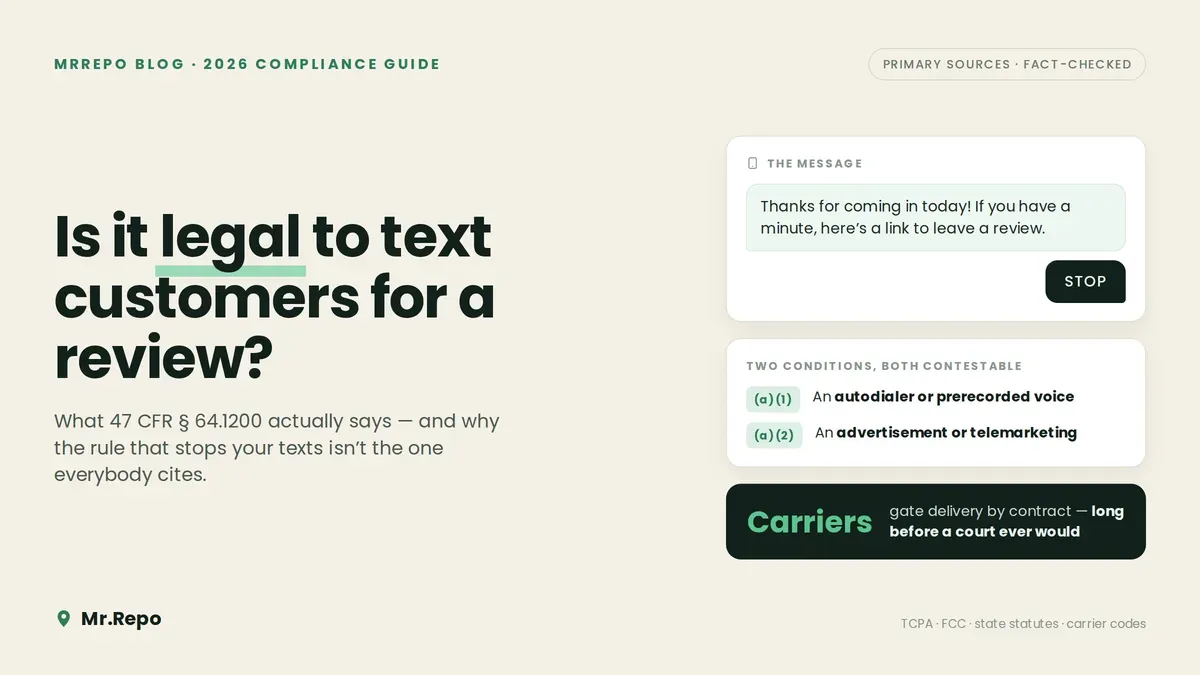
Ask a review platform whether texting customers is allowed and you will usually get some version of this: a review request is an advertisement, advertising texts need prior express written consent under the TCPA, so collect a signed opt-in.
We read the rule text. That answer is more confident than the regulation supports — and it points at the wrong risk.
Not legal advice. Several questions below are genuinely unsettled, and we say so where they are.
First, the part everyone gets right: a text is a "call"
There is no loophole here. In its 2016 declaratory ruling FCC 16-88, the Commission restated a position it has held since 2003: "The Commission has concluded that the TCPA's protections against unwanted calls to wireless numbers encompass both voice calls and text messages, including short message service (SMS) texts, if the call is made to a telephone number assigned to such service."
The question is never whether the TCPA reaches texting. It is which of its prohibitions attaches to this message.
What the TCPA prohibits — and two conditions review texts can contest
The operative rule is 47 CFR § 64.1200. Two paragraphs matter.
Paragraph (a)(1) bars calls to a cell number other than for emergencies or with "the prior express consent of the called party" — but only those made "using an automatic telephone dialing system or an artificial or prerecorded voice."
Paragraph (a)(2) raises the bar for a narrower class: it bars initiating "any telephone call that includes or introduces an advertisement or constitutes telemarketing, using an automatic telephone dialing system or an artificial or prerecorded voice," to those same numbers, "other than a call made with the prior express written consent of the called party..."
Both rest on a condition with nothing to do with content: the autodialer or prerecorded voice. Remove it and neither paragraph bites. Most review-request texts have a real argument on that, and on the content question too.
Condition one: is your review platform an autodialer?
Courts disagreed about this for years until the Supreme Court narrowed it in April 2021. In Facebook, Inc. v. Duguid, No. 19–511, Justice Sotomayor wrote for the Court: "To qualify as an 'automatic telephone dialing system,' a device must have the capacity either to store a telephone number using a random or sequential generator or to produce a telephone number using a random or sequential number generator."
That is a narrow definition. A system that pulls your customers' actual numbers out of your booking software is not generating numbers randomly or sequentially — it is working from a list you built. On Duguid's reasoning that is a strong argument it is not an autodialer, which, if accepted, leaves (a)(1) and (a)(2) with an unmet predicate before content is reached. The limit matters: Duguid turns on the capacity of specific equipment, a factual question plaintiffs still litigate.
Condition two: is a review request an "advertisement" or "telemarketing"?
The definitions in paragraph (f) are narrower than the everyday meanings. "Advertisement" at (f)(1) is "any material advertising the commercial availability or quality of any property, goods, or services." "Telemarketing" at (f)(13) is "the initiation of a telephone call or message for the purpose of encouraging the purchase or rental of, or investment in, property, goods, or services..."
A message saying thanks for coming in — here's a link if you have a minute arguably encourages no purchase; they already bought. And we read it as not advertising your quality to that recipient — it asks them to state their own. A plain review request sits awkwardly outside both definitions.
That is an argument, not a holding. So we went looking for a court that had decided it.
The one analogous ruling we found is a fax case
We searched for a court decision or FCC ruling holding squarely that a review-request text is an advertisement or telemarketing. We did not find one.
In Mauthe v. National Imaging Associates, No. 18-2119 (3d Cir., 17 April 2019), a faxed customer satisfaction survey was held not an "unsolicited advertisement." The reasoning we would borrow, as reported: "asking a recipient in a survey whether a sender's services meet a standard is not the same thing as claiming the services meet that standard." A review request asks the customer to make the claim; it does not make the claim.
Scope this carefully. Mauthe was a fax case construing the "unsolicited advertisement" definition, not "telemarketing"; it binds one circuit; and we quote it from a report of the opinion rather than the slip opinion. Persuasive reasoning, not permission.
One version of the review text does cross the line: the one that bundles an offer. Leave us a review and get 10% off encourages a future purchase — and it has worse problems than the TCPA. The FTC's rule at 16 CFR § 465.4 bars incentives "conditioned expressly or by implication on, the writing or creation of consumer reviews expressing a particular sentiment, whether positive or negative," which an offer paired with a nudge to be positive can trip. Google's Maps content policy separately bans "Reviews or ratings that have been paid for, directly or in kind" — with no sentiment condition at all. Keep the incentive out and both questions close.
Revocation: what (a)(10) actually attaches to
Paragraph (a)(10) lets a called party revoke consent "to receive calls or text messages made pursuant to paragraphs (a)(1) through (3) and (c)(2) of this section by using any reasonable method." The words "stop," "quit," "end," "revoke," "opt out," "cancel," and "unsubscribe" sent in reply to a text are a "reasonable means per se," alongside a key-press opt-out or a designated website or number; other methods get a rebuttable presumption under (a)(11), assessed on the totality of circumstances. Requests "must be honored within a reasonable time not to exceed ten business days." Paragraph (a)(12) permits one confirmation text if it contains no "marketing or promotional information."
Now read that opening clause again. (a)(10) attaches to calls made pursuant to (a)(1) through (3) and (c)(2) — of which we have argued only (a)(1) and (a)(2). We did not analyse (a)(3), and (c)(2), the do-not-call registry, has no equipment element. The argument is partial.
That is not permission to ignore STOP — a carrier contract requires it regardless.
One currency note: the FCC has delayed a narrow piece of (a)(10). An order released 6 January 2026 (DA 26-12) extended the waiver of the requirement that a revocation "made in response to one type of message" apply "to all future robocalls and robotexts from that caller on unrelated matters," pushing it to 31 January 2027. We did not verify the effective-date position of the rest.
Where the exposure actually sits: state law
The federal analysis is the reassuring half. Several states wrote their own telemarketing statutes with different words, and the differences land precisely where a review request sits.
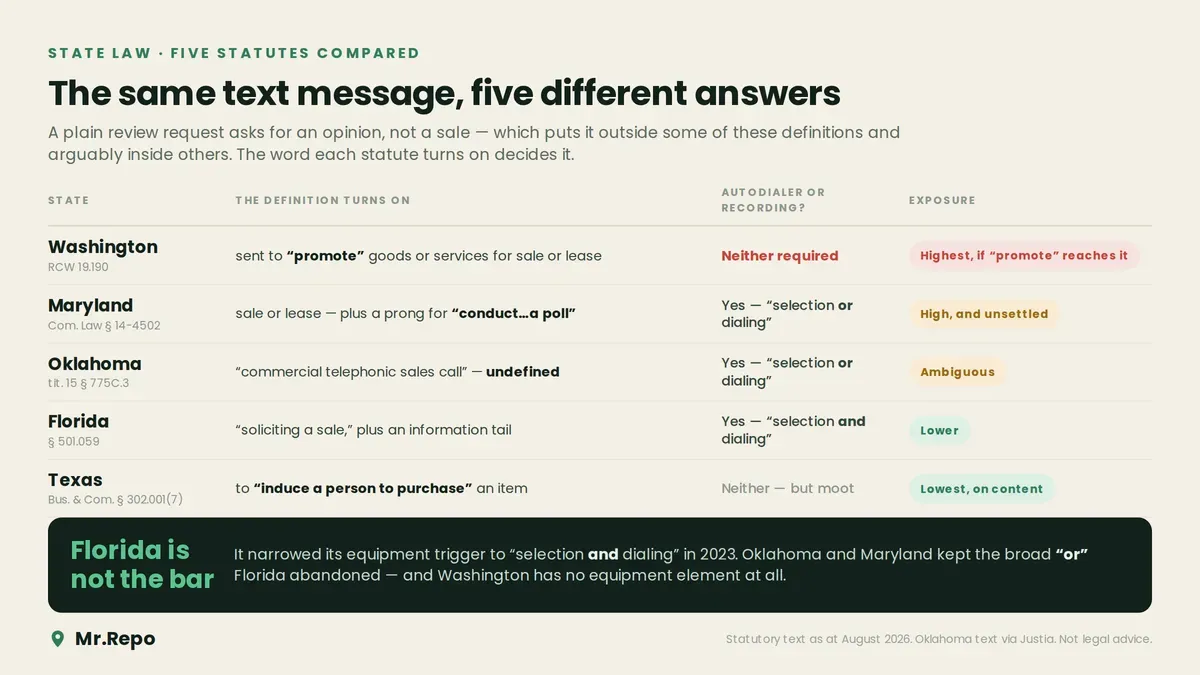
| State | Definition turns on | Autodialer or recording? | Exposure for a review text |
|---|---|---|---|
| Washington (RCW 19.190) | "sent to promote real property, goods, or services for sale or lease" | Neither required | Highest if "promote" reaches it: no equipment defence |
| Maryland (Com. Law § 14-4502) | Sale/lease — plus a prong covering "conduct or attempt to conduct a poll" | Yes: "selection or dialing" | High, and unsettled |
| Oklahoma (tit. 15 § 775C.3, per Justia) | "commercial telephonic sales call" — undefined in the statute | Yes: "selection or dialing" | Ambiguous |
| Florida (§ 501.059) | "soliciting a sale," plus an "obtaining information" tail | Yes: "selection and dialing" since 2023 | Lower |
| Texas (Bus. & Com. § 302.001(7)) | "to induce a person to purchase, rent, claim, or receive an item" | Neither required | Lowest, on content alone |
Washington is the outlier to plan around. Promote is a broader verb than solicit a sale, and RCW 19.190.060 bars a "person conducting business in the state" from transmitting such a message to a Washington cell number — with no equipment element anywhere. RCW 19.190.070 permits it where "the subscriber has clearly and affirmatively consented in advance..." Damages under RCW 19.190.040 are "$100, or actual damages, whichever is greater," and § 19.190.060(2) makes a violation an unfair or deceptive act under the state Consumer Protection Act. The equipment defence that helps you in Florida is unavailable here.
Maryland's poll prong is the odd one. Its definition of telephone solicitation comes from Public Utilities § 8-205, which reaches an organized activity to "conduct or attempt to conduct a poll" — with no commercial limitation. The adjacent survey prong has one: it applies only where results "will be used directly to solicit persons to purchase, lease, or rent goods or services." Which prong a rate your experience campaign falls under is unsettled.
Do not build to Florida's standard and assume you are covered. Florida narrowed its equipment trigger in 2023 from "selection or dialing" to "selection and dialing," and added a pre-suit step for text claims: the recipient must first reply STOP, and the sender has 15 days to comply, before a damages action exists. Oklahoma and Maryland kept the broad "or" Florida abandoned — so Florida is narrower than either, not the benchmark.
The layer that gates delivery, and it isn't a court
Long before a lawyer is involved, your messages pass through mobile carriers, who impose their own consent requirements by contract — stricter than the statute, and enforced.
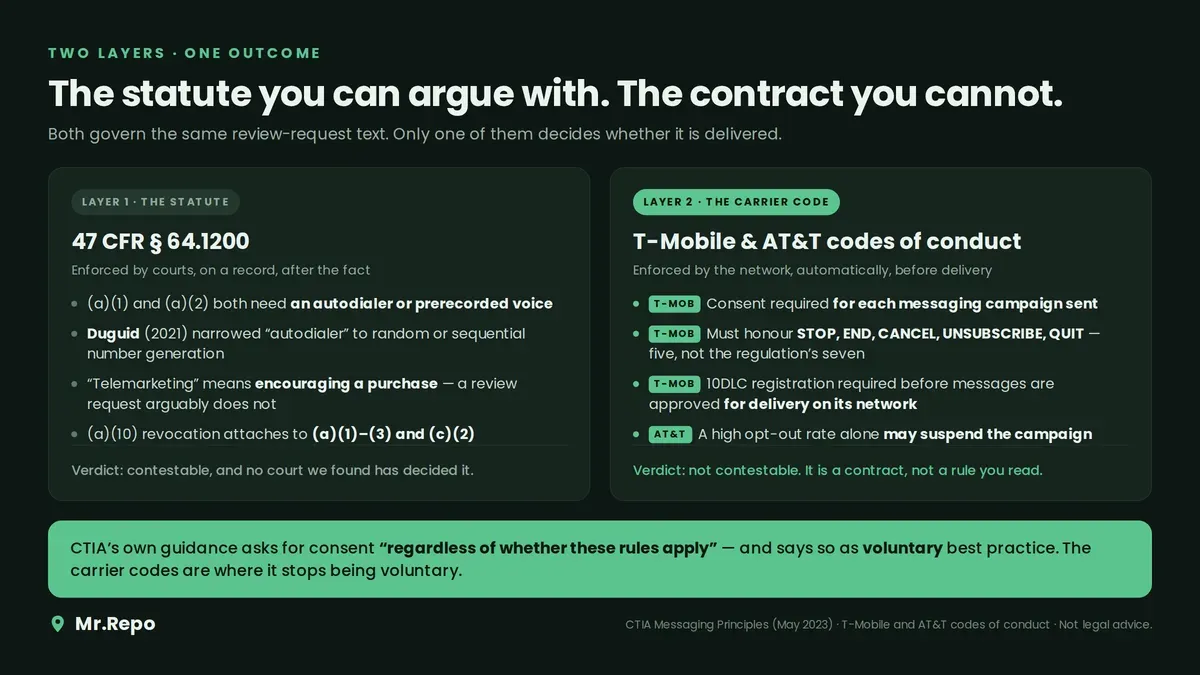
The industry baseline is CTIA's Messaging Principles and Best Practices (May 2023), and its status matters: "As a set of voluntary best practices, CTIA's Principles and Best Practices do not impose, prescribe, or require contractual or technical implementation." Voluntary — but note what it expects anyway: "Regardless of whether these rules apply and to maintain Consumer confidence in messaging services, Non-Consumer Message Senders are expected to: Obtain a Consumer's consent to receive messages generally; Obtain a Consumer's express written consent to specifically receive marketing messages; Ensure that Consumers have the ability to revoke consent."
Where it stops being voluntary is the carrier codes. T-Mobile's Code of Conduct: "The message sender must obtain proper consumer consent for each messaging campaign sent." On opt-outs it is unconditional — "Messaging programs must respond to, at a minimum, the universal keywords STOP, END, CANCEL, UNSUBSCRIBE, and QUIT" — though its five keywords are narrower than the regulation's seven. It lists no lawsuits: non-compliance "could result in the suspension of sending rights for a provisioned shortcode, longcode or Toll-Free numbers... and/or Suspension of all network services." AT&T's code reserves the right to downgrade, suspend or terminate a sender without prior notice, and adds that "a 'high' volume or percentage of opt-out messages may result in suspension or termination of a specific messaging campaign" — triggered independently of any law.
There is also a registration gate. Carriers route ten-digit business messaging through 10DLC registration with The Campaign Registry; T-Mobile says of its own network: "All entities that wish to send sanctioned 10DLC messaging traffic must be registered before their campaign messages will be approved for delivery on our network."
So you may have the better of the federal argument and still not get delivered — the entity deciding that is a carrier applying a contract, not a judge applying § 64.1200. It gates delivery, not liability. We found no named, dated, primary-source dataset on how much non-compliant traffic gets filtered; every percentage we encountered traced to vendor marketing pages.
What to actually do
Cited rules where marked; the rest are our working heuristics, not legal thresholds.
Get consent at the point of contact and record where it came from. A number handed over at checkout, with the customer told what it is for, is a different record from one scraped out of an old spreadsheet. Keep the source and the date.
Keep the incentive out. No discount, no prize draw, nothing conditioned on the review or its sentiment. That rule answers § 465.4, Google's policy, and the "encouraging the purchase" definition at once.
Honour STOP fast, and honour the near-misses. The regulation names seven words; other wording gets only a rebuttable presumption. T-Mobile's code requires STOP handling regardless.
Send one message and at most one reminder. A high opt-out rate may itself trigger suspension under AT&T's code, and volume is the risk you control most cheaply. Our scripts and timing guide covers the wording.
Check the states you actually operate in. If you have customers in Washington or Maryland, the federal analysis does not carry over — Washington requires affirmative advance consent.
Ask whether you need SMS at all. A QR code the customer scans is customer-initiated, so the messaging analysis drops away: no carrier registration, no state text statute. The FTC and Google review rules still apply.
That last point is the honest trade. SMS reaches people who would never return to a link; it also drags in the TCPA, state statutes, a carrier contract and a registration process. That is why MrRepo is built around the scan rather than the send — the customer initiates and chooses openly between a public Google review and private feedback, the kind of unsteered request 16 CFR § 465.2(d) carves out of § 465.2(b) and (c) as "generalized solicitations to purchasers." Our QR placement guide and interactive demo cover placement.
Frequently Asked Questions
Do I need written consent to text a customer asking for a review? The written-consent requirement at § 64.1200(a)(2) applies to messages that are advertisements or telemarketing and are sent using an autodialer or prerecorded voice. A plain review request from a stored customer list arguably meets neither condition. But CTIA's voluntary guidance and carrier contracts expect consent regardless, several state statutes are broader than the federal rule, and no court we found has decided it directly. Consent is the low-cost answer to an unsettled question.
Is a review request an advertisement under the TCPA? Not obviously — § 64.1200(f)(1) defines an advertisement as material advertising the commercial availability or quality of goods or services, and a review request asks for the customer's assessment rather than asserting one. The Third Circuit reasoned similarly about a faxed satisfaction survey in Mauthe (2019), construing a related definition and binding only in that circuit.
What happens if someone replies STOP? Stop texting them. If § 64.1200(a)(10) applies, seven words — "stop," "quit," "end," "revoke," "opt out," "cancel," "unsubscribe" — are per se revocations, other wording is rebuttably presumed valid, and requests must be honoured within ten business days. T-Mobile's code separately mandates only five of them: STOP, END, CANCEL, UNSUBSCRIBE, QUIT.
Can I offer a discount for leaving a review? Don't. An incentive conditioned on the review's sentiment violates 16 CFR § 465.4; an unconditioned one still breaches Google's policy against ratings "paid for, directly or in kind," and turns an arguably non-telemarketing message into one encouraging a future purchase.
Does the state where my customer lives matter? Yes, more than the federal analysis. Washington's CEMA has no equipment element and turns on "promote"; Maryland reaches an organized activity to conduct a poll. Neither is covered by building to Florida's narrowed 2023 standard.
Key Takeaways
The prohibitions at § 64.1200(a)(1) and (a)(2) both require an autodialer or a prerecorded voice. After Facebook v. Duguid (2021), a platform texting stored customer numbers arguably is neither — a capacity question plaintiffs still litigate — so the federal rule vendors cite may have an unmet predicate.
"Advertisement" and "telemarketing" turn on advertising your own availability or quality, and encouraging a purchase. A plain review request arguably does neither. No court we found has ruled directly; the one we found, Mauthe (3d Cir. 2019), was a faxed survey case.
The revocation rule at § 64.1200(a)(10) is tied by its own terms to (a)(1)–(3) and (c)(2) — so only part of that argument carries over. Honour STOP anyway: T-Mobile's code requires it by contract.
State law is where the exposure sits. Washington's CEMA has no equipment element and turns on "promote" rather than "solicit a sale"; Maryland's definition includes a non-commercial "conduct a poll" prong. Building to Florida's narrowed 2023 standard covers neither.
Carriers, not courts, are the practical gate — and a QR code the customer scans avoids the messaging analysis, though the FTC and Google review rules still apply.