You Don't Have to Reply to Every Review — and Trying May Cost More Than It's Worth
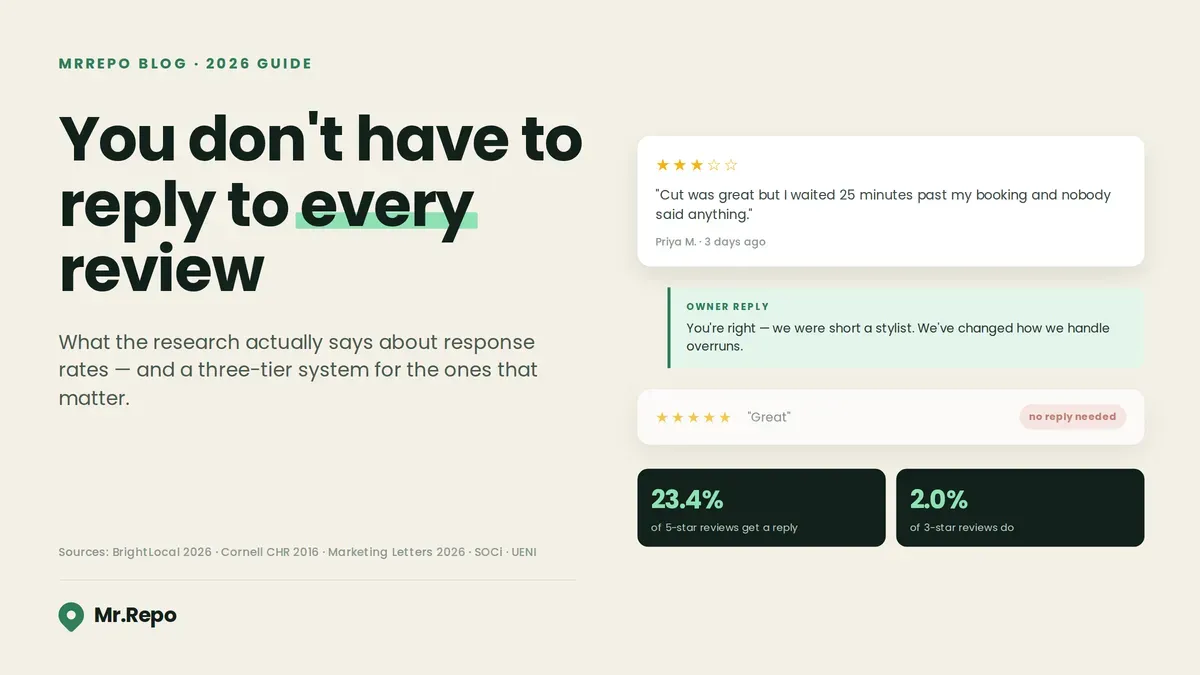
Ask consumers and 89% say they expect business owners to respond to reviews — a stated preference, from a survey of 1,002 US adults. Ask what happens when a business actually tries to reply to all of them, and the picture gets more complicated, and considerably more human.
This post isn't about how to word a reply; we have guides for negative reviews and positive ones, plus a piece on what changes when you start replying at all. This one asks what those posts skip: how many replies is the right number, and what happens to the person writing them when the answer is "all of them, forever."
The advice everyone gives, and the evidence that complicates it
BrightLocal's Local Consumer Review Survey 2026 (11 February 2026, n=1,002 US adults) found 80% of consumers say they're likely to use a business that responds to all of its reviews, and 42% say they're unlikely to use one that never replies. Read quickly, that says: reply to everything.
Now set it beside the only source we found that linked response rate to business outcomes. Cornell's Center for Hospitality Research report Hotel Performance Impact of Socially Engaging with Consumers (Chris Anderson and Saram Han, 19 April 2016) found that "revenue levels increase as the number of management responses increases, but only to a point. After about a 40-percent response rate, hotels seem to reach a point of diminishing returns." Blunter, from the same report: "making too many responses is worse than offering no response at all, in terms of both ratings and revenue." Its own recommendation is to put constructive effort into negative reviews rather than simply acknowledging positive ones.
That's less contradictory than it looks. BrightLocal measured stated preference — what people say in a survey. Cornell described a relationship between response rate and hotel revenue, in an industry report that isn't peer-reviewed and disclosed neither sample size, time period, nor a design that would establish cause. Neither asked anyone to weigh a reply against the time it costs to write — which, as we'll get to, no peer-reviewed study we found has measured.
What survives both: consumers say replying matters, and replying to everything isn't obviously the goal. Finding your number is an operational decision, not a moral one.
Almost nobody replies to everything anyway
Two datasets, neither peer-reviewed, both worth reading because of where they disagree.
SOCi, The State of Google Reviews: 4,936,814 Google reviews and 545,371 responses across 31,326 locations — belonging to just 53 multi-location brands that SOCi itself manages, across 18 industries, from January 2015 to July 2022. Reply rates by star rating: 23.4% of 5-star, 8.6% of 1-star, 4.6% of 4-star, 3.3% of 2-star, 2.0% of 3-star. Overall that works out to about 11% of reviews answered (545,371 of 4,936,814 — our calculation, not a figure SOCi states).
UENI, a small-business website platform, published a study on 19 August 2026 covering 229,882 Google reviews received by small businesses in the 18 months to 14 August 2026, from profiles connected to UENI. It doesn't disclose how many distinct businesses or which countries. Reply rates: 29.3% of 5-star, 13.9% of 2-star, 12.9% of 4-star, 10.2% of 3-star, 9.8% of 1-star.
They agree on two things. 5-star reviews draw the highest reply rate in both — roughly two to three times any other band. And 4-star reviews rank third in both. The disagreement is at the tails: SOCi's chains answer 1-star reviews second-most, UENI's small businesses answer them least of all.
So the reliable finding is narrower than "businesses ignore complaints." The top rating takes a disproportionate share of the effort, and below 5 stars there's no clean praise-versus-complaint split — UENI's 4-star reviews are answered slightly less often than its 2-star ones. Why isn't in either dataset: these are reply counts, not surveys of intent.
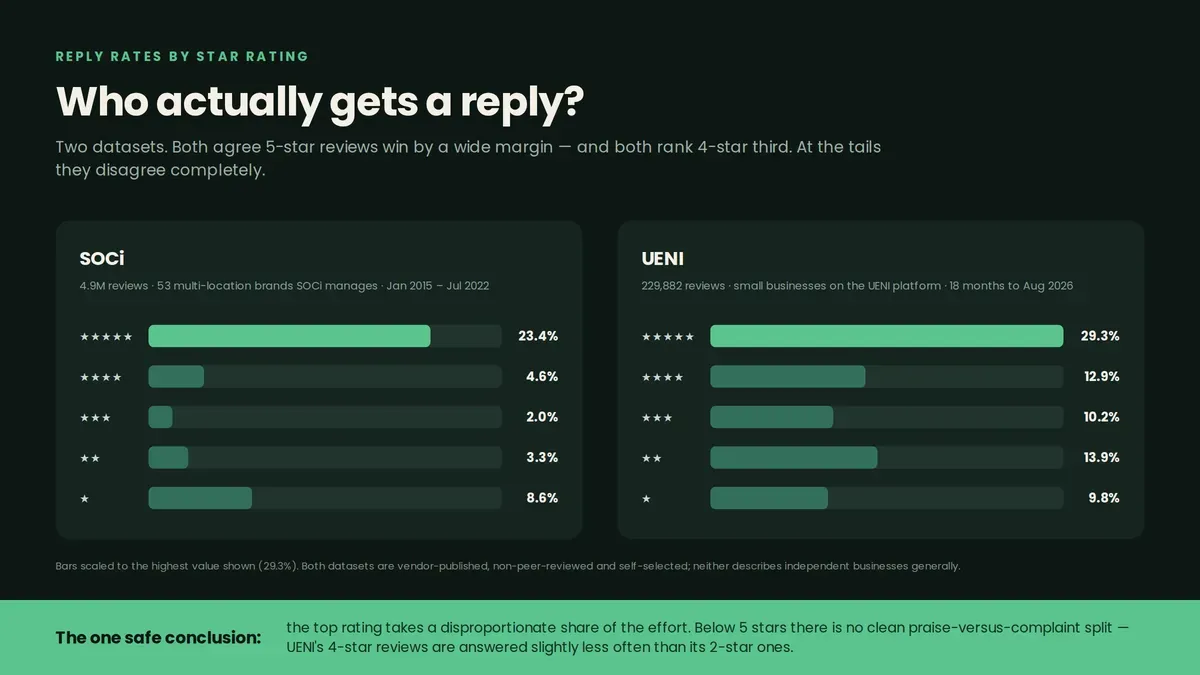
Neither describes independent businesses generally: one is chains on reputation software over a window that closed in July 2022, four years before this post; the other is businesses on the publisher's own platform. (SOCi's page also cites its 2022 Local Marketing Benchmark Report, where "the average business responds to 36.2 percent of its reviews" — a different study of a different population, not comparable to the 11% above.)
The cost nobody puts on the spreadsheet
Here's the part reputation software companies, ours included, tend not to mention.
Bradley, Sparks and Weber surveyed 421 restaurant owners, managers and employees about negative online reviews (Journal of Service Management, 2016, 27(4), 507–533). Many respondents reported anger and maladaptive coping strategies; smaller numbers reported embarrassment, guilt, and thoughts of leaving the industry. The authors describe it as the first known evidence of the personal impact of negative reviews on business owners, managers and employees. It's an anonymous self-report questionnaire — read it as what people say reviews do to them, not as a measured effect.
The same team then modelled the relationship statistically (Weber, Bradley and Sparks, International Journal of Contemporary Hospitality Management, 2017, 29(11), 2847–2866; 418 US hospitality workers, roles not broken out). After accounting for ordinary face-to-face customer stressors, receipt of negative online reviews predicted anger, and in their model anger mediated the relationship between those reviews and two indices of burnout. Like the 2016 paper, it's self-report captured at a single point in time, so the ordering is modelled rather than observed.
Healthcare points the same way. Tebra's 2025 report (published 16 October 2025, fielded September 2025) surveyed 203 healthcare providers and 803 patients. Among providers, 41% said online reviews contribute to their professional burnout and 24% said they've considered leaving their role or the profession. In the same survey, 45% said they never respond to negative reviews — while 71% of patients said they're more likely to trust a provider who responds thoughtfully to negative reviews.
Read the provider figures precisely: Tebra asked about online reviews, not about the work of answering them. And the 45% and the 41% aren't cross-tabulated, so we can't tell whether the non-responders are the burnt-out ones. What the survey does show is that declining to reply hasn't spared this group the strain.
Selective replying has a name, and it isn't "slacking"
The instinct when you can't reply to everything is guilt. At least one recent paper models selectivity as the normal condition instead.
Khoushinsky and Kokotov (Marketing Letters, 2026, 37(1), Article 17, published 6 February 2026) modelled managerial responses across 71 million Google reviews in ten industries and introduced "structured selectivity" — a framework for understanding why firms respond to some reviews and not others. Responsiveness, in their account, is a function of structural attention capacity and situational attention demand: routines shape responsiveness, and review-level cues such as sentiment deviation and linguistic distinctiveness determine which reviews attract attention.
That's a description of behaviour, not a recommendation. But it maps onto something practical: your capacity is finite and your attention gets hijacked, so a system beats willpower. Tran and colleagues (Journal of Vacation Marketing, 2025) reach the same constraint from the operations side, framing hotel responses as a productivity problem limited by workforce allocation — and observing hoteliers templating generic and positive reviews while customising specific and negative ones. That's triage, already in practice.
A triage system that fits a fixed weekly slot
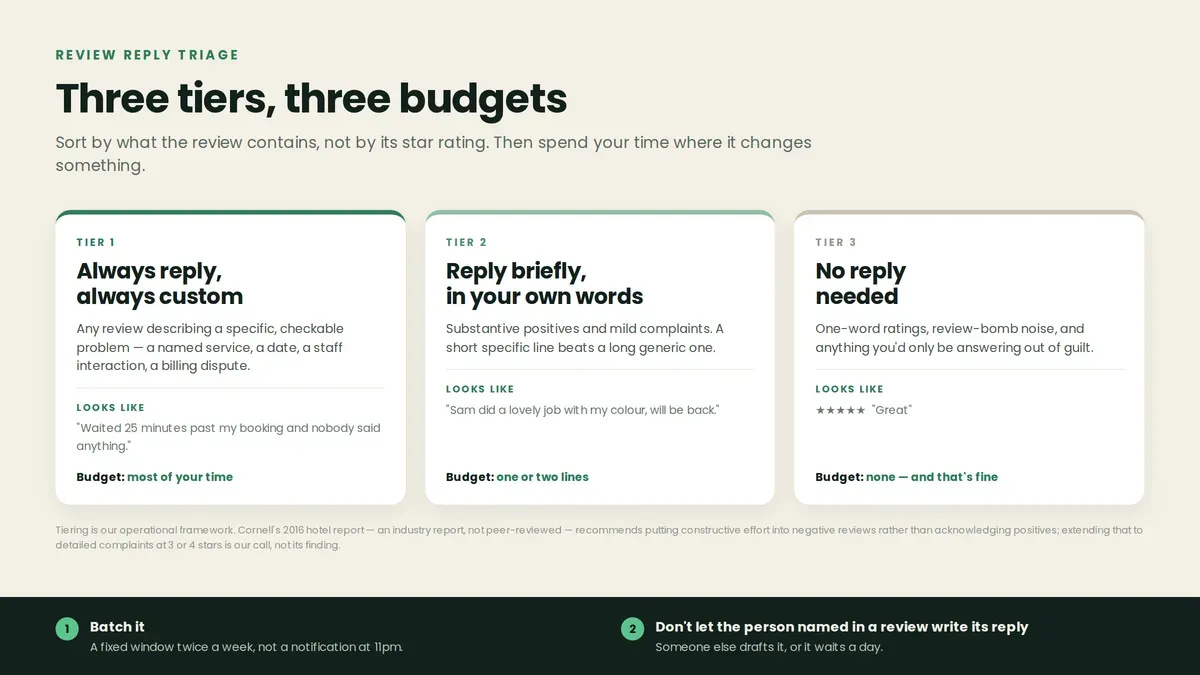
Sort incoming reviews into three tiers and give each a different budget.
Tier 1 — always reply, always custom. Any review describing a specific, checkable problem: a named service, a date, a staff interaction, a billing dispute. Cornell's report recommends putting constructive effort into negative reviews rather than acknowledging positives; extending that to a detailed complaint that arrives attached to 3 or 4 stars is our operational call, not Cornell's finding. Spend the real time here.
Tier 2 — reply briefly, in your own words. Substantive positives and mild complaints. A short specific line beats a long generic one — BrightLocal found 50% of respondents say generic or templated replies put them off, so "reply to more" and "paste the same thing" cancel each other out.
Tier 3 — no reply needed. One-word five-star ratings, review-bomb noise, and anything you'd only answer out of guilt. Neither dataset above tells us what share of replies currently goes to reviews like these — they report rates by star, not by content — so treat this tier as a budgeting choice. The Cornell hotel finding is evidence that a ceiling exists somewhere; it isn't a number you can transplant onto your own business.
Two rules protect the person doing this. Neither comes from a study — they're operational suggestions built on what the research does show.
Batch it. A fixed window twice a week, not a notification at 11pm. In the 2017 model, anger sits between negative reviews and burnout; the paper says nothing about how long anger lasts, but writing while it's fresh is a risk you don't need to take.
Don't let the person named in a review write its reply. Someone else drafts it, or it waits a day.
What about AI-drafted replies?
In March 2026, Search Engine Roundtable reported (24 March 2026) that a user, Chandan Mishra, had spotted an AI-suggested-replies option inside the Google Business Profile dashboard; the article's author said he couldn't see it on his own profile. A limited test, not a rollout — though third-party tools already offer the same thing.
As a first draft for Tier 2, it's reasonable. As a way to hit a 100% reply rate, it walks into both findings above: half of BrightLocal's respondents say generic or templated replies put them off, and Cornell placed diminishing returns for hotel revenue at about a 40% response rate while calling too many responses worse than none for ratings and revenue alike. Speed and volume are the easiest things to automate — and we found no outcome evidence supporting either, only a stated preference for speed and a hotel-industry warning about volume.
Worth knowing too: Google's "Tips to improve your local ranking" Help page says replying "shows that you value their feedback" and that "positive reviews and helpful replies can help your business stand out." It gives no guidance on response timing and makes no claim that replying affects local ranking, and we found none elsewhere in the Business Profile Help documentation. If a tool cites Google for a ranking benefit from replies, ask which page.
A note on the evidence
We've flagged each source's limits where it appears above, so two additions here. The Bradley and Weber papers are the strongest evidence in this post on personal impact — both peer-reviewed, both self-report — but only the 2016 sample explicitly includes owners, and its country isn't stated in the abstract. And beyond the missing time-cost research, we found no peer-reviewed benchmark for what share of reviews independent small businesses reply to. Where figures for either are offered, they came from vendor material.
FAQ
Is there a "correct" reply rate?
We found no published number that applies to an independent small business. Cornell's hotel report found diminishing returns for revenue past roughly 40%, but that's non-peer-reviewed hotel data, not a target for your salon. Treat it as evidence a ceiling exists, not as your ceiling.
Does replying improve my Google ranking?
Google's "Tips to improve your local ranking" Help page makes no such claim, and we found none elsewhere in the Business Profile Help documentation. It says replies help you stand out and show you value feedback. Review quantity and positive ratings are named as prominence signals; replies are not.
Should I reply to one-word five-star reviews?
Optional, and the first thing to cut when time is short. There's no specific information to respond to, and BrightLocal found 50% of respondents say generic or templated replies put them off — which is what a thank-you with nothing to work from tends to become.
How fast do I need to reply?
BrightLocal found 81% expect a reply within a week, 32% by the following day (up from 18%) and 19% the same day (up from 6%). Those are stated preferences, not measured outcomes. We found no peer-reviewed evidence that replying faster improves ratings, volume or revenue — so within a week is defensible on the evidence, even as stated expectations tighten.
What if a review is upsetting me too much to reply well?
Anger in response to negative reviews is documented, not a personal failing: in a survey of 418 US hospitality workers, anger sat between review receipt and burnout in the authors' model — self-report, measured at one point in time. It doesn't measure whether being upset makes replies worse; that part is common sense. Wait a day, have someone else draft it, or both.
Key Takeaways
80% of consumers say they're likely to use a business that replies to all its reviews (BrightLocal 2026 — stated preference). The only outcome-linked source we found, a non-peer-reviewed 2016 Cornell hotel report, put diminishing returns for revenue past roughly a 40% response rate and warned too many responses can be worse than none.
In both datasets we found, 5-star reviews draw the highest reply rate and 4-star reviews rank third. They disagree at the tails — SOCi's chain data puts 3-star lowest (2.0%), UENI's platform data puts 1-star lowest (9.8%). Both are vendor-published and self-selected.
The cost lands on a person: among 421 restaurant owners, managers and employees self-reporting, many described anger and maladaptive coping, and smaller numbers thoughts of leaving the industry. In 418 US hospitality workers, anger mediated the modelled relationship between negative reviews and burnout.
Selectivity is what firms actually do — a 2026 Marketing Letters study of 71 million Google reviews names it "structured selectivity" and ties it to finite attention capacity. That's a description of behaviour, not a recommendation.
Triage in three tiers, batch the work into a fixed slot, and don't let the person named in a review write its reply.
We found no peer-reviewed measure of how long replying takes, and no peer-reviewed benchmark for independent small-business reply rates.
MrRepo helps small businesses collect feedback without gating it — customers choose freely between leaving a public Google review and sending private feedback straight to you. Private feedback gives you somewhere to route the fixable complaints that don't need a public reply at all. Try the interactive demo.