How to Get More Google Reviews for Your Salon (Without Making It Awkward)
Nearly half of Americans — 49% — say online reviews and reputation influenced their choice of hair salon, according to research by Phorest Salon Software. And 72% of them searched Google to find that salon in the first place.
Here's what makes this uncomfortable: your best work doesn't show up in those searches. The balayage that took four hours, the client who cried (happy tears) over her wedding updo, the regular who's been in your chair for six years — none of it exists to a potential client scrolling Google Maps at 9 pm. What exists is your star rating, your review count, and how recently someone said something nice about you.
The good news: salon clients are among the easiest customers on earth to get reviews from — they sit with you for 45 minutes, they leave visibly transformed, and they already tell you they're thrilled. Most salons just never build a system for capturing that. This guide shows you how, without awkward begging and without breaking Google's rules.
Why Google Reviews Matter More for Salons Than Almost Any Business
A haircut is personal. Nobody risks a bad one on a stranger with a 3.8 rating.
That intuition shows up clearly in the data:
49% of clients say online reviews influenced which salon they chose (Phorest)
72% search Google for salons, 18% use Google Maps, and only 15% check Yelp (Phorest) — Google is where the decision happens
81% of consumers use Google reviews to evaluate local businesses generally (SocialPilot)
73% of consumers only trust reviews written in the last month (Sixth City Marketing) — a wall of glowing reviews from 2024 quietly stops working
And reviews don't just win new clients — they win the right ones. Referred and reputation-driven clients stick around: industry retention data shows referred clients have around 74% first-year retention versus 41% for clients acquired through ads (JeriCommerce, 2026). With new-client acquisition costing salons roughly $45–$120 per head in advertising, every client your reviews bring in for free is pure margin.
Reviews also feed your visibility. Review count, rating, recency, and your responses are meaningful local ranking signals — we broke down exactly how in our guide to how Google reviews impact local SEO.
What's a "Good" Google Rating for a Salon?
Salons are a high-rating category. Happy clients rate generously, so the curve is brutal at the bottom:
Below 4.0 — you're effectively invisible; most people filter you out before reading a word
4.0–4.4 — you're in the conversation but losing side-by-side comparisons
4.5–4.8 — the sweet spot where clients feel safe booking
4.9–5.0 with few reviews — can read as thin or curated; volume and recency fix this
Two salons with 4.7 stars are not equal, either. One with 340 reviews and five from this week beats one with 41 reviews and nothing since March. Your goal isn't a number — it's a steady stream.
7 Google-Safe Ways to Get More Salon Reviews
1. Fix your Google Business Profile first
Before asking anyone for a review, make sure the destination is worth arriving at. Claim your profile, choose the right categories (hair salon, nail salon, beauty salon — be specific), add current photos of your space and your work, keep hours accurate, and enable booking links. A profile that looks abandoned undermines every review on it.
2. Create a short review link — and put a QR code where clients actually pause
Google lets you generate a direct "leave a review" link from your Business Profile. Turn it into a QR code and place it where a salon client naturally has idle time and their phone in hand:
At the styling station mirror — clients stare at that mirror for most of the visit
At the checkout counter — scan while the card machine does its thing
On the receipt or aftercare card — reaches them at home, hair still perfect
We tested placement across hundreds of small businesses; position changes scan rates dramatically. See where to put your feedback QR code so people actually scan it for the full breakdown.
3. Let your stylists ask — with a script that doesn't feel like begging
The person holding the scissors has more review-earning power than any piece of software. A client who just said "oh my god, I love it" is at peak willingness. The ask should take five seconds and zero pressure:
The mirror moment: "I'm so glad you love it! If you get a second later, a Google review honestly helps us more than anything. There's a QR code at the front desk."
The checkout handoff: "Sarah mentioned you loved your color today — if you'd ever leave us a quick Google review, it makes a huge difference for a small salon like ours."
The regular: "You've been coming to me for years and I've never asked — would you mind leaving us a Google review sometime? It really helps new clients find us."
Notice what's not in these scripts: no discounts, no "five stars," no follow-up pressure. Just an honest ask from a person the client already likes.
4. Time the ask to the emotional peak
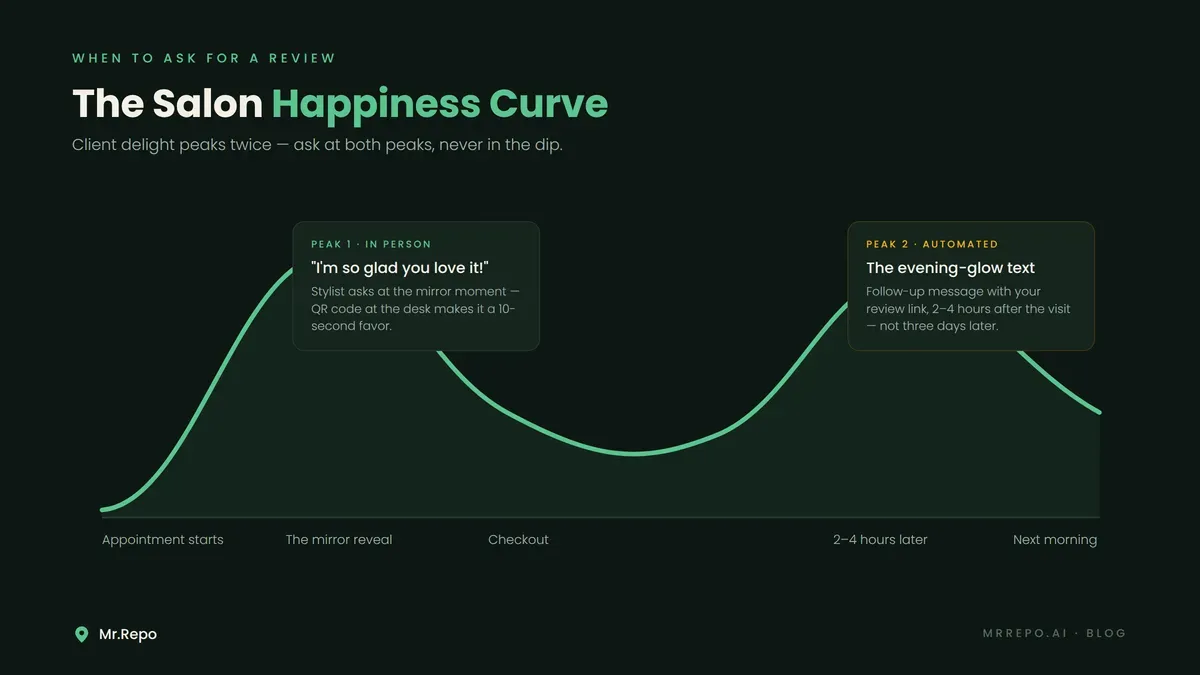
Salon happiness has a curve. It peaks twice: in the mirror right after the reveal, and again that evening when the client sees themselves in good lighting (or gets a compliment). Ask in person at peak one; send your follow-up message at peak two — 2 to 4 hours after the appointment, not three days later when the moment has passed. 73% of consumers only trust recent reviews, and fresh asks are how you keep them coming.
5. Automate the follow-up so it happens every time
The difference between salons with 40 reviews and salons with 400 is rarely quality — it's consistency. Humans forget to ask; systems don't. A simple automated flow — appointment ends, client gets a friendly text or email with your review link — turns reviews from a lucky accident into a weekly rhythm. This is exactly the kind of always-on collection MrRepo automates with QR codes and follow-ups, so nobody on your team has to remember anything.
6. Encourage photo reviews
Hair and beauty are visual. A review that says "amazing balayage" is good; a review with a photo of the balayage is marketing you couldn't buy. When a client is clearly thrilled with a dramatic result, add one line: "If you post a review, feel free to add a photo — future clients love seeing real results." Photo reviews also get more engagement on your profile and stay memorable longer.
7. Respond to every review — yes, all of them
97% of people who read reviews also read the owner's responses. Your replies are a public audition for future clients: they show warmth, professionalism, and how you handle criticism. Thank positive reviewers by name and mention the service ("So glad the keratin treatment worked out, Priya!"). For critical ones, stay calm, take it offline, and show you fix things. We've written step-by-step playbooks for both: how to respond to positive reviews and how to respond to negative reviews.
What NOT to Do (Even Though Other Guides Tell You To)
This is where many salon owners get hurt — often by following popular advice.
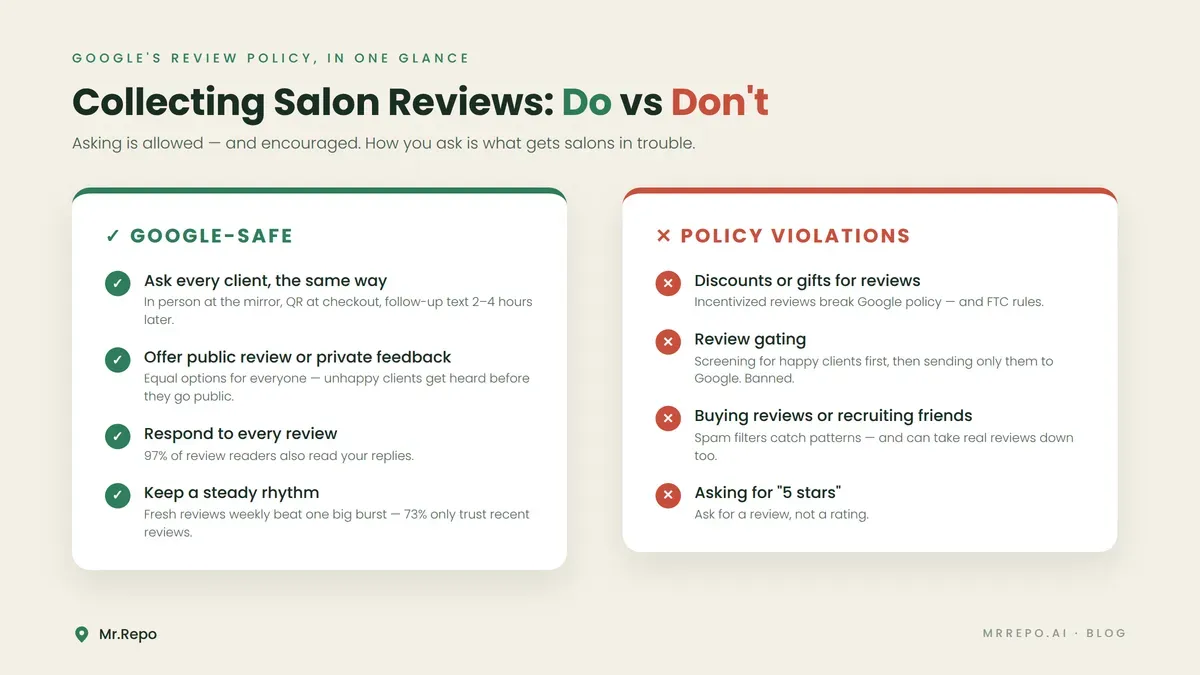
Don't offer discounts, freebies, or entries into a draw for reviews. Plenty of salon marketing guides still recommend "10% off your next visit for a Google review." It violates Google's review policies outright, and it violates FTC rules if the incentive isn't disclosed. If Google detects it, you can lose reviews — or your whole profile's trust.
Don't "gate" reviews. Review gating means asking clients how they feel first, then sending only the happy ones to Google. It feels clever; it's explicitly banned. Every client must get the same options. We covered the policy in depth in review gating: what it is and why Google bans it.
Don't buy reviews or recruit friends-and-family. Google's spam detection looks at reviewer patterns, and fake-looking reviews get filtered — sometimes taking real ones down with them.
Don't review-bomb your own profile in bursts. Forty reviews in one weekend after a year of silence looks like manipulation. Steady beats spiky.
The compliant version of "filtering" is simple: give every client an equal, easy way to speak — publicly on Google or privately to you. Unhappy clients usually don't want to hurt you; they want to be heard. When a private channel exists, many will use it, you get the chance to fix the problem before it becomes a one-star story, and the clients who do go public are the ones with something to say. That equal-options approach is the model MrRepo is built around — fully within Google's rules.
The Real Cost of Not Asking
Most unhappy salon clients never complain. They smile, tip, say "it's great," and quietly book elsewhere — retention data shows only 45–55% of first-visit clients ever return, and the majority of churn traces to perceived indifference, not price. Without a feedback system you lose twice: the silent unhappy client you never got to win back, and the silent happy client whose five stars never made it to Google.
A review system isn't about vanity metrics. It's the only scalable way to hear both groups.
FAQ
How many Google reviews does a salon need? More than the salons you compete with locally, and recent ones. In most areas, 100+ total with several fresh reviews each month puts you in the top tier. Check the top three salons in your local map pack and treat their counts as your benchmark.
Can I ask for a 5-star review specifically? Ask for a review, not a rating. "Leave us a 5-star review" pressures clients and edges toward policy trouble. Great service plus an easy ask produces five stars on its own.
Is it against Google's rules to ask clients for reviews? No — asking is completely allowed and encouraged. What's banned: paying or incentivizing reviews, gating (only asking happy clients), and posting fake reviews.
What if a client leaves an unfair negative review? Respond calmly and professionally within a day or two, offer to make it right offline, and flag it to Google only if it actually violates policy (fake, spam, harassment). Our guide to removing fake Google reviews covers the process.
Should stylists ask, or should it come from the salon? Both. The stylist's personal ask converts best; the salon's automated follow-up catches everyone the stylist missed. Salons that rely on only one of the two leave most reviews uncollected.
Do Google reviews actually bring in new salon clients? Yes — 49% of clients say reviews influenced their salon choice, and 72% search Google when looking for one. Reviews are the closest thing to word-of-mouth at scale.
Key Takeaways
Google is where salon decisions happen: 49% of clients choose based on reviews, and 72% search Google to find salons.
Recency beats volume: 73% of consumers only trust reviews from the last month — build a steady stream, not a one-time push.
The winning system is simple: a great Google Business Profile, a QR code where clients pause, a 5-second stylist ask at the mirror moment, and an automated follow-up 2–4 hours later.
Never incentivize, gate, or buy reviews — give every client equal options to share feedback publicly or privately.
Respond to every review; 97% of review readers read your responses too.
Want reviews to collect themselves? MrRepo gives your salon a QR code that lets every client choose — public Google review or private feedback straight to your inbox — with real-time alerts when something needs your attention. See how it works in the interactive demo.