What a Bad Review Does to the Person Who Reads It — and How to Handle It
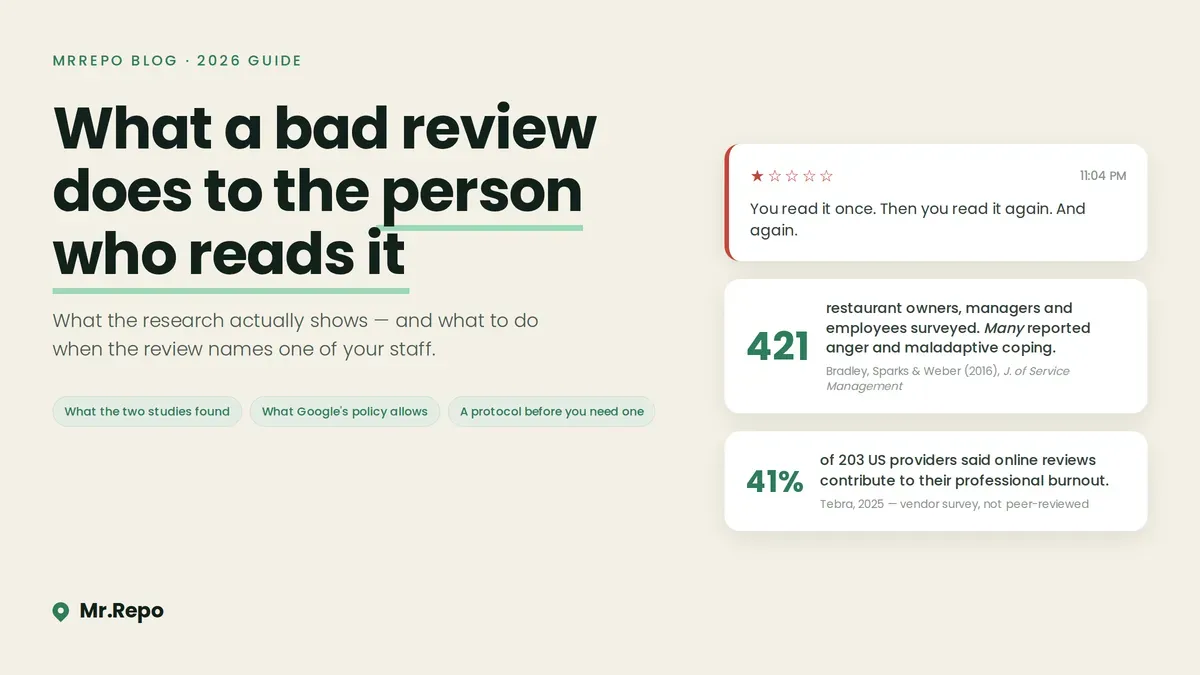
You have read this advice a hundred times. Stay calm. Thank them for the feedback. Apologise, take it offline, keep it under four sentences.
All of that is reasonable. None of it accounts for the fact that you read the review at 11pm, on your phone, in bed, and then read it again, and again.
Guides on this subject — ours included — tend to treat the owner as a calm processor of feedback. The small body of research that has studied owners and staff says otherwise. This post is about what the evidence shows, and what to put in place before the next one.
The research is thin, and worth reading carefully
Two studies form most of what we could find.
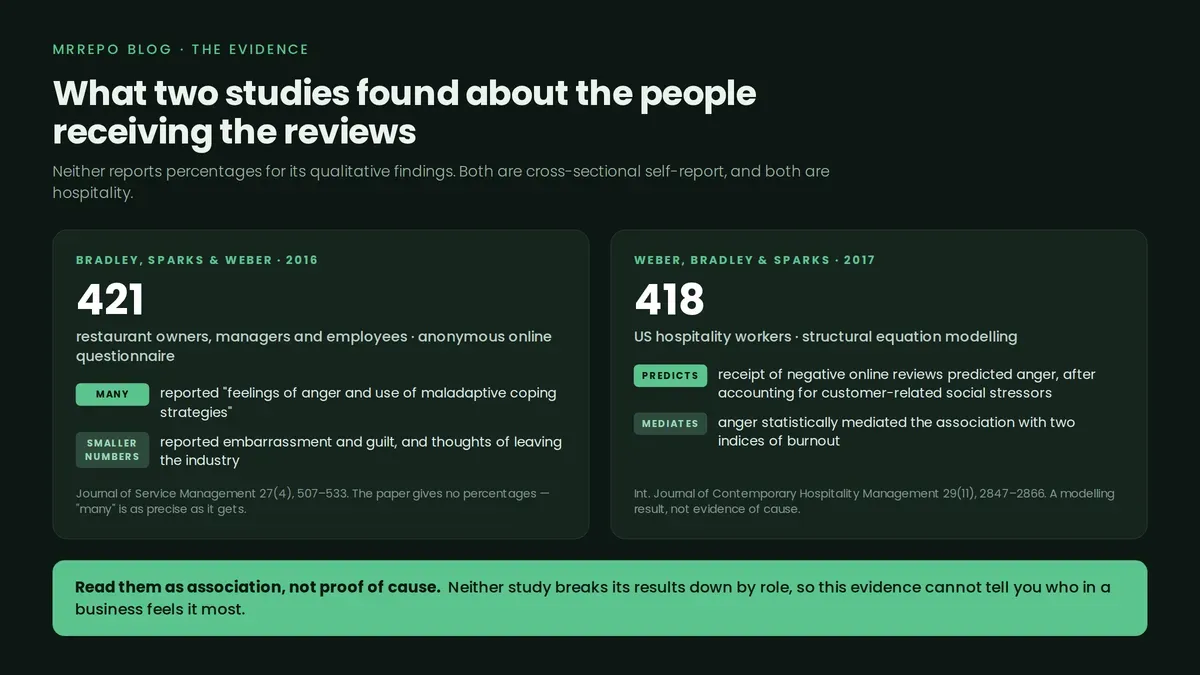
Bradley, Sparks and Weber (2016), in the Journal of Service Management, surveyed 421 restaurant owners, managers and employees by anonymous online questionnaire — "the first known evidence of the personal impact" of negative online reviews "on business owners, managers, and employees," as the authors put it. Their finding, in their words: many respondents reported "feelings of anger and use of maladaptive coping strategies." Smaller numbers reported embarrassment and guilt, and thoughts of leaving the industry.
The paper gives no percentages behind either word, so "many" is as precise as this evidence gets.
The follow-up — Weber, Bradley and Sparks (2017), in the International Journal of Contemporary Hospitality Management — tested a mediation model in 418 US hospitality workers. After taking customer-related social stressors into account, receipt of negative online reviews predicted anger, and anger statistically mediated the association between receiving those reviews and two indices of burnout.
That is a modelling result on cross-sectional self-report data. It does not show that a review last Tuesday caused burnout this one. And "hospitality workers" is broader than restaurant staff.
One caveat worth knowing: both papers come from the same three researchers, so this is one research programme, not two independent teams. Between them they suggest the reported harm is personal as well as commercial — though neither breaks its results down by role in anything we could read.
One signal from outside hospitality
The only recent data we found from another sector comes from Tebra, a practice-management software company, which in September 2025 surveyed 203 US healthcare providers and 803 Americans who had visited a provider in the past 12 months.
Among the providers, 41% said online reviews contribute to their professional burnout, and 24% said they had considered leaving their role or the profession entirely because of review-related stress — with 4% seriously considering it.
Three caveats, because this figure travels badly. It is a vendor survey, not peer-reviewed. The sample is 203 providers and Tebra does not disclose how they were recruited, so treat 41% as indicative rather than precise. And the 24% is soft — most of that quarter had thought about it, so "one in four doctors want to quit over reviews" distorts Tebra's own sentence.
Providers are their own occupational group, not a stand-in for salons or trades — but it is the only non-hospitality signal we found.
Where the word "burnout" stops
In a news release of 28 May 2019, the World Health Organization said burn-out is included in ICD-11 as an occupational phenomenon and "is not classified as a medical condition." WHO describes it as a syndrome resulting from chronic workplace stress that has not been successfully managed: exhaustion, cynicism about the job, and reduced professional efficacy.
A steady pattern of reviews you cannot stop reading fits that description — and stressors are structural, which means the fix is structural too.
When the review names one of your staff
Response templates have little to say about this one, and it lands differently: a named person has to come to work and be the subject of it.
Google's Maps content policy says: "Do not distribute or post personal information without consent." It defines personal information as information that applies to a living identifiable person and where "disclosure could result in risk of harm if it is compromised or misused" — including another person's "full name, or last name" or "their face in a photograph or a video."
The carve-outs decide whether reporting gets you anywhere. Google also allows "an individual's name if it is part of the commonly known or advertised business entity," and "an individual's name if they are a public-facing professional conducting business under their name" — listing "doctors, lawyers, realtors, financial planners, contractors" and "CEOs and other executive level employees whose names and professional connection to a place are publicly known and available."
Our reading: a practitioner whose name is effectively the business is likely inside that carve-out; a receptionist, server or junior stylist probably is not. We found no worked examples from Google, and the harm-risk condition makes each case a judgement call — treat that as interpretation, not a ruling.
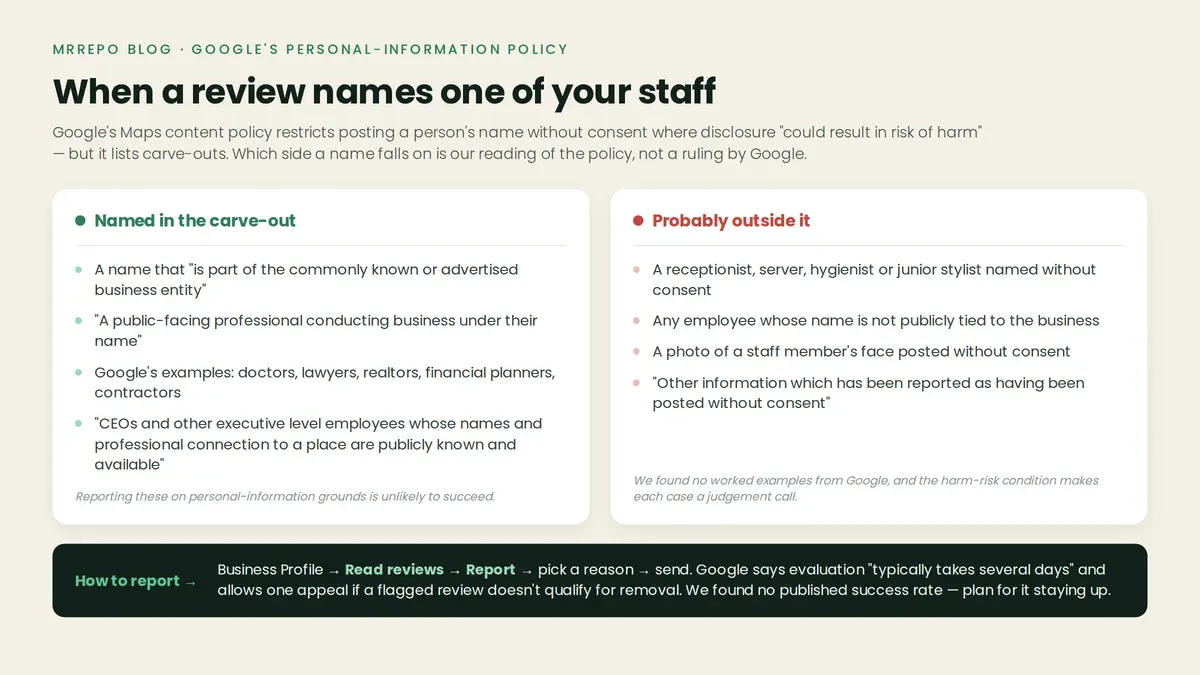
To report: open your Business Profile, select Read reviews, choose Report next to the review, pick a reason, and send. Google says evaluation "typically takes several days," lets you check status in its Reviews Management Tool, and allows a one-time appeal if a flagged review doesn't qualify for removal. We found no published success rate and no service-level guarantee — treat removal as possible, not expected.
Then the internal part. These are our own working rules, not findings:
Tell the named person first. Assume they will find it anyway.
Say out loud who is responsible for the reply. Not them.
If the complaint has a real operational core, address it separately, later, as a work conversation — never in the same breath as the review.
A protocol worth having before you need it
None of the rules below are research findings either — we found no established standard for any of this. They are the rules we work to.
Wait a day on anything above a certain temperature. In BrightLocal's 2026 survey far more consumers expected a reply within a week than same-day, so a day of distance is usually affordable.
Let someone else write the first draft. The person who was insulted is rarely well placed to write four measured sentences about it.
Separate the two things in the review. Painful reviews can contain both an operational fact and a personal attack. Write down the fact; do not answer the attack at all. The reply is for the next reader, not for the reviewer.
Decide in advance what you don't reply to. You are not obliged to answer every review, and a standing rule takes that decision out of the moment you are least able to make it.
The structural question underneath
Everything above is damage control. The structural question is why the complaint arrived in public at all — some unhappy customers never raise it with you directly, and the first you hear of it is the public page. A private feedback channel gives them a third option: somewhere to be annoyed that isn't carrying your staff member's name.
Be honest about what that does and doesn't do. We found no study showing a private channel reduces the emotional impact of the reviews you still get. What it can change, when a customer uses it, is routing: the complaint reaches you before the public page does. Whether it also lands more softly is untested, and we won't claim it does. Routing is what MrRepo is built for — without steering anyone away from leaving a public review.
Frequently asked questions
Is it normal to be this upset about one review? In the one survey we found, it was common. Bradley and colleagues reported that many of their 421 restaurant owners, managers and employees described anger and maladaptive coping in response to negative online reviews — with no percentages, so "many" is as far as the evidence goes.
Can I get a review removed for naming my employee? Possibly. Google restricts posting another person's personal information without consent where disclosure could risk harm, but carves out names that are part of the advertised business entity and public-facing professionals trading under their own name. Whether a given name falls inside that carve-out is our reading, not a ruling. Report it from your Business Profile; Google says evaluation "typically takes several days" and allows one appeal if the review doesn't qualify. We found no published removal rate — plan for it staying up.
Does replying quickly help? We found no research on whether replying faster improves ratings, volume or revenue, and nothing at all on how it affects the person replying. What exists is consumer expectation: in BrightLocal's 2026 survey of 1,002 US adults, 89% said they expect owners to respond, 81% within a week and 19% same-day, and generic or templated replies put off 50%. Those are stated preferences, not measured behaviour.
Should I tell my staff about negative reviews? Tell the named person directly and first. Beyond that it is a judgement call. The 2017 study associates receiving negative reviews with anger and two burnout indices in 418 US hospitality workers, but does not test what happens when management circulates reviews internally — a reason for caution, not a finding.
Is burnout from reviews a medical condition? No. In a 2019 news release, WHO said burn-out is included in ICD-11 as an occupational phenomenon and is not classified as a medical condition. It describes chronic, unmanaged workplace stress — a reason to restructure how review work is done, not a diagnosis. If stress is affecting your health, that is a conversation for a doctor, not a blog post.
Key takeaways
Two peer-reviewed studies by the same three researchers carry most of what we could find, and both are hospitality. The 2016 survey of 421 restaurant owners, managers and employees reported anger and maladaptive coping in many respondents, exit thoughts in smaller numbers. The 2017 study of 418 US hospitality workers found anger statistically mediating the association between negative reviews and two burnout indices — cross-sectional self-report, so association, not proof of cause.
A 2025 vendor survey of 203 US healthcare providers found 41% saying reviews contribute to burnout and 24% having considered leaving, 4% seriously. Small, non-peer-reviewed, healthcare-only: a signal, not a statistic.
WHO says burn-out is an occupational phenomenon and not classified as a medical condition.
Google restricts naming a person without consent where disclosure could risk harm, but carves out public-facing professionals trading under their own name. Report it anyway, but expect it to stay up; we found no published success rate.
Our working protocol, not a finding: wait a day, let someone else draft, split the operational fact from the personal attack, decide what you don't reply to.
We found no evidence that a private feedback channel makes bad reviews hurt less. What it can change, when customers use it, is where the complaint lands first.